Who is Being Facile?

I very seldom go wallowing about responding to comments in my comment threads.  As I have posted before, I try to learn from criticisms in the comments and improve or modify my positions next time I post on a similar subject.  Besides, I would lose my life to playing the troll game on climate issues.

However, I am sitting at home with some time on my hands and thought I would address a representative critical comment, from this post on the sun.  Take this post as evidence, I guess, that I am perfectly capable of responding in depth to criticisms in the comments, had I this much time to spend with every one.

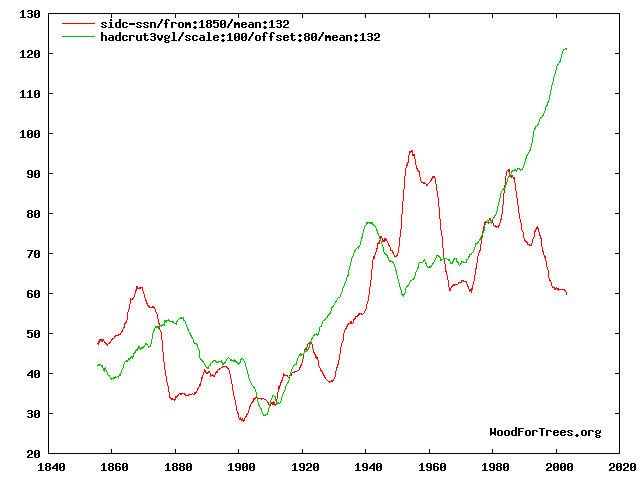
Staggering. You obviously haven’t read a single scholarly paper on this, or even looked at the data. This graph should dispel all your wrong-headed thinking. It’s the temperature, and monthly sunspot numbers, both plotted as 11 year running means (and scaled so that they roughly align). How, exactly, did rising temperatures in 1920 trigger increased solar activity 10 years later? Why did a peak in solar activity in the 1950s not correspond to a rise in temperatures then? Why do the green line and the red line diverge so wildly after 1985? Why is there basically hardly any correlation between solar activity and temperatures, over the last 150 years?

You betray a great immaturity on this web page, regurgitating the same nonsense time and again, calling people ‘morons’ and never even having the courtesy to respond when people tell you you’re wrong. When a fellow denialist tells you you’ve misrepresented him, and you don’t even bother to reply, let alone correct your error, what becomes crystal clear is that you’re simply dishonest.

A couple of responses:

  1. One of the great things about WordPress is that I have a nifty and powerful site search plugin (called Search Regex).  I just searched every post on this site.  The word “moron” has never, ever appeared on this site in text I have written.   She puts moron in quotes, but I am fairly certain she is not quoting me.  According to a Google search of this site, “moron” does appear 20-30 times in the comment section, usually wielded by my critics.
  2. When folks email me that I have made a mistake in quoting them, I post an update 100% of the time.  However, I occasionally miss such notifications if they are posted the comments and not emailed to me.  Believe it or not, I can go days without even glancing at this site or thinking about climate when the real job intervenes.  But that is what comments are for.  Unlike other climate sites that will remain nameless, *cough* realclimate *cough* I don’t moderate any comments, good, bad, or indifferent, except to eliminate outright spam.  If you disagree or I screwed up, that’s what the comments are there for.
  3. The commenter argues that I am simplistic and immature in this post.  I find this odd, I guess, for the following reason:  One group out there tends to argue that the sun is largely irrelevant to the past century’s temperature increases.  Another argues that the sun is the main or only driver.  I argue that the evidence seems to point to it being a mix, with the sun explaining some but not all of the 20th century increase, and I am the one who is simplistic?  Just for the record, I actually began the post with this:

    “I wouldn’t say that I am a total sun hawk, meaning that I believe the sun and natural trends are 100% to blame for global warming. I don’t think it unreasonable to posit that once all the natural effects are unwound, man-made CO2 may be contributing a 0.5-1.0C a century trend”

  4. The commenter links to this graph, which I will include.  It is a comparison of the Hadley CRUT3 global temperature index (green) and sunspot numbers (red):

    mean-1321

    Since I am so ridiculously immature, I guess I don’t trust myself to interpret this chart, but I would have happily used this chart myself had I had access to it originally (The chart uses a trailing 12 average of temperature as well as sunspots, which is why the line does not flatten and fall at the end.  I have to think a bit if I accept this metric as the correct comparison).

    It is wildly dangerous to try to visually interpret data and data correlations, but I don’t think it is unreasonable to say that there might be a relationship between these two data sets.  Certainly not 100%, but then again the same could easily be said of the relationship of temperature to Co2.  The same type of inconsistencies the commenter points out in this correlation could easily be made for Co2 (e.g., why, if CO2 was increasing, and in fact accelerating, were temps in 1980 lower than 1940?The answer, of course, is that climate is complicated.  But I see nothing in this chart that is inconsistent with the hypothesis that the sun might have been responsible for perhaps half of the 20th century warming.  And if Co2 is left with credit for just 0.3-0.4C warming over the last century, it is a very tough road to get from this past warming to sensitivities as high as 3C or greater.  I have all along contended that Co2 will likely drive 0.5-1.0C warming over the next century, and see nothing in this chart that makes me want to change that prediction.

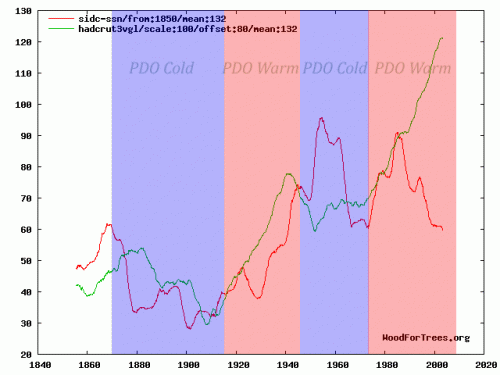
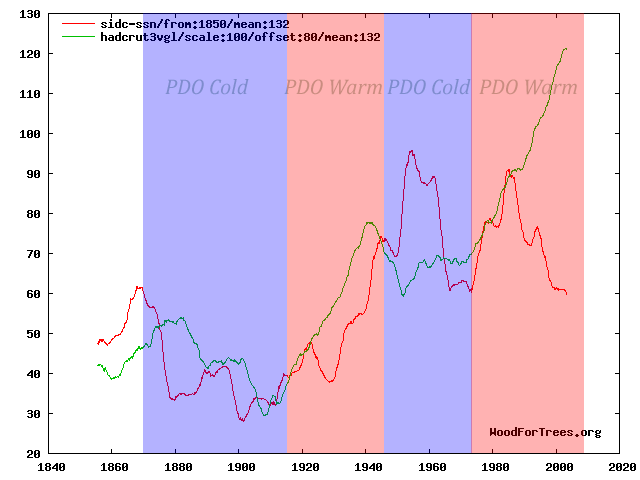
  5. I was playing around a bit more, and found adding in PDO cycles fairly interesting (really this should be some combined AMO/PDO metric, and the exact dates of PDO reversals can be argued about, but I was going for quick and dirty).  Here is what I got:
    temp_spots_with_pdo

    If I wanted to make the same kind of observations as the commenter, I could say that temperature outpaced the sun during PDO warm phases and lagged the sun during cool phases, about what one would expect.  Again, I firmly believe there is still a positive warming trend when you take out cycles like the PDO and effects of the sun and other such influences — but that trend, even if all due to CO2, appears to be far below catastrophic sensitivity levels.

  6. It is kind of ironic that the post was actually not an in-depth analysis of solar cycles, but merely a statement of a hypothesis that solar activity level rather than the trend in solar activity should be regressed against temperature changes.  This seems like a fair hypothesis — one only has to think of a burner on a stove to understand it — but the commenter ignored it.  In fact, the divergence she points to in the late 1990’s is really exactly to the point.   Should a decreased solar output yield decreased temperatures?  Or, if that output is still higher than a historical average, will it still drive temperatures higher?  The answer likely boils down to how fast equilibrium is reached, and I don’t know the answer, nor do I think anyone else does either.
  7. I ask that people use their terms carefully.  I am not a “denialist” if that is meant to mean that I deny any anthropogenic effects on temperature or climate.  I am a denialist if that is meant to mean that I deny that warming from anthropogenic Co2 will cause catastrophic impacts that will outweigh the cost of Co2 abatement.
Updates: OK, I see that in the post in question, one of the quotes from another source used the word “morons.”  For those not experienced with reading blogs, indented text is generally quoted material from another source.  I guess I now understand the confusion — I stand by my statement, though, that I never use such terms in my own writing.  It is not the style I try to adopt on this blog.  Writers I quote have their own style, and my quoting them does not necesarily mean I totally agree with them, merely that the point they are making is somehow thought-provoking or one I want to comment on, extend, or rebut.
More on the Sun

I wouldn’t say that I am a total sun hawk, meaning that I believe the sun and natural trends are 100% to blame for global warming. I don’t think it unreasonable to posit that once all the natural effects are unwound, man-made CO2 may be contributing a 0.5-1.0C a century trend (note this is far below alarmist forecasts).

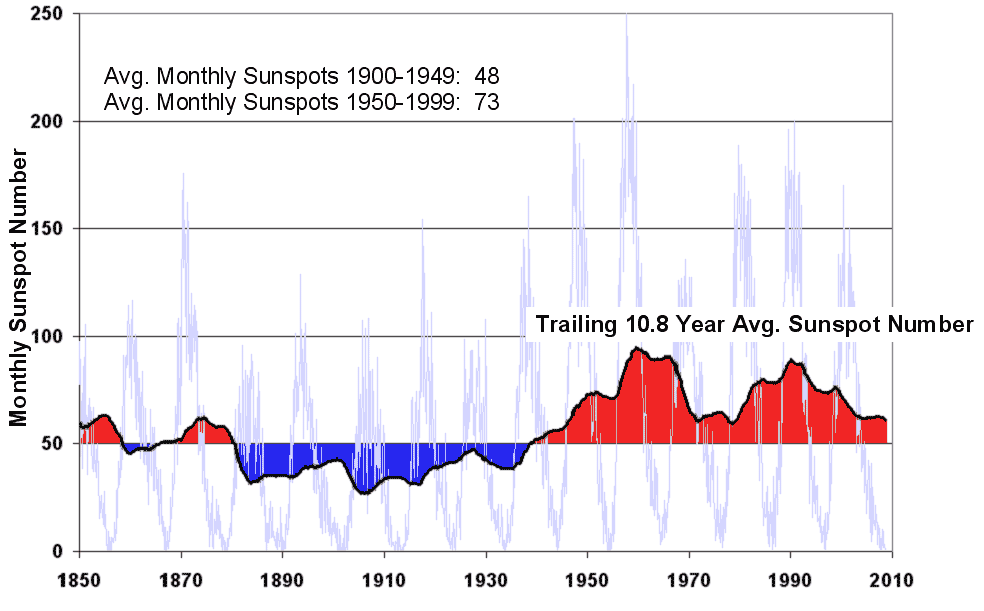
But the sun almost had to be an important fact in late 20th century warming. Previously, I have shown this chart of sunspot activity over the last century, demonstrating a much higher level of solar activity in the second half than the first (the 10.8 year moving average was selected as the average length of a 20th century sunspot cycle).
sunspot2

Alec Rawls has an interesting point to make about how folks are considering the sun’s effect on climate:

Over and over again the alarmists claim that late 20th century warming can’t be caused by the solar-magnetic effects because there was no upward trend in solar activity between 1975 and 2000, when temperatures were rising. As Lockwood and Fröhlich put it last year:

Since about 1985,… the cosmic ray count [inversely related to solar activity] had been increasing, which should have led to a temperature fall if the theory is correct – instead, the Earth has been warming. … This should settle the debate.

Morons. It is the levels of solar activity and galactic cosmic radiation that matter, not whether they are going up or down. Solar activity jumped up to “grand maximum” levels in the 1940’s and stayed there (averaged across the 11 year solar cycles) until 2000. Solar activity doesn’t have to keep going up for warming to occur. Turn the gas burner under a pot of stew to high and the stew will heat. You don’t have to keep turning the flame up further and further to keep getting heating!

Update: A commenter argues that I am simplistic and immature in this post.  I find this odd, I guess, for the following reason.  One group tends to argue that the sun is largely irrelevant to the past century’s temperature increases.  Another argues that the sun is the main or only driver.  I argue that the evidence seems to point to it being a mix, with the sun explaining some but not all of the 20th century increase, and I am the one who is simplistic?

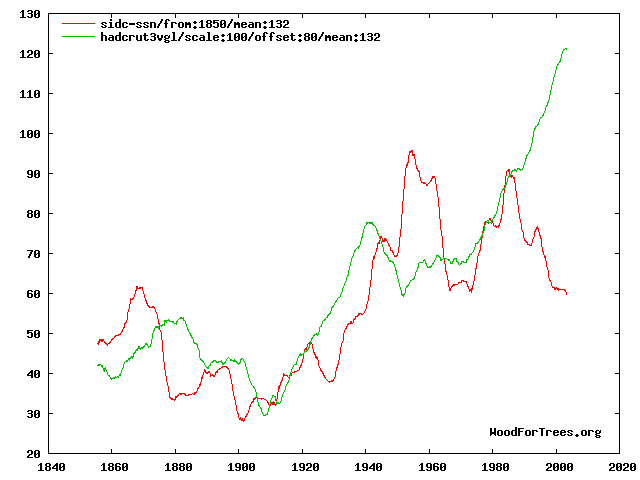
The commenter links to this graph, which I will include.  It is a comparison of the Hadley CRUT3 global temperature index (green) and sunspot numbers (red):

mean-132

Since I am so ridiculously immature, I guess I don’t trust myself to interpret this chart, but I would have happily used this chart myself had I had access to it originally.  Its wildly dangerous to try to visually interpret data and data correlations, but I don’t think it is unreasonable to say that there might be a relationship between these two data sets.  Certainly not 100%, but then again the same could easily be said of the relationship of temperature to Co2.  The same type of inconsistencies the commenter points out in this correlation could easily be made for Co2 (e.g., why, if CO2 was increasing, and in fact accelerating, were temps in 1980 lower than 1940?

The answer, of course, is that climate is complicated.  But I see nothing in this chart that is inconsistent with the hypothesis that the sun might have been responsible for half of the 20th century warming.  And if Co2 is left with just 0.3-0.4C warming over the last century, it is a very tough road to get from past warming to sensitivities as high as 3C or greater.  I have all along contended that Co2 will likely drive 0.5-1.0C warming over the next century, and see nothing in this chart that makes me want to change that prediction.

Update #2: I guess I must be bored tonight, because commenter Jennifer has inspired me to go beyond my usual policy of not mixing it up much in the comments section.  A lengthy response to her criticism is here.

Whew! Done.

OK, I think I have finally, successfully migrated both my blogs from the Typepad ASP service to self-hosted WordPress. Many of you on feeds may have gotten a one-time slug of about 10 old posts in your feed (sorry). This was an artifact of the change of feed sources toFeedburner and should not happen again. Overall, I am very pleased with the results. The sites look better , they are easier to modify, they run faster, and the back-end interface is MUCH better. Most of you don’t care, but I will post on the process I followed to migrate as a repayment to others whose past such posts helped me through the process.

If you are getting this post, you should not have to change any of your settings. Enjoy.

Site Migration

If you are reading this, it means that you have found my new WordPress site for Climate-Skeptic.com.  You may find that permalinks or some images don’t function quite right — I learned from migrating my other blog that it takes about 24-48 hours for all these problems to settle out.  If you are using the feed at feeds.feedburner.com/ClimateSkeptic, you should be fine and that feed should still work.  If you are using a different feed, I will soon post instructions on how to switch.

Climate Model Validation

I am sorry that posting has been light, but I am currently working to migrate this site to WordPress from hosted Typepad.  This is a real hassle, as described at my other blog where I just completed a succesful migration.  I hope to have this blog moved over this weekend.

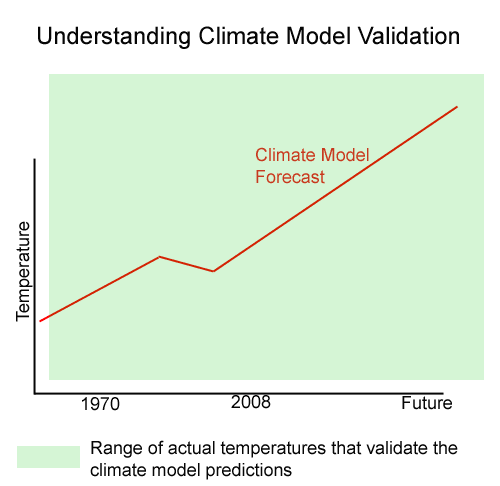
In the mean time, I thought my readers might need some help understanding James Hansen’s recent comments that flat world temperatures over the last 10 years and substantially cooler temperatures in 2008 were entirely consistent with the climate models that forecast  0.2-0.3C (or more) warming for this decade.  Most other natural sciences are stuck in the old and outdated practice of questioning forecasts when actual observational data diverges from the forecast by several standard deviations.  Not so modern, enlightened, consensus-based climate science.  Below is my graphical representation of how climate scientists evaluate their models in light of new data.

forestast_validation

Global Warming Is Caused by Computers

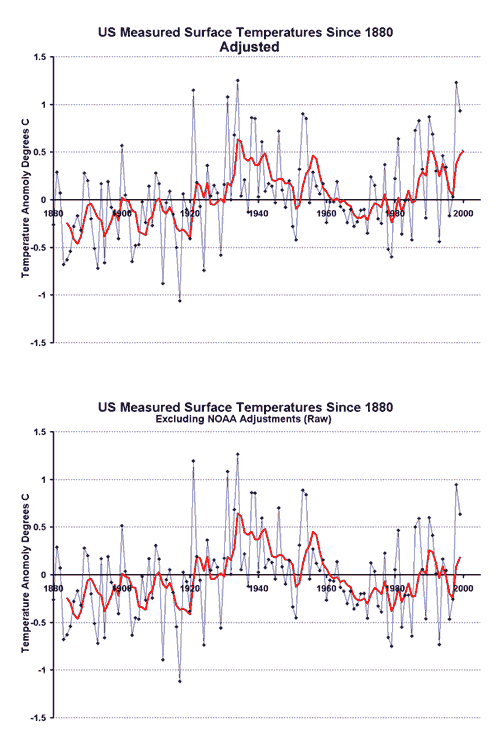
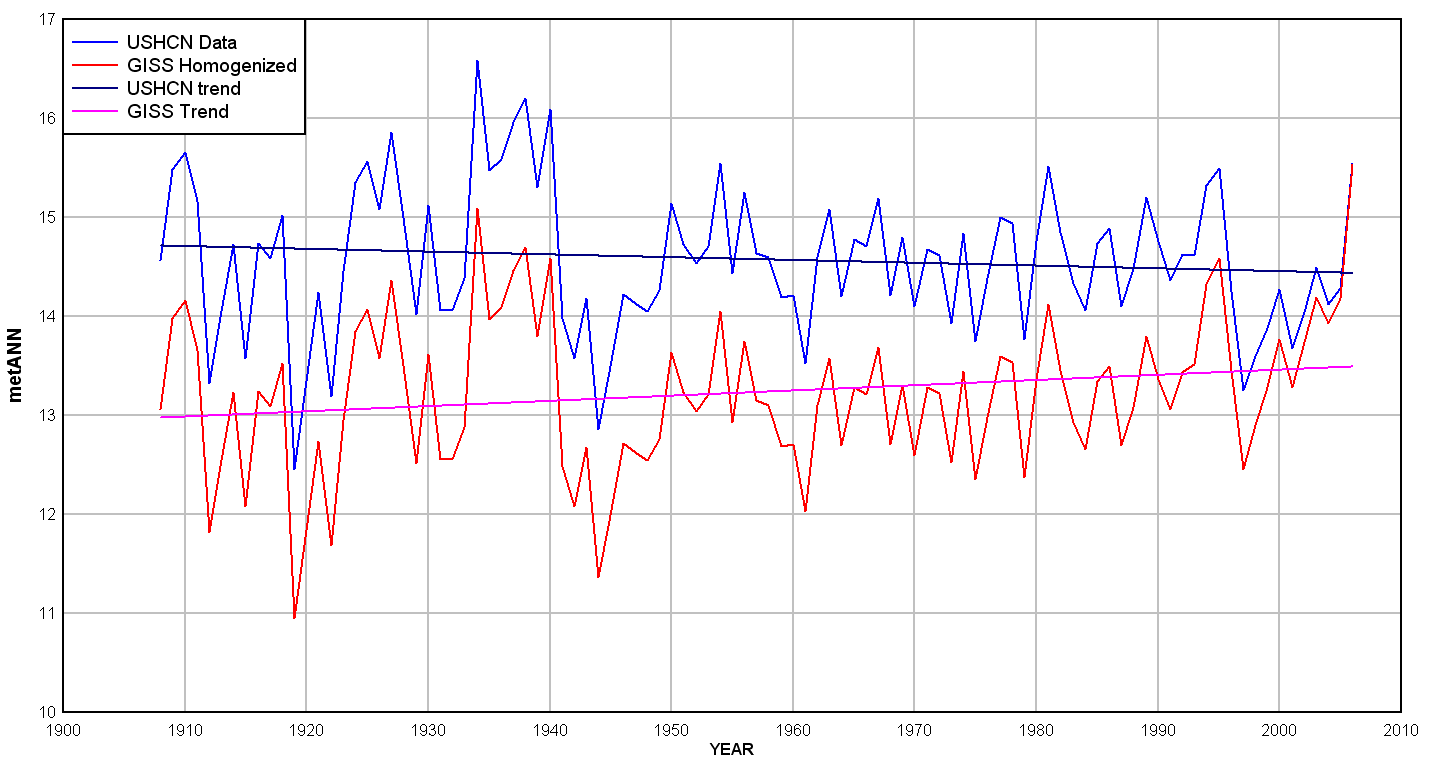
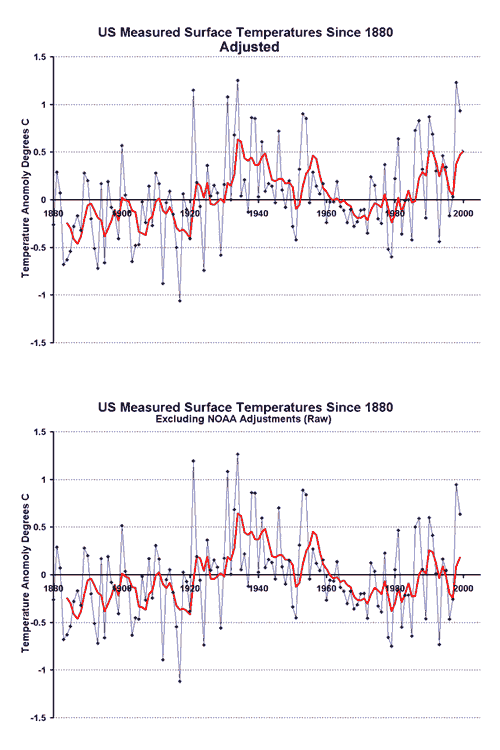
In particular, a few computers at NASA’s Goddard Institute seem to be having a disproportionate effect on global warming.  Anthony Watt takes a cut at an analysis I have tried myself several times, comparing raw USHCN temperature data to the final adjusted values delivered from that data by the NASA computers.  My attempt at this compared the USHCN adjusted to raw for the entire US:

temperature_adjustments1

Anthony Watt does this analysis from USHCN raw all the way through to the GISS adjusted number  (the USHCN adjusts the number, and then the GISS adds their own adjustments on top of these adjustments).  The result:  100%+ of the 20th century global warming signal comes from the adjustments.  [Update: I was not very clear on this — this is merely an example for one single site — it is not for the USHCN or GISS index as a whole.  This is merely an example of the low signal to noise ratio in much of the surface temperature record]  There is actually a cooling signal in the raw data:

temperature_adjustments21

Now, I really, really don’t want to be misinterpreted on this, so a few notes are necessary:

  1. Many of the adjustments are quite necessary, such as time of observation adjustments, adjustments for changing equipment, and adjustments for changing site locations and/or urbanization.  However, all of these adjustments are educated guesses.  Some, like the time of observation adjustment, probably are decent guesses.  Some, like site location adjustments, are terrible (as demonstrated at surfacestations.org).The point is that finding a temperature change signal over time with current technologies is a measurement subject to a lot of noise.  We are looking for a signal on the order of magnitude of 0.5C where adjustments to individual raw instrument values might be 2-3C.  It is a very low signal-noise environment, and one that is inherently subject to biases  (researches who expect to find a lot of warming will, not surprisingly, adjust a lot of measurements higher).
  2. Warming has occurred in the 20th century.  The exact number is unclear, but we have much better data via satellites now that have shown a warming trend since 1979, though that trend is lower than the one that results from surface temperature measurements with all these discretionary adjustments.

Steve Chu: “Climate More Sensitive Than We Thought”

The quote in the title comes from Obama’s nominee to become energy secretary, Steven Chu.  Specifically,

Chu’s views on climate change would be among the most forceful ever held by a cabinet member. In an interview with The Post last year, he said that the cost of electricity was “anomalously low” in the United States, that a cap-and-trade approach to limiting greenhouse gases “is an absolutely non-partisan issue,” and that scientists had come to “realize that the climate is much more sensitive than we thought.”

I will leave aside of why hard scientists typically make bad government officials (short answer:  they have a tendency towards hubris in their belief in a technocrats ability to optimize complex systems.  If one thinks they can assign a 95% probability that a specific hurricane is due to man-made CO2, against the backdrop of the unimaginable chaos of the Earth’s climate, then they will often have similar overconfidence in regulating the economy and/or individual behavior).

However, I want to briefly touch on his “more sensitive” comment.

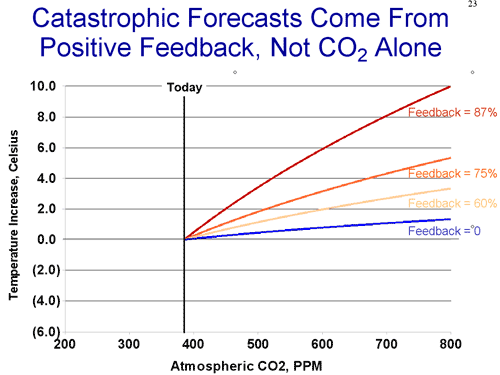
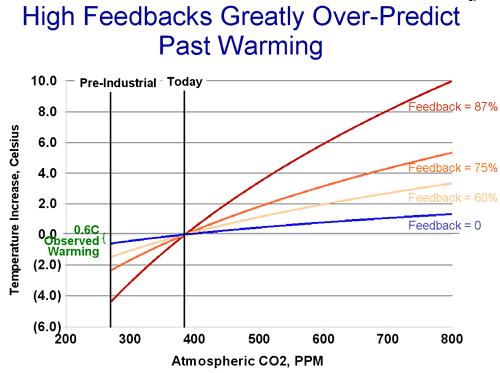
Using assumptions from the last IPCC report, we can disaggregate climate forecasts into two components:  the amount of warming from CO2 alone, and the multiplication of this warming by feedbacks in the climate.  As I have pointed out before, even by the IPCC’s assumptions, most of the warming comes not from CO2 alone, but from assumed quite large positive feedbacks.

feedback1

This is based on the formula used by the IPCC (which may or may not be exaggerated)

T = F(C2) – F(C1) Where F(c) = Ln(1+1.2c+0.005c2+0.0000014c3)

Plotting this formula, we get the blue no-feedback line above (which leads to about a degree of warming over the next century).  We then apply the standard feedback formula of Multiplier = 1/(1-feedback%)  to get the other lines with feedback.  It requires a very high 60% positive feedback number to get a 3C per century rise, close to the IPCC base forecast, and nutty 87% feedback to get temperature rises as high as 10C, which have been quoted breathlessly in the press.  It is amazing to me that any natural scientist can blithely accept such feedback numbers as making any sense at all, particularly since every other long-term stable natural process is dominated by negative rather than positive feedback.

By saying that climate is “more sensitive than we thought” means essentially that Mr. Chu and others are assuming higher and higher levels of positive feedback.  But even the lower feedback numbers are almost impossible to justify given past experience.  If we project these sensitivity numbers backwards, we see:

feedback2

The higher forecasts for the future imply that we should have seen 2-4C of warming over the last century, which we clearly have not.  Even if all the past warming of the last century is attributable to man’s CO2  (a highly unlikely assumption) past history only really justifies the zero feedback case  (yes, I know about damping and time delays and masking and all that — but these adjustments don’t come close to closing the gap).

In fact, there is good evidencethat at most, man’s CO2 is responsible for about half the past warming, or 0.3-0.4C.  But if that is the case, as the Reference Frame put it:

The authors looked at 750 years worth of the local ice core, especially the oxygen isotope. They claim to have found a very strong correlation between the concentration of this isotope (i.e. temperature) on one side and the known solar activity in the epoch 1250-1850. Their data seem to be precise enough to determine the lag, about 10-30 years. It takes some time for the climate to respond to the solar changes.

It seems that they also have data to claim that the correlation gets less precise after 1850. They attribute the deviation to CO2 and by comparing the magnitude of the forcings, they conclude that “Our results are in agreement with studies based on NH temperature reconstructions [Scafetta et al., 2007] revealing that only up to approximately 50% of the observed global warming in the last 100 years can be explained by the Sun.”…

Note that if 0.3 °C or 0.4 °C of warming in the 20th century was due to the increasing CO2 levels, the climate sensitivity is decisively smaller than 1 °C. At any rate, the expected 21st century warming due to CO2 would be another 0.3-0.4 °C (the effect of newer CO2 molecules is slowing down for higher concentrations), and this time, if the solar activity contributes with the opposite sign, these two effects could cancel.

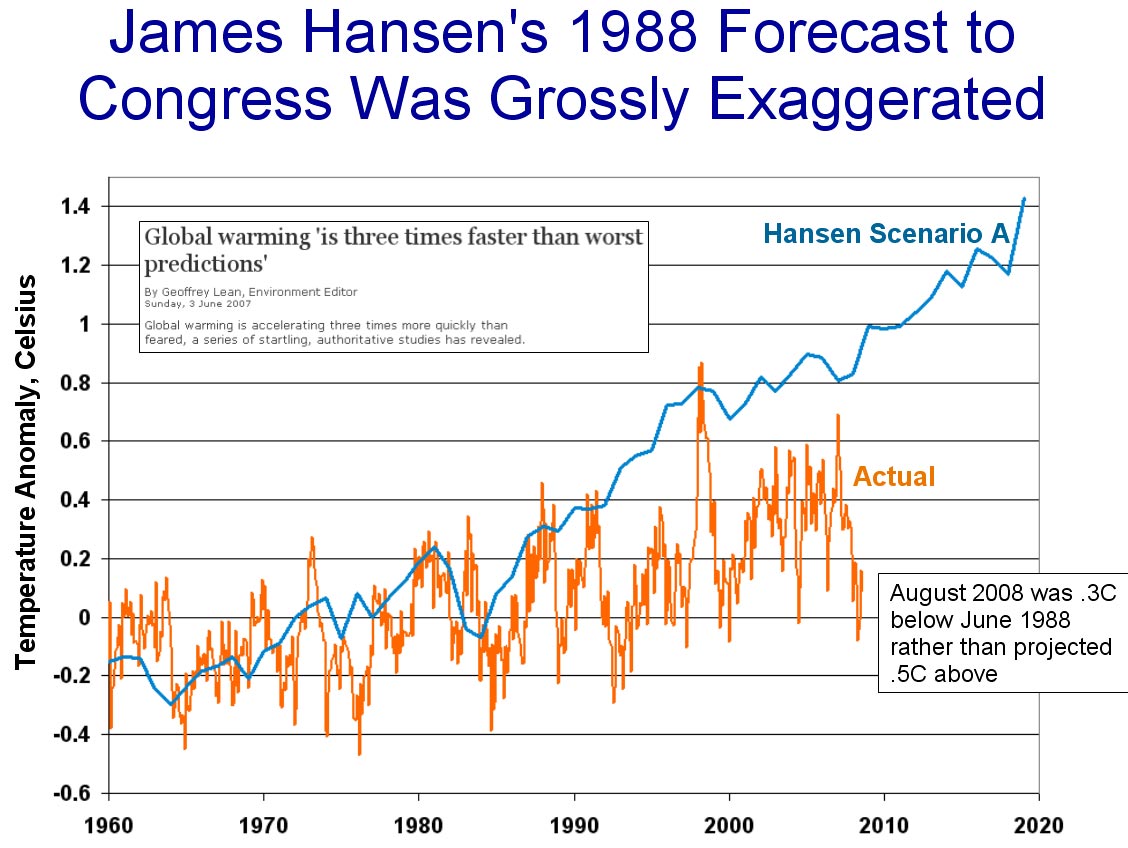
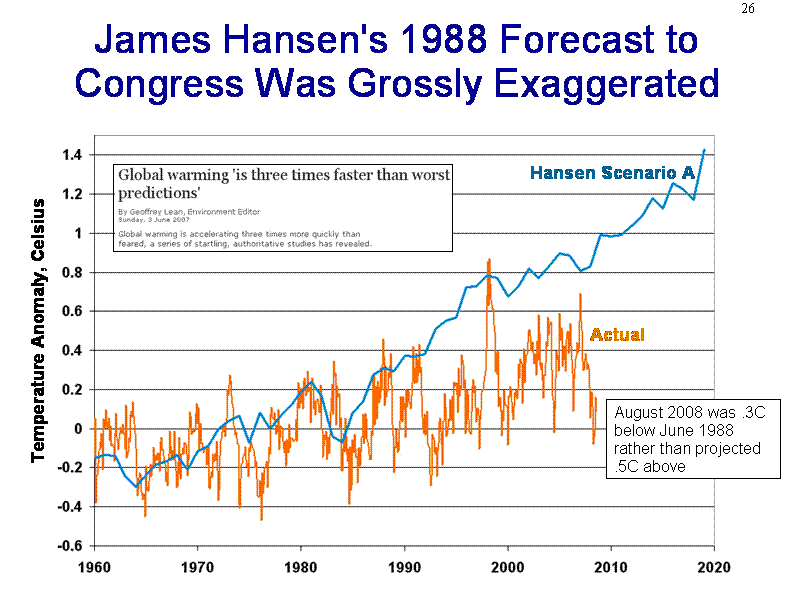
Not surprisingly, then, given enough time to measure against them, alarmist climate forecasts, such as James Hansen’s below, tend over-estimate actual warming.  Which is probably why the IPCC throws out their forecasts and redoes them every 5 years, so no one can call them on their failures (click to enlarge chart below)

hansen

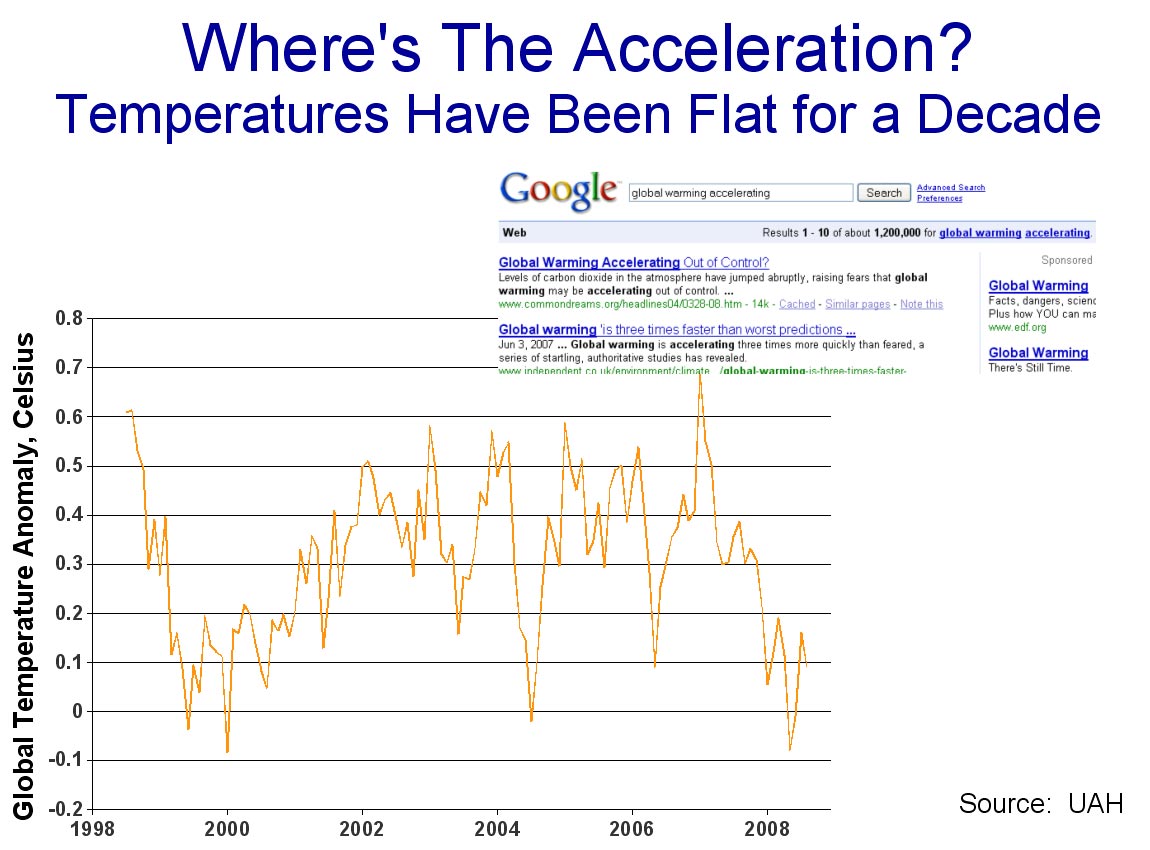
Because, at the end of the day, for whatever reason, warming has slowed or stopped over the last 10 years, even as CO2 concentrations have increased faster than ever in the modern period.  So it is hard to say what physical evidence one can have that tenperature sensitivity to CO2 is increasing.

last10

Update: First, to answer a couple of questions, the data above is from the UAH, not Hansen’s GISS.  To be fair to Hansen, it has been adjusted to be re-centered on his data for the period before 1988 (since all of the major data sets use different zero centers for their anomalies, they have to be re-centered to be compared, a step many often forget to take).

I have a number of issues with the quality and reliability of surface temperature data, and the GISS data in particular, so I think the satellite data is a better source (just as we abandoned observations by passing ships in favor of satellite measurement of sea ice extent, it is probably time to do the same for surface temperature measurement).    Second, if I understand one of the comments correctly, there is some implication that I am being nefarious is cutting off the data in August of 2008.   Hardly.  Unlike those who work at this full time, I do this as a hobby between crises in my day job,  so I tend to reuse charts for a few months until I have time to create new ones.  Certainly there is nothing in the Sep-Nov UAH temperature data, though, that magically validates Hansen’s forecast.  I think November was a few tenths higher than August (making it just about even with June 1988) but well short of Hansen’s forecast.

One thing I didn’t mention, but Hansen and his enablers are often dishonest in trying to explain away the above forecast.  They will say, well, the A case was extreme and not meant to conform to reality.  But the only differences between the forecasts was in their CO2 output assumptions, and in fact Hansen A actually understated CO2 production and growth since 1988.  If anything, it was conservative!

New Climate Video – RCRC Climate Debate

I have finally been able to publish a video of my presentation at the climate debate held by the Regional Council of Rural Counties last September.  The entire video is about an hour long.  As usual, I am offering several ways to view it.  First, it has been posted on YouTube but had to be broken into seven parts.  The playlist of all seven parts is below:

The playlist link is here:  RCRC Climate Debate (Skeptic's Side)

Unfortunately, YouTube crushes the resolution so many of the charts are hard to read.  You can download the full resolution windows media version (about 96MB) as long as my bandwidth holds out by right-clicking and downloading form this link:  Download RCRC Climate Debate (wmv)

Also, you can stream higher resolution version of this film (and all my other climate films) at this site.  The resolution is not as good as the downloadable version but is much better than YouTube.  Again, bandwidth pending.

Finally, you can download the actual powerpoint presentation shown in this video here or you can view the presentation online here.

In the future, all of my videos and presentations will be available via the links just under the banner for this site.

Linear Regression Doesn’t Work if the Underlying Process is not Linear

Normally, I would have classified the basic premise of Craig Loehle's recent paper, as summarized at Climate Audit, as a blinding glimpse of the obvious.  Unfortunately, the climate science world is in desperate need of a few BGO's, so the paper is timely.  I believe his premise can be summarized as follows:

  1. Many historical temperature reconstructions, like Mann's hockey stick, use linear regressions to translate tree ring widths into past temperatures
  2. Linear regressions don't work when the underlying relationship, here between tree rings and temperature, is not linear.

The relationship between tree ring growth and temperature is almost certainly non-linear.  For example, tree ring growth does not go up forever, linearly, with temperature.  A tree that grows 3mm in a year at 80F and 4mm at 95F is almost certainly not going to grow 6mm at 125F. 

However, most any curve, over a sufficiently narrow range, can be treated as linear for the purposes of most analyses.  The question here is, given the relationship between tree ring growth and temperatures, do historical temperatures fall into such a linear region?  I think it is increasingly obvious the answer is "no," for several reasons:

  1. There is simply not very good, consistent data on the behavior of tree ring growths with temperature from folks like botanists rather than climate scientists.  There is absolutely no evidence whether we can treat ring widths as linear with temperatures over a normal range of summer temperatures.
  2. To some extent, folks like Mann (author of the hockey stick) are assuming their conclusion.  They are using tree ring analysis to try to prove the hypothesis that historic temperatures stayed in a narrow band (vs. current temperatures that are, they claim, shooting out of that band).  But to prove this, they must assume that temperatures historically remained in a narrow band that is the linear range of tree ring growth.  Essentially, they have to assume their conclusion to reach their conclusion.
  3. There is strong evidence that tree rings are not very good, linear measurements of temperature due to the divergence issue.  In short — Mann's hockey stick is only hockey stick shaped if one grafts the surface temperature record onto the tree ring history.  Using only tree ring data through the last few decades shows no hockey stick.  Tree rings are not following current rises in temperatures, and so it is likely they underestimate past rises in temperature.  Much more here.

  4. Loehle's pursues several hypotheticals, and demonstrates that a non-linear relationship of tree rings to temperature would explain the divergence problem and would make the hockey stick a completely incorrect reconstruction.

Deconstructing the Hockey Stick

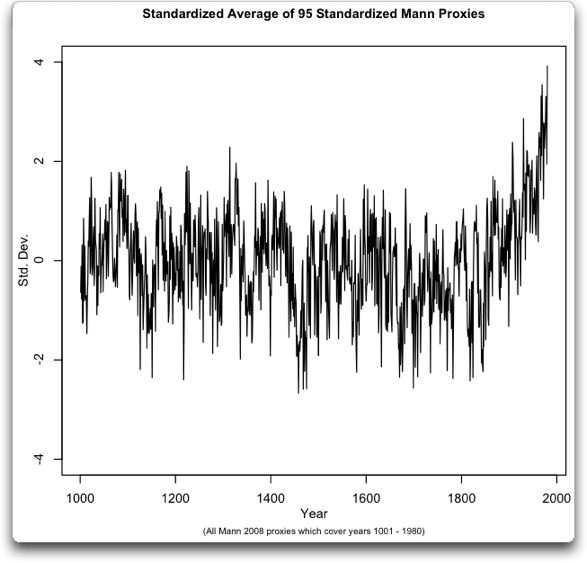
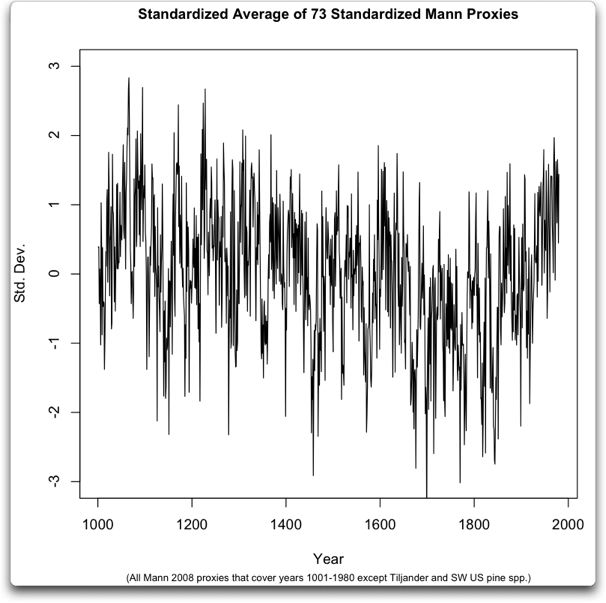
Will there ever be a time when sane people are not having to deconstruct yet another repackaging of Mann’s hockey stick, like some endless wack-a-mole game?  Mann is back with a new hockey stick and, blow me away with surprise, it looks a heck of a lot like the old hockey stick:

hs_1

Willis Eschenbach, writing at Climate Audit, outlines a new statistical approach he claims can help determine the signal-to-noise ratio in such a multi-proxy average, and in turn determine which proxies are contributing the most to the final outcome.

His approach and findings seem interesting, but I need to withhold judgment and let the statistical geeks tear it apart.  I am always suspicious of algorithms that purport to sort or screen samples in or out of a sample set.

However, his climate-related finding can be accepted without necessarily agreeing with the methodology that got there.  He claims his methodology shows that two sets of proxies — the Tiljander sediments and the Southwestern US Pines (mainly the bristlecones) — drive the hockey stick shape.  This is reminiscent of Steve McIntyre’s finding years ago that just a few proxies in the original MBH 1999 drove most of the hockey stick form.  Interestingly, these two series are the very ones that have received the most independent criticism for their methodology and ability to act as a proxy.  In particular, the Tiljander Lake sediment data is out and out corrupted, and it is incredible that they could get past a peer review process (just reinforcing my feeling that peer review passes shoddy work that reinforces the professions prejudices and stands in the way of quality work by mavericks challenging the consensus).

Anyway, with these proxies removed, less than a quarter of the total, the hockey stick disappears.

hs_2

Update: If you still have any confidence at all in climate scientists, I urge you to read this discussion of the Tiljander sediments.  Mann managed to make two enormous mistakes.  One, he used a series that the authors of the series very specifically caution has been disturbed and is not a valid proxy for the last 200-300 years.  And two, he inverts the whole series!  instead of showing it decreasing in the last 200 years  (again due to corruption the authors warned about) he shows it upside down, increasing in the last 200 years, which then helps him build his hockey stick on absolutely false data.

One might argue that this is just the indictment of one scientist, but everyone in the profession seems to rally around and defend this one scientist, and the flaws listed above have been public for a while and absolutely no one seems interested in demanding Mann correct his numbers.  In fact, most climate scientists spend their time shooting the messenger (Steve McIntyre).

Uh Oh. I Think I Am On NASA’s S-List

This screen shot was sent by a reader, who titled the email “you have hit the big time.”  I suppose I have, or at least I have really ticked off James Hansen and Gavin Schmidt at NASA.  It appears that this site has been added to the list of sites blocked by the NASA servers as ostensiblybeing sexually explicit.  Well, I guess we have caught the GISS with their pants down a few times….

nasa1

As usual, you may click on the image for the full-size version.  Thanks to a reader, who asked only that I hide his/her IP address.

Update: From the archives:

The top climate scientist at NASA says the Bush administration has tried to stop him from speaking out since he gave a lecture last month calling for prompt reductions in emissions of greenhouse gases linked to global warming.

The scientist, James E. Hansen, longtime director of the agency’s Goddard Institute for Space Studies, said in an interview that officials at NASA headquarters had ordered the public affairs staff to review his coming lectures, papers, postings on the Goddard Web site and requests for interviews from journalists.

Dr. Hansen said he would ignore the restrictions. “They feel their job is to be this censor of information going out to the public,” he said.

OK, I kindof mostly don’t think there is anything sinister here.  Coyote’s Law tells us that this is much more likely to be incompetence rather than evil intent.  But it would be interesting to see how Dr. Hansen would react if, say, the RealClimate site had been similarly filtered.  Anyone want to bet he would have thrown a conspiracy-laden hissy fit?

Update #2: Thanks for all those who pointed out that http://climate-skeptic.com was going to a park page with a bunch of ads.  That is fixed now.  Not sure if that was the cause or not.

Minor Site Redesign

I am doing a bit of site redesign as my CSS skills improve.  All of this is a prelude to my pending attempt to move this entire beast over to WordPress, a goal mainly thwarted right now by trying to preserve all the permalinks at the same addresses.

Anyway, I have a new page with all my published books and Powerpoint presentations here.  I have a page collecting all my videos here.   Since YouTube crunches all the videos to a resolution too small to really read my charts well, I have also set up a streaming video site with full resolution videos here.  All of these sites are easily reachable by the new menu bar across the top of the site.

Polar Amplification

Climate models generally say that surface warming on the Earth from greenhouse gasses should be greater at the poles than at the tropics.  This is called “polar amplification.”  I don’t now if the models originally said this, or if it was observed that the poles were warming more so it was thereafter built into the models, but that’s what they say now.  This amplification is due in part to how climate forcings around the globe interact with each other, and in part due to hypothesized positive feedback effects at the poles.  These feedback effects generally center around increases in ice melts and shrinking of sea ice extents, which causes less radiative energy to be reflected back into space and also provides less insulation of the cooler atmosphere from the warmer ocean.

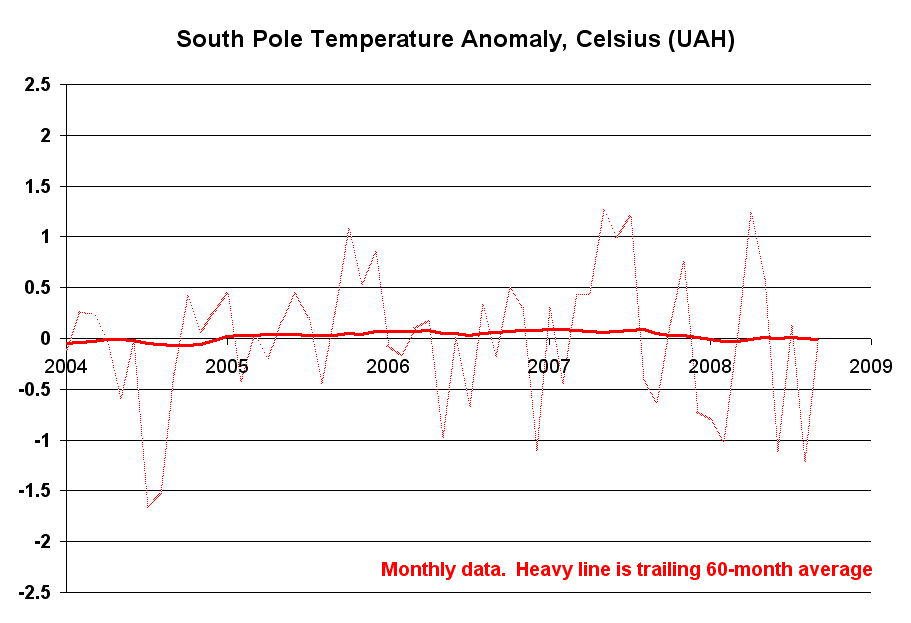
In response to polar amplification, skeptics have often shot back that there seems to be a problem here, as while the North Pole is clearly warming, it can be argued the South Pole is cooling and has seen some record high sea ice extents at the exact same time the North Pole has hit record low sea ice extents.

Climate scientists now argue that by “polar amplification” they really only meant the North Pole.  The South Pole is different, say some scientists (and several comm enters on this blog) because the larger ocean extent in the Southern Hemisphere has always made it less susceptible ot temperature variations.  The latter is true enough, though I am not sure it is at all relevant to this issue.  In fact, per this data from the Cryosphere today, the seasonal change in sea ice area is larger in the Antarctic than the Arctic, which might argue that the south should see more sea ice extent.  Anyway, even the realclimate folks have never doubted it applied to the Antarctic, they just say it is slow to appear.

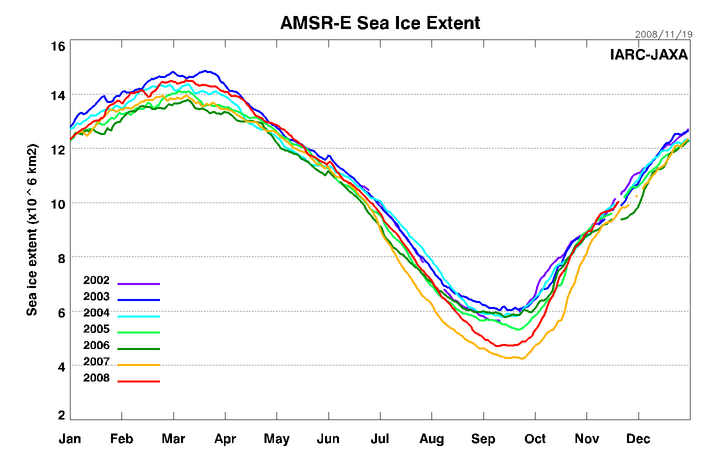
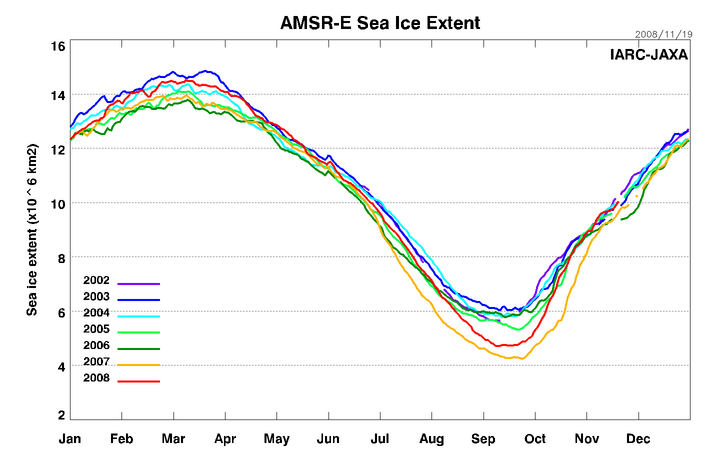
Anyway, I won’t go into the whole Antarctic thing more (except maybe in a postscript) but I do want to ask a question about Arctic amplification.  If the amplification comes in large part due to decreased albedo and more open ocean surface, doesn’t that mean most of the effect should be visible in summer and fall?  This would particularly be our expectation when we recognize that most of the recent anomaly in sea ice extent in the Arctic has been in summer.  I will repeat this chart just to remind you:

sea_ice

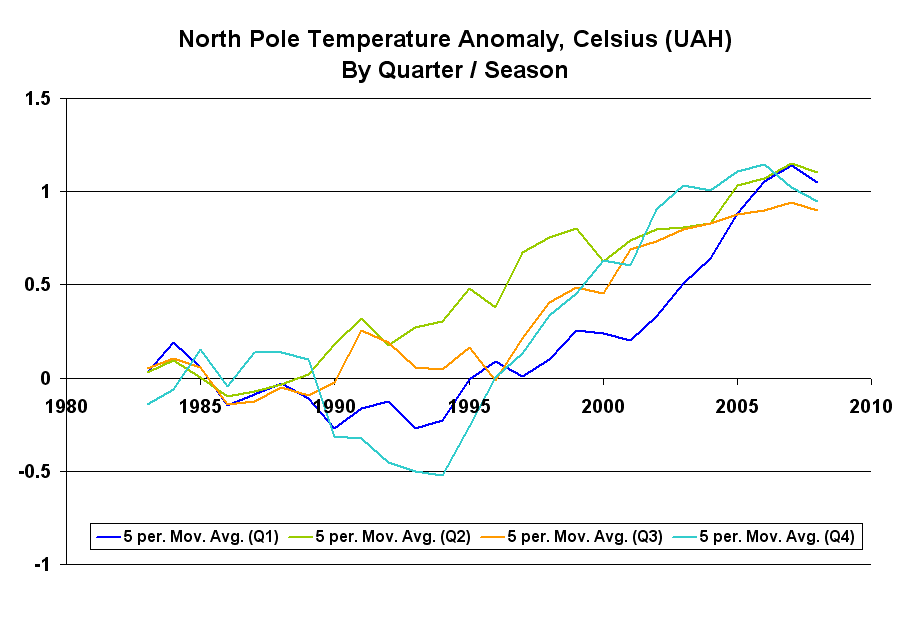
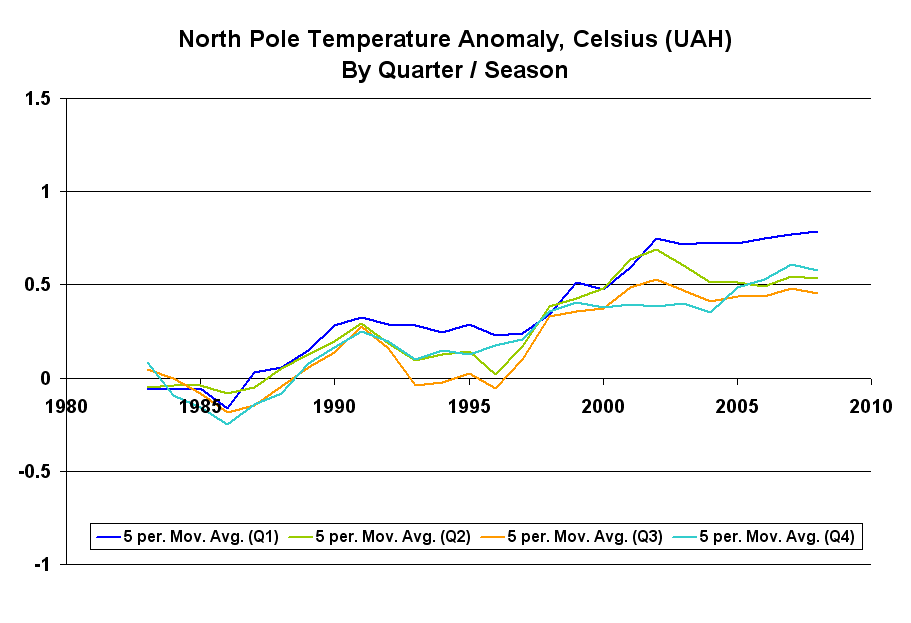
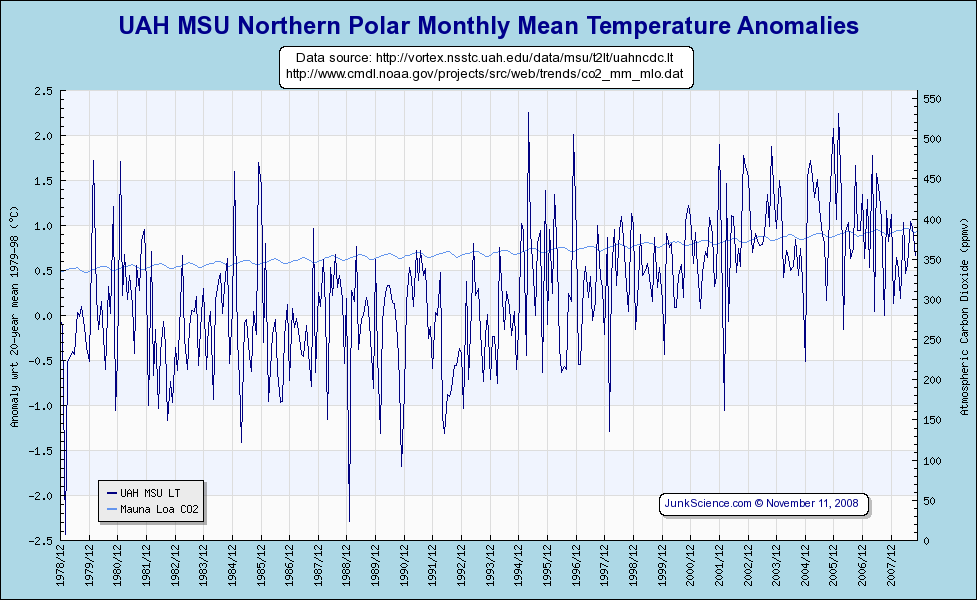
You can see that July-August-September are the biggest anomaly periods.  I took the UAH temperature data for the Arctic, and did something to it I had not seen before — I split it up into seasons.  Actually, I split it up into quarters, but these come within 8 days or so of matching the seasons.  Here is what I found (I used 5 year moving averages because the data is so volatile it was hard to eyeball a trend;  I also set each of the 4 seasonal anomalies individually to zero using the period 199-1989 as the base period)

seasons1

I see no seasonal trend here.  In fact, winter and spring have the highest anomalies vs. the base period, but the differences are so small currently as to be insignificant.  If polar amplification were occurring and the explanation for the North Pole warming more than the rest of the Earth (by far) over the last 30 years, shouldn’t I see it in the seasonal data.  I am honestly curious, and would like comments.

Postscript: Gavin Schmidt (who else) and Eric Steig have an old article in RealClimate if you want to read their Antarctic apologia.   It is kind of a funny article, if one asks himself “how many of the statements do they make discounting Antarctic cooling are identical to the ones skeptics use in reverse?  Here are a couple of gems:

It is important to recognize that the widely-cited “Antarctic cooling” appears, from the limited data available, to be restricted only to the last two decades

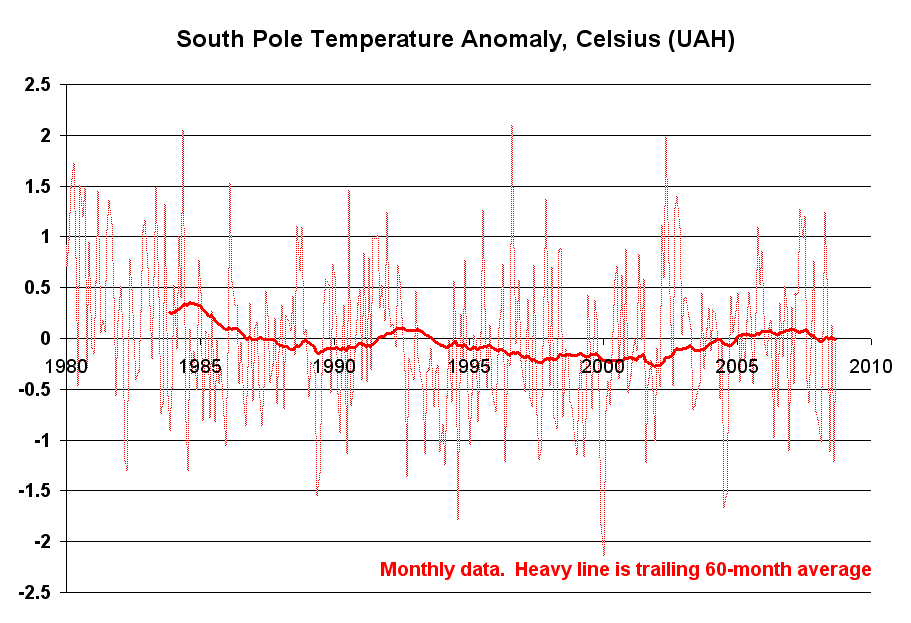
Given that this was written in 2004, he means restricted to 1984-2004.  Unlike global warming? By the way, he would see it for much longer than 20 years if these NASA scientists were not so hostile to space technologies (ie satellite measurement)

south_pole

It gets better.  They argue:

Additionally, there is some observational evidence that atmospheric dynamical changes may explain the recent cooling over parts of Antarctica. .

Thompson and Solomon (2002) showed that the Southern Annular Mode (a pattern of variability that affects the westerly winds around Antarctica) had been in a more positive phase (stronger winds) in recent years, and that this acts as a barrier, preventing warmer air from reaching the continent.

Interestingly, these same guys now completely ignore the same type finding when it is applied to North Pole warming.  Of course, this finding was made by a group entire hostile to folks like Schmidt at NASA. It comes from…. NASA

A new NASA-led study found a 23-percent loss in the extent of the Arctic’s thick, year-round sea ice cover during the past two winters. This drastic reduction of perennial winter sea ice is the primary cause of this summer’s fastest-ever sea ice retreat on record and subsequent smallest-ever extent of total Arctic coverage. …

Nghiem said the rapid decline in winter perennial ice the past two years was caused by unusual winds. “Unusual atmospheric conditions set up wind patterns that compressed the sea ice, loaded it into the Transpolar Drift Stream and then sped its flow out of the Arctic,” he said. When that sea ice reached lower latitudes, it rapidly melted in the warmer waters

I think I am going to put this into every presentation I give.  They say:

First, short term observations should be interpreted with caution: we need more data from the Antarctic, over longer time periods, to say with certainly what the long term trend is. Second, regional change is not the same as global mean change.

Couldn’t agree more.  Practice what you preach, though.  Y’all are the same guys raising a fuss over warming on the Antarctic Peninsula and the Lassen Ice Shelf, less than 2% of Antarctica which in turn is only a small part of the globe.

I will give them the last word, from 2004:

In short, we fully expect Antarctica to warm up in the future.

Of course, if they get the last word, I get the last chart (again from those dreaded satellites – wouldn’t life be so much better at NASA without satellites?)

south_pole2

Update:  I ran the same seaonal analysis for may different areas of the world.  The one area I got a strong seasonal difference that made sense was for the Northern land areas above the tropics.

seasons2

This is roughly what one would predict from CO2 global warming (or other natural forcings, by the way).  The most warming is in the winter, when reduced snow cover area reduces albedo and so provides positive feedback, and when cold, dry night air is thought to be more sensitive to such forcings.

For those confused — the ocean sea ice anomaly is mainly in the summer, the land snow/ice extent anomaly will appear mostly in the winter.

Black Carbon and Arctic Ice

My company runs a snow play area north of Flagstaff, Arizona.  One of the problems with this location is that the main sledding runs are on a black cinder hill.  Covered in snow, this is irrelevant.  But once the smallest hole opens up to reveal the black cinders underneath, the hole opens and spreads like crazy.  The low albedo cinders absorb heat much faster than reflective white snow, and then spread that heat into the snow and melts it.

Anthony Watt does an experiment with ash and snow in his backyard, and the effects are dramatic.

Even tiny amounts of soot pollution can induce high amounts of melting. There is little or no ash at upper right.. Small amounts of ash in the lower and left areas of the photo cause significant melting at the two-hour mark in the demonstration.

I won’t steal his thunder by taking his pictures, but you should look at them — as the saying goes, they are worth a thousand words.

We know that Chinese coal plants pump out a lot of black carbon soot that travels around the world and deposits itself over much of the norther hemisphere.  We can be pretty sure a lot of this carbon ends up on the Arctic ice cap, and as such contributes to an acceleration of melting.

I’v tried to do a thought experiment to think about what we would expect to see if this soot was driving a measurable percentage of Arctic ice melt.  It seems fairly certain that the soot would have limited effects during the season when new snow is falling.  Even a thin layer of new snow on top of deposited carbon would help mitigate its albedo-reducing effect.  So we would expect winter ice to look about like it has in the past, but summer ice, after the last snowfalls, to melt more rapidly in the past.  Once the seasons cool off again, when new ice is forming fresh without carbon deposits and snow again begins to fall, we would expect a catch-up effect where sea ice might increase very rapidly to return to winter norms.

Here is the Arctic ice chart from the last several years:

sea_ice1

Certainly consistent with our though experiment, but not proof by any means.  The last 2 years have shown very low summer ice conditions, but mostly normal/average winter extent.  One way we might get some insights into cause and effect is to look at temperatures.  If the last 2 years have had the lowest summer sea ice extents in 30 years, did they have the highest temperatures?

arctic_temp

Not really, but it may have been past warming has had a lag effect via ocean temperatures.

The point is that I am not opposed the idea that there can be anthropogenic effects on the climate, and it looks like black carbon deposits might have a real negative impact on sea ice.  If that were the case, this is really good news.  It is a LOT easier and cheaper to mitigate black carbon from combustion (something we have mostly but not completely done in the US) than it is to mitigate CO2  (which is a fundamental combustion product).

Don’t Count Those Skeptics Out

From Mark Scousen in "Making Modern Economics"

Ironically, by the time of the thirteenth edition [of Paul Samuelsons popular economics textbook], right before the Berlin Wall was torn down, Samuleson and Nordhaus confidently declared, "The Soviet economy is proof that, contrary to what many skeptics believed [a reference to Mises and Hayek], a socialist command economy can function and even thrive."  From this online excerpt.


Your One-Stop Climate Panic Resource

Absolutely classic video — a must see:

From Marc Marano via Tom Nelson:

This 9 ½ minute video brilliantly and accurately (it is not a spoof!) shows the absurdity of today’s man-made global warming fear campaign. It appears to have been produced by a group called Conservative Cavalry. They really did their homework and put together quite a show. This video should be shown in classrooms across the country and in newsrooms!

The video is based on the website “A complete list of things caused by global warming.”

The website is run by Dr. John Brignell is a UK Emeritus Engineering Professor at the University of Southampton who held the Chair in Industrial Instrumentation at Southampton.

This Just In, From Climate Expert Barrack Obama

Via Tom Nelson:

“Few challenges facing America — and the world – are more urgent than combating climate change,” he says in the video. “The science is beyond dispute and the facts are clear. Sea levels are rising. Coastlines are shrinking. We’ve seen record drought, spreading famine, and storms that are growing stronger with each passing hurricane season. Climate change and our dependence on foreign oil, if left unaddressed, will continue to weaken our economy and threaten our national security.

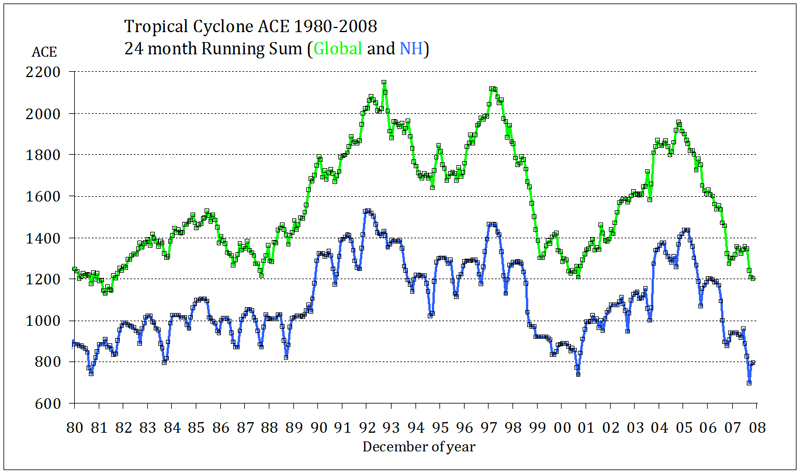
From Ryan Maue of FSU comes accumulated cyclonic energy, the best single metric of the strength of hurricane seasons:

cyclone_energy

Coming soon, Obama tells that story about this guy he knows who swears his grandmother tried to dry her cat by putting it in the microwave.

NOAA Adjustments

Anthony Watts has an interesting blink comparisonbetween the current version of history from the GISS and their version of history in 1999.  It is amazing that all of the manual adjustments they add to the raw data constantly have the effect of increasing historical warming.  By continuing to adjust recent temperatures up, and older temperatures down, they are implying that current measurement points have a cooling bias vs. several decades ago.  REALLY?  This makes absolutely no sense given what we now know via Anthony Watt’s efforts to document station installation details at surfacestations.org.

I created a blink comparison a while back that was related but slightly different.  I created a blink comparison to show the effect of NOAA manual adjustments to the raw temperature data.

adjustments

My point was not that all these adjustments were unnecessary (the time of observation adjustment is required, though I have always felt it to be exaggerated).  But all of the adjustments are upwards, even those for station quality.  The net effect is that there is no global warming signal in the US, at least in the raw data.  The global warming signal emerges entirely from the manual adjustments.  Which causes one to wonder as to the signal to noise ratio here.  And increases the urgency to get more scrutiny on these adjustments.

It only goes through 2000, because I only had the adjustment numbers through 2000.  I will see if I can update this.

On Quality Control of Critical Data Sets

A few weeks ago, Gavin Schmidt of NASAcame out with a fairly petulant response to critics who found an error in NASA's GISS temperature database.  Most of us spent little time criticizing this particular error, but instead criticized Schmidts unhealthy distaste for criticism and the general sloppiness and lack of transparency in the NOAA and GISS temperature adjustment and averaging process.

I don't want to re-plow old ground, but I can't resist highlighting one irony.  Here is Gavin Schmidt in his recent post on RealClimate:

It is clear that many of the temperature watchers are doing so in order to show that the IPCC-class models are wrong in their projections. However, the direct approach of downloading those models, running them and looking for flaws is clearly either too onerous or too boring.

He is criticizing skeptics for not digging into the code of the individual climate models, and focusing only on how their output forecasts hold out (a silly criticism I dealt with here).  But this is EXACTLY what folks like Steve McIntyre have been trying to do for years with the NOAA, GHCN, and GISS temperature metric code.  Finding nothing about the output that makes sense given the raw data, they have asked to examine the source code.  And they have met with resistance at every turn by, among others, Gavin Schmidt.  As an example, here is what Steve gets typically when he tries to do exactly as Schmidt asks:

I'd also like to report that over a year ago, I wrote to GHCN asking for a copy of their adjustment code:

I’m interested in experimenting with your Station History Adjustment algorithm and would like to ensure that I can replicate an actual case before thinking about the interesting statistical issues.  Methodological descriptions in academic articles are usually very time-consuming to try to replicate, if indeed they can be replicated at all. Usually it’s a lot faster to look at source code in order to clarify the many little decisions that need to be made in this sort of enterprise. In econometrics, it’s standard practice to archive code at the time of publication of an article – a practice that I’ve (by and large unsuccessfully) tried to encourage in climate science, but which may interest you. Would it be possible to send me the code for the existing and the forthcoming Station History adjustments. I’m interested in both USHCN and GHCN if possible.

To which I received the following reply from a GHCN employee:

You make an interesting point about archiving code, and you might be encouraged to hear that Configuration Management is an increasingly high priority here. Regarding your request — I'm not in a position to distribute any of the code because I have not personally written any homogeneity adjustment software. I also don't know if there are any "rules" about distributing code, simply because it's never come up with me before.

I never did receive any code from them.

Here, by the way, is a statement from the NOAA web site about the GHCN data:

Both historical and near-real-time GHCN data undergo rigorous quality assurance reviews. These reviews include preprocessing checks on source data, time series checks that identify spurious changes in the mean and variance, spatial comparisons that verify the accuracy of the climatological mean and the seasonal cycle, and neighbor checks that identify outliers from both a serial and a spatial perspective.

But we will never know, because they will not share the code developed at taxpayer expense by government employees to produce official data.

A year or so ago, after intense pressure and the revelation of another mistake (again by the McIntyre/Watt online communities) the GISS did finally release some of their code.  Here is what was found:

Here are some more notes and scripts in which I've made considerable progress on GISS Step 2. As noted on many occasions, the code is a demented mess – you'd never know that NASA actually has software policies (e.g. here or here. I guess that Hansen and associates regard themselves as being above the law. At this point, I haven't even begum to approach analysis of whether the code accomplishes its underlying objective. There are innumerable decoding issues – John Goetz, an experienced programmer, compared it to descending into the hell described in a Stephen King novel. I compared it to the meaningless toy in the PPM children's song – it goes zip when it moves, bop when it stops and whirr when it's standing still. The endless machinations with binary files may have been necessary with Commodore 64s, but are totally pointless in 2008.

Because of the hapless programming, it takes a long time and considerable patience to figure out what happens when you press any particular button. The frustrating thing is that none of the operations are particularly complicated.

So Schmidt's encouragement that skeptics should go dig into the code was a) obviously not meant to be applied to hiscode and b) roughly equivalent to a mom answering her kids complaint that they were bored and had nothing to do with "you can clean your rooms" — something that looks good in the paper trail but is not really meant to be taken seriously.  As I said before:

I am sure Schmidt would love us all to go off on some wild goose chase in the innards of a few climate models and relent on comparing the output of those models against actual temperatures.

Responses to Gavin Schmidt, Part 2

OK, we continue to the final paragraph of Gavin Schmidt’s postadmitting a minor error in the October GISS numbers, and then proceeding to say that all the folks who pointed out the error are biased and unhelpful, in spite of the fact (or maybe because of the fact) that they found this error.

As I reviewed in part 1, most of the letter was just sort of petulant bad grace.  But this paragraph was worrisome, and I want to deal with it in more depth:

Which brings me to my last point, the role of models. It is clear that many of the temperature watchers are doing so in order to show that the IPCC-class models are wrong in their projections. However, the direct approach of downloading those models, running them and looking for flaws is clearly either too onerous or too boring. Even downloading the output (from here or here) is eschewed in favour of firing off Freedom of Information Act requests for data already publicly available – very odd. For another example, despite a few comments about the lack of sufficient comments in the GISS ModelE code (a complaint I also often make), I am unaware of anyone actually independently finding any errors in the publicly available Feb 2004 version (and I know there are a few). Instead, the anti-model crowd focuses on the minor issues that crop up every now and again in real-time data processing hoping that, by proxy, they’ll find a problem with the models.

I say good luck to them. They’ll need it.

Since when has direct comparison of forecast models against observation and measurement been the wrong way to validate or invalidate the forecast or model? I am sure there were lots of guys who went through the Principia Mathematica and tore apart the math and equations to make sure they balanced, but most of the validation consisted of making observations of celestial bodies to see if their motion fit the predicted results.  When Einstein said time would change pace in a gravity well, scientists took atomic clocks up in high-altitude airplanes to see if his predictions matched measured results.  And physicists can play with models and equations all day, but nothing they do with the math will be as powerful as finding a Higgs Boson at the LHC.

Look, unlike some of the commenters Schmidt quoted, there is no reason to distrust a guy because his staff made a data error.  But I think there is a big freaking reason to distrust someone who gets huffy that people are using actual data measurements to test his prediction models.

There is probably a reason for Schmidt to be sensitive here.  We know that Hansen’s 1988 forecasts don’t validate at all against actual data from the last 20 years (below uses the Hansen A case from his Congressional testimony, the case which most closely matches actual CO2 production since the speech).

gavin_forecast

More recent forecasts obviously have had less time to validate.  Many outsiders have found that current temperatures fall outside of the predicted range of the IPCC forecasts, and those that have found temperatures within the error bars of the forecasts have generally done so by combining large error bars, white noise, and various smoothing approaches to just eek actual temperatures into the outer molecular layers of the bottom edge of the forecast band.

As to the rest, I am not sure Schmidt knows who has and has not poked around in the innards of the models – has he studied all the referrer logs for their web sites?  But to some extent this is beside the point.  Those of us who have a lot of modeling experience in complex systems (my experience is in both econometrics and in mechanical control systems) distrust models and would not get any warm fuzzies from poking around in their innards.  Every modeler of chaotic systems knows that it is perfectly possible to string together all sorts of logically sound and reasonable assumptions and algorithms only to find that the whole mass of them combined spits out a meaningless mess.  Besides, there are, what, 60 of these things?  More?  I could spend 6 months ripping the guts out of one of them only to have Schmidt then say, well there are 59 others.  That one does not really affect anything.  I mean, can’t you just see it — it would be entirely equivalent to the reaction every time an error or problem measurement station is found in the GISS data set.  I am sure Schmidt would love us all to go off on some wild goose chase in the innards of a few climate models and relent on comparing the output of those models against actual temperatures.

No, I am perfectly happy to accept the IPCC’s summary of these models and test this unified prediction against history.  I am sure that no matter what temperature it is this month, some model somewhere in the world came close.  But how does that help, unless it turns out that it is the same model that is right month after month, and then I might get excited someone was on to something.  But just saying current temperatures fall into a range where some model predicts it just says that there is a lot of disagreement among the models, and in turn raises my doubts about the models.

The last sentence of Schmidt’s paragraph is just plain wrong.  I have never seen anyone who is out there really digging into this stuff (and not just tossing in comments) who has said that errors in the GISS temperature anomaly number imply the models are wrong, except of course to the extent that the models are calibrated to an incorrect number.  Most everyone who looks at this stuff skeptically understand that the issues with the GISS temperature metric are very different than issues with the models.

In a nutshell, skeptics are concerned with the GISS temperature numbers because of the signal to noise problem, and a skepticism that the GISS has really hit on algorithms that can, blind to station configuration, correct for biases and errors in the data.  I have always felt that rather than eliminate biases, the gridcell approach simply spreads them around like peanut butter.

My concern with the climate models is completely different.  I won’t go into them all, but they include:

  • the inherent impossibility of modeling such a chaotic system
  • scientists assume CO2 drives temperatures, so the models they build unsurprisingly result in CO2 driving temperature
  • modelers assume WAY too much positive feedback.  No reasonable person, if they step back from it, should really be able to assume so much positive feedback in a long-term stable system
  • When projected backwards, modeler’s assumptions imply far more warming than we have experienced, and it takes heroic assumptions and tweaks and plugs to make the models back-cast reasonably well.
  • Its insane to ignore changes in solar output, and/or to assume that the sun over the last 40 years has been in a declining cycle
  • Many models, by their own admission, omit critical natural cycles like ENSO/PDO.

By the way, my simple hypothesis to describe past and future warming is here.

As a final note, the last little dig on Steve McIntyre (the bit about FOIA requests) is really low.  First, it is amazing to me that, like Hogwarts students who can’t say the word Voldemort, the GISS folks just can’t bring themselves to mention his name.  Second, Steve has indeed filed a number of FOIA requests on Michael Mann, the GISS, and others.  Each time he has a pretty good paper trail of folks denying him data (Here is the most recent for the Santer data). Almost every time, the data he is denied is taxpayer funded research, often by public employees, or is data that the publication rules of a particular journal require to be made public.  And remember the source for this — this is coming from the GISS, which resisted McIntyre’s calls for years to release their code  (publicly funded code of a government organization programmed by government employees to produce an official US statistic) for the GISS grid cell rollup of the station data, releasing the code only last year after McIntyre demonstrated an error in the code based on inspection of the inputs and outputs.

At the end of the day, Hansen and Schmidt are public employees who like having access to government budgets and the instant credibility the NASA letterhead provides them, but don’t like the public scrutiny that goes with it.  Suck it up guys.  And as to your quest to rid yourself of these skeptic gadflies, I will quote your condescending words back to you:  Good Luck.  You’ll need it.