Archive for the ‘Temperature History’ Category.

Urban Bias on Surface Temperature Record

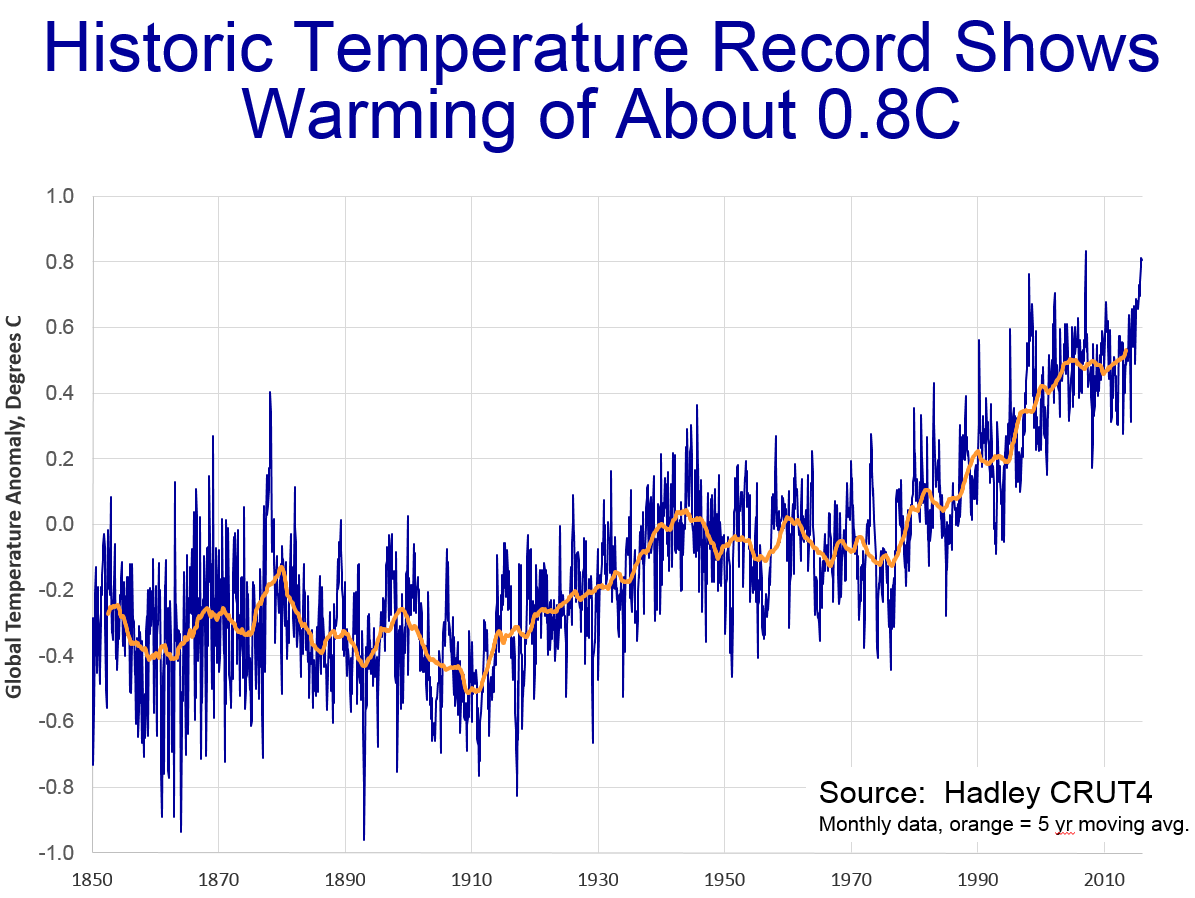
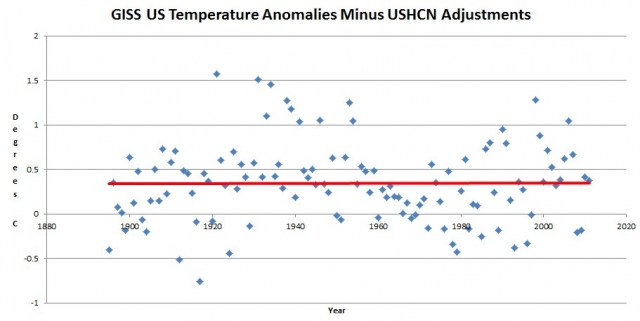
A lot of folks have started to analyze the surface temperature record for urban biases.  This site has linked a number of past analyses, and I’ve done some first-hand analysis of local surface temperature stations and measurements of the Phoenix urban heat island.  My hypothesis is that as much as half of the historic warming signal of 0.7C or so in the surface temperature record is actually growing urban heat islands biasing measurement stations.

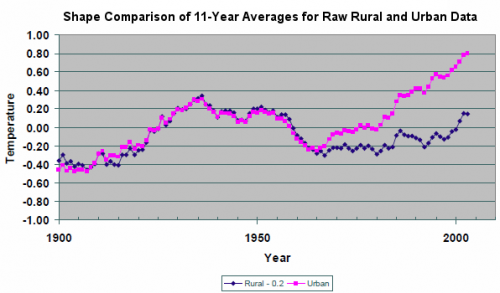
Edward Long took a selection of US measurement points from the NCDC master list and chose 48 rural and 48 urban locations (one for each of the lower-48 states).  While I would like to see a test to ensure no cherry-picking went on, his results are pretty telling:

Station Set
oC/Century, 11-Year Average Based on the Use of
Raw Data
Adjusted Data
Rural (48)
0.11
0.58
Urban (48)
0.72
0.72
Rural + Urban (96)
0.47
0.65

More at Anthony Watt, who has this chart from the study:

The Reference Frame has more analysis as well.

If this data is representative of the whole data set, we see two phenomena that should not be news to readers of this site:

  • Inclusion of biased urban data points may be contributing as much as 5/6 of the warming signal in the test period
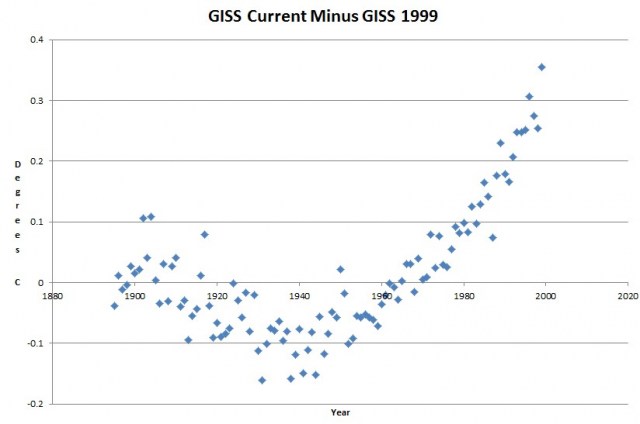
  • The homogenization and adjustment process, which is supposed to statistically correct for biases, seems to be correcting the wrong way, increasing clean sites to matched biased ones rather than vice versa  (something I discussed years ago here)

The homogenization process has always bothered me.  It is probably the best we can do if we don’t know which of two conflicting measurements are likely to be biased, but it makes no sense in this case, as we have a fair amount of confidence the rural location is likely better than the urban.

Let’s say you had two compasses to help you find north, but the compasses are reading incorrectly.  After some investigation, you find that one of the compasses is located next to a strong magnet, which you have good reason to believe is strongly biasing that compass’s readings.  In response, would you

  1. Average the results of the two compasses and use this mean to guide you, or
  2. Ignore the output of the poorly sited compass and rely solely on the other unbiased compass?

Most of us would quite rationally choose #2.

Most climate data bases go with approach #1.

Let’s remind everyone why this matters:  We are not going to eliminate past warming.  The Earth was at one of its coldest periods in 5000 years through about 1800 and it has gotten warmer since.   The reason it matter is twofold:

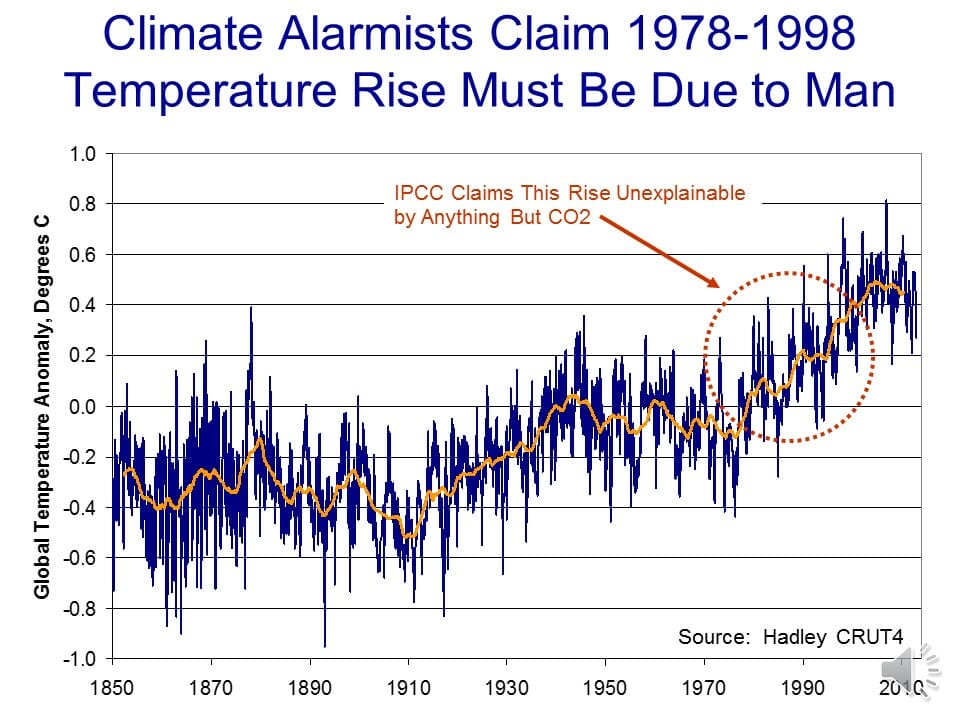
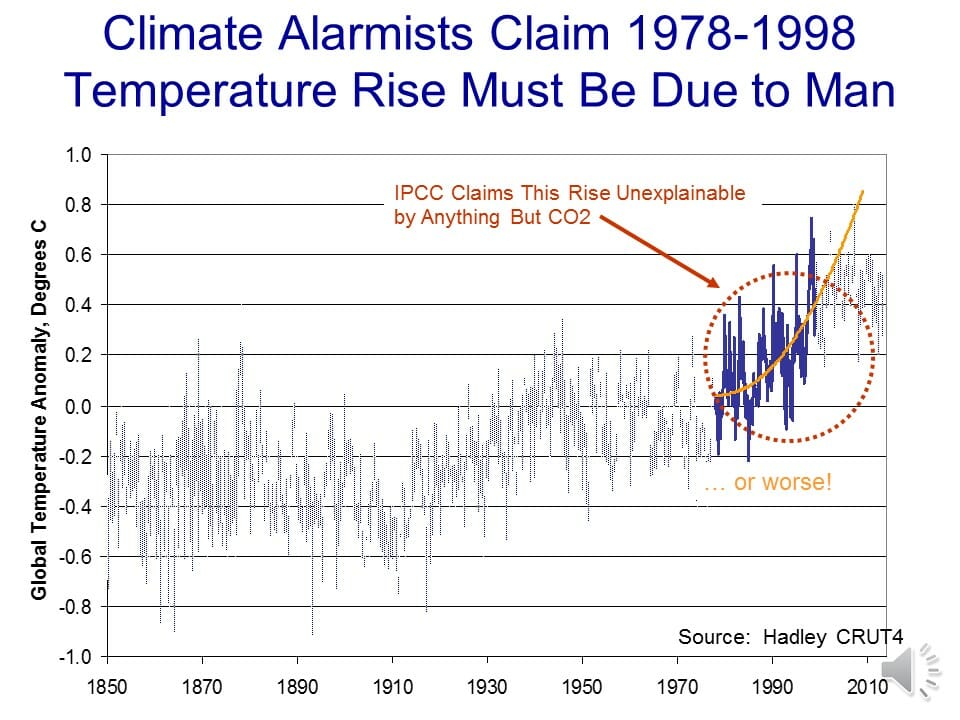
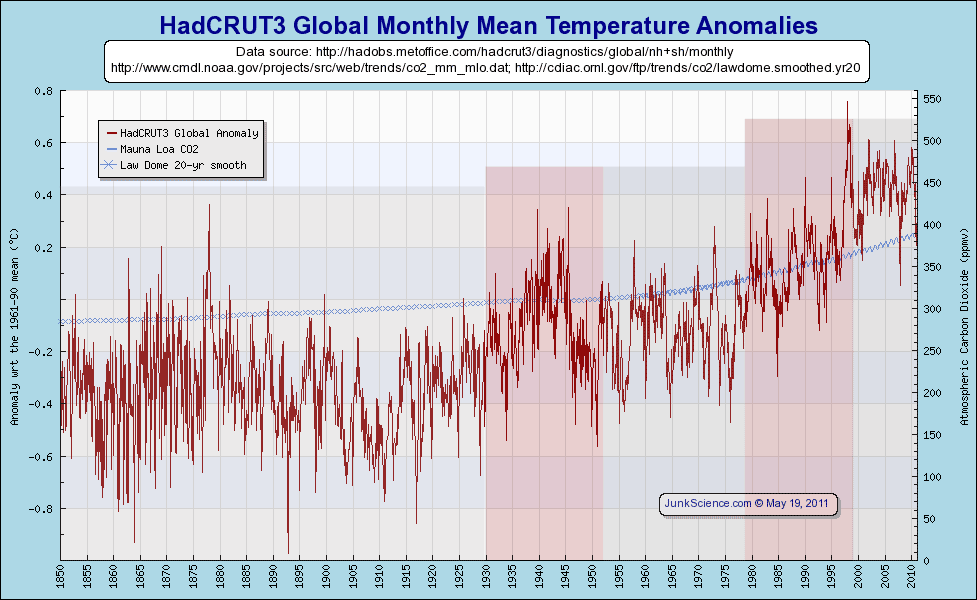
  • The main argument for anthropogenic causes of warming is that the rise of late (particularly 1978 – 1998)  has been so steep and swift that it couldn’t be anything else.  This was always an absurd argument, because we have at least two periods in the last 150 years prior to most of our fossil fuel combustion where temperature rises were as fast and steep as 1978-1998.  But if temperatures did not rise as much as we thought, this argument is further gutted.
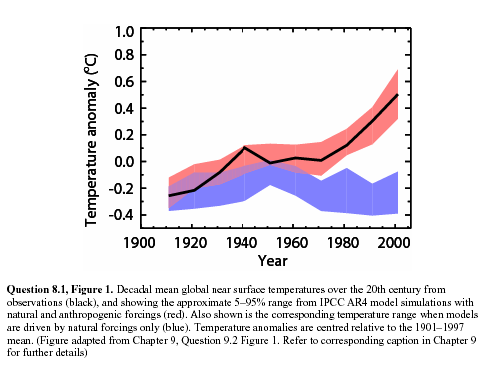
  • High sensitivity climate models have always had trouble back-casting history.  Models that predict 5C of warming with a doubling have a difficult time replicating past warming of 0.6C for 40% of a doubling.  If the 0.6C is really 0.3C, then someone might actually raise their hand and observe that the emperor has not clothes – ie, that based on history, high sensitivity models make no sense.

The Madness of Prince Charles

Charleses have not had the best of luck on the English throne.  And the current Prince of Wales does not seem to be doing much to change that tradition.  The other day he said:

“Well, if it is but a myth, and the global scientific community is involved in some sort of conspiracy, why is it then that around the globe sea levels are more than six inches higher than they were 100 years ago?

“This isn’t an opinion – it is a fact.”

He added: “And, ladies and gentlemen please be in no doubt that the evidence of long-term and potentially irreversible changes to our world is utterly overwhelming.”

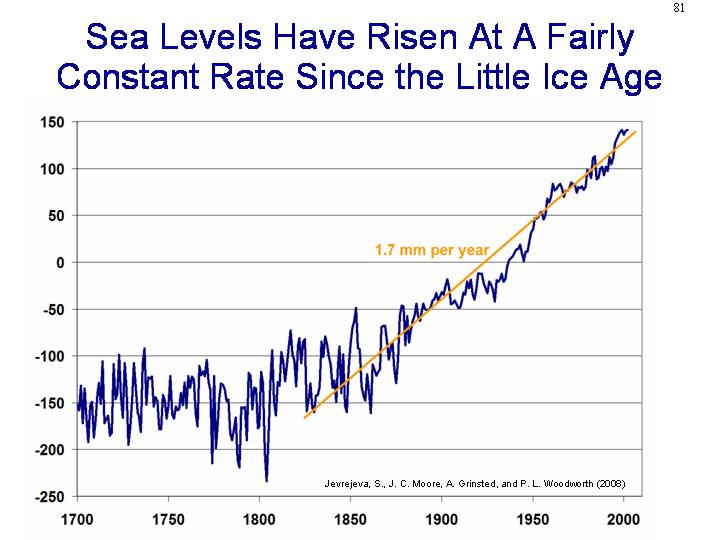
Here is the deal with sea levels.  Yes, they were rising in 2009.  And they were rising in 2000.  And they were rising in 1950.  And they were rising in 1900.  And they were rising in 1850.   In fact, sea levels have been rising (due to thermal expansion of water and perhaps some melting land ice**) since the end of the little ice age  (and longer, see WUWT)

slide81

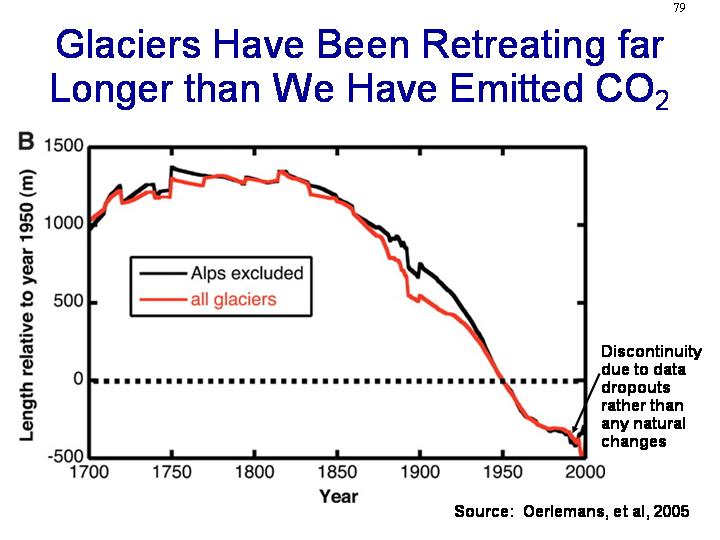
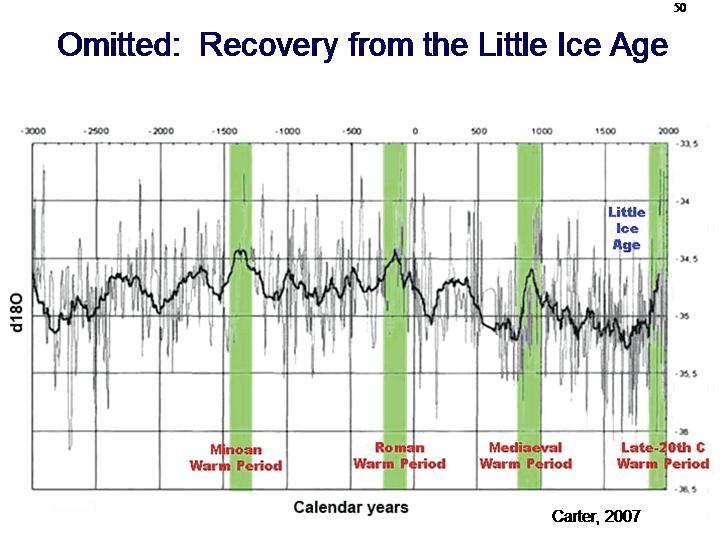
In fact, I would argue that this extended sea level rise helps disprove, rather than prove, the strong anthropogenic hypothesis.   The influence of manmade CO2 had to be small from 1850 to 1900 or even 1950.  Therefore, for the 1950-2000 sea level rise to be due to man, it means the natural warming had to stop at the exact same moment that anthropogenic effects took over.  Occam’s Razor says a better answer is that the end of the little ice age around 1800 has led to a general recovery of temperatures ever since.  We see the exact same pattern in glaciers melting

slide79

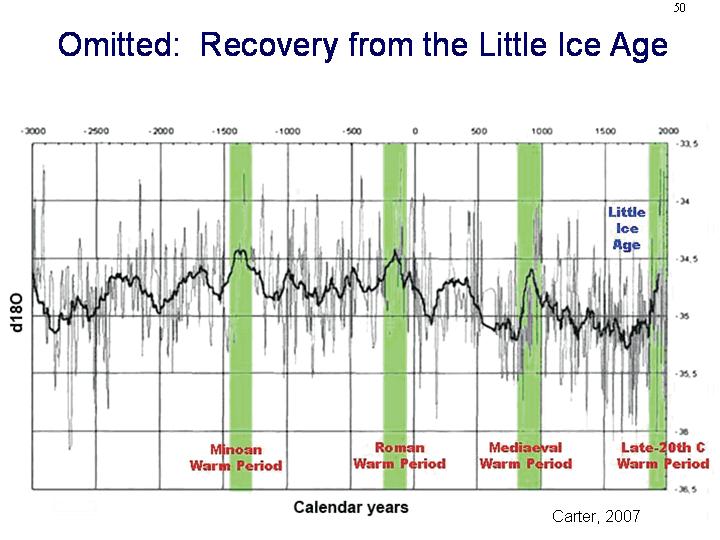
So many people are obsessed over whether or not current temperatures are the highest in the last 100o years or not, they forget that the temperatures in the little ice age were in fact lower than at any time in perhaps the last 5000 years.  It was very cold.
slide50

Postscript: By the way, I love the carbon footprint for me, but not for thee angle of the Prince Charles story:

Charles spoke after arriving in Manchester by Royal Train pulled by a coal-fired steam locomotive, named the Tornado, which was rebuilt from a 1948 design.

** Footnote: We know glaciers around the world have retreated since 1850, as shown above, but 90% of the world’s land ice is in Antarctica and we don’t fully understand what has happened there.  Some climatologists believe that warming weather actually increases the ice pack in Antarctica because it never will cause much melting but it increases  snowfall.

Assuming Your Conclusion

I thought this was pretty interesting, and oh-so typical of climate science, from an article by Viscount Monkton:

The paper was based on a test of a widely-used climate model on the mid-Pleiocene warm period, 3 million years ago, when the Earth warmed in response to natural processes. Cores drilled from ocean sediment provide some evidence for atmospheric carbon levels and temperature at the time.

The team found that at that era, although CO2 levels were close to today’s 388 parts per million by volume, global temperature was 3 C° (5.5 F°) warmer than today. The paper assumes – without evidence – that the difference can only be fully explained by the long-term loss of ice sheets and changes in vegetation that caused the Earth’s surface to absorb more solar radiation. One of the authors said that today’s CO2 concentration of 388 ppmv might already be too high to prevent more than 2 C° (3.5 F°) of warming compared with pre-industrial times – the limit agreed as an aspiration by the recent Copenhagen accord.

The authors are concluding that there is therefore another 3C of warming we should see over time due to our current CO2 levels that has just not showed up yet because slow-response-time feedbacks like ice melting / albedo changes haven’t fully come into play.

I presume you see the problem.  This conclusion can only be drawn if either

1.  We know the value of every other climate forcing that was in play 3 million years ago, and know them to be identical to their values today, such that the only changed variable in the temperature system between then and now is CO2.  Of course, this is absurd — we can’t possibly know all the other forcings from 3 million years ago (we argue about what they are today) and there is a very low probability they were all of the same value as today to set up a nice controlled experiment.  – OR -

2.  We assume that the only major driver of climate, the one that dominates and makes all others irrelevant, is CO2.  This is not only not proven, it is not even reasonably true.

These guys, as is so often the case in climate, are assuming their conclusion.  “If we assume that CO2 is the primary driver of climate, then sensitivity of the climate to CO2 is high.”  Duh.

Defending the Tribe

This is a really interesting email string form the CRU emails, via Steve McIntyre:

June 4, 2003 Briffa to Cook 1054748574
On June 4, 2003, Briffa, apparently acting as editor (presumably for Holocene), contacted his friend Ed Cook of Lamont-Doherty in the U.S. who was acting as a reviewer telling him that “confidentially” he needed a “hard and if required extensive case for rejecting”, in the process advising Cook of the identity and recommendation of the other reviewer. There are obviously many issues involved in the following as an editor instruction:

From: Keith Briffa
To: Edward Cook
Subject: Re: Review- confidential REALLY URGENT
Date: Wed Jun 4 13:42:54 2003

I am really sorry but I have to nag about that review – Confidentially I now need a hard and if required extensive case for rejecting - to support Dave Stahle’s and really as soon as you can. Please
Keith

Cook to Briffa, June 4, 2003
In a reply the same day, Cook told Briffa about a review for Journal of Agricultural, Biological, and Environmental Sciences of a paper which, if not rejected, could “really do some damage”. Cook goes on to say that it is an “ugly” paper to review because it is “rather mathematical” and it “won’t be easy to dismiss out of hand as the math appears to be correct theoretically”. Here is the complete email:

Hi Keith,
Okay, today. Promise! Now something to ask from you. Actually somewhat important too. I got a paper to review (submitted to the Journal of Agricultural, Biological, and Environmental Sciences), written by a Korean guy and someone from Berkeley, that claims that the method of reconstruction that we use in dendroclimatology (reverse regression) is wrong, biased, lousy, horrible, etc. They use your Tornetrask recon as the main whipping boy. I have a file that you gave me in 1993 that comes from your 1992 paper. Below is part of that file. Is this the right one? Also, is it possible to resurrect the column headings? I would like to play with it in an effort to refute their claims. If published as is, this paper could really do some damage. It is also an ugly paper to review because it is rather mathematical, with a lot of Box-Jenkins stuff in it. It won’t be easy to dismiss out of hand as the math appears to be correct theoretically, but it suffers from the classic problem of pointing out theoretical deficiencies, without showing that their improved inverse regression method is actually better in a practical sense. So they do lots of monte carlo stuff that shows the superiority of their method and the deficiencies of our way of doing things, but NEVER actually show how their method would change the Tornetrask reconstruction from what you produced. Your assistance here is greatly appreciated. Otherwise, I will let Tornetrask sink into the melting permafrost of northern Sweden (just kidding of course).
Cheers,
Ed

A couple of observations

  1. For guys who supposedly represent the consensus science of tens of thousands of scientists, these guys sure have a bunker mentality
  2. I would love an explanation of how math can have theoretical deficiencies but be better in a practical sense.  In the practical sense of … giving the answer one wants?
  3. The general whitewash answer to all the FOIA obstructionism is that these are scientists doing important work not to be bothered by nutcases trying to waste their time.  But here is exactly the hypocrisy:  The email author says that some third party’s study is deficient because he can’t demonstrate how his mathematical approach might change the answer the hockey team is getting.  But no third party can do this because the hockey team won’t release the data needed for replication.  This kind of data – to check the mathematical methodologies behind the hockey stick regressions – is exactly what Steve McIntyre et al have been trying to get.  Ed Cook is explaining here, effectively, why release of this data is indeed important
  4. At the very same time these guys are saying to the world not to listen to critics because they are not peer-reviewed, they are working as hard as they can back-channel to keep their critics out of peer-reviewed literature they control.
  5. For years I have said that one problem with the hockey team is not just that the team is insular, but he reviewers of their work are the same guys doing the work.  And now we see that these same guys are asked to review the critics of their work.

A First

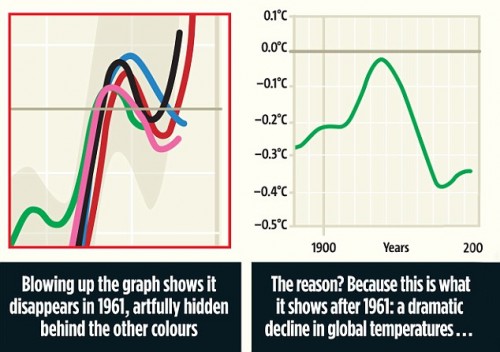
To my knowledge, this may be a first.  After years of folks like Steve McIntyre deconstructing numerous problems in historical temperature proxy studies, a major media outlet actually does a detailed article on some of the issues with proxy studies.  David Rose in the Mail Online.  Whoever thought we would see this chart in the MSM?

article-0-07949b82000005dc-809_634x447

Only 25 months after a similar chart was shown on this site (and here).

Powers of 10

This is a really interesting post at WUWT by J. Storrs Hall. It reminds me of one of those powers of ten films. He looks at data from a Greenland ice core (archived at NOAA here) going back over 50,000 years.   He begins looking at the last few hundred years, and then pulls back the view on larger and large time scales.  Highly recommended.
Note: Box, et al in 2009 claim to have found from 1-1.5C of warming since around 1900 when this chart leaves off.  It is very, very , very dangerous to splice data sets together, but one probably has to add a degree or so to the tail of the chart to bring it up to date, putting current warming about at the Medieval level but below earlier Holocene temperatures.

A Total Bluff

Gavin Schmidt has absolutely no evidence for this:  (via Tom Nelson)

Gavin [Schmidt],

In your opinion, what percentage of global warming is due to human causes vs. natural causes?

[Response: Over the last 40 or so years, natural drivers would have caused cooling, and so the warming there has been (and some) is caused by a combination of human drivers and some degree of internal variability. I would judge the maximum amplitude of the internal variability to be roughly 0.1 deg C over that time period, and so given the warming of ~0.5 deg C, I'd say somewhere between 80 to 120% of the warming. Slightly larger range if you want a large range for the internal stuff. - gavin]

This is a complete bluff.  There is no way he or anyone else knows this.  I could reverse his numbers and say 0-20% for CO2 and have just as much justification (actually more, see below).  We have devised no good way to parse the temperature changes into any reliable division between various drivers given the complexity of climate.  The only way climate scientists claim to do it is with their highly flawed temperature models, which is a fit of hubris that is unfathomable.

But, beyond the fact that he simply can’t know the answer, his guess here is just awful.  It does not reality check at all.   Here are a few pointers:

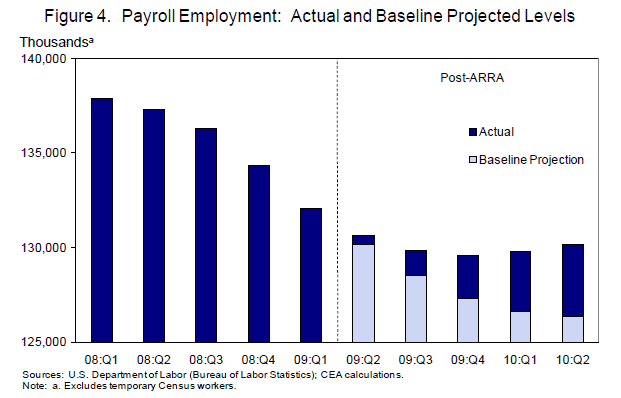
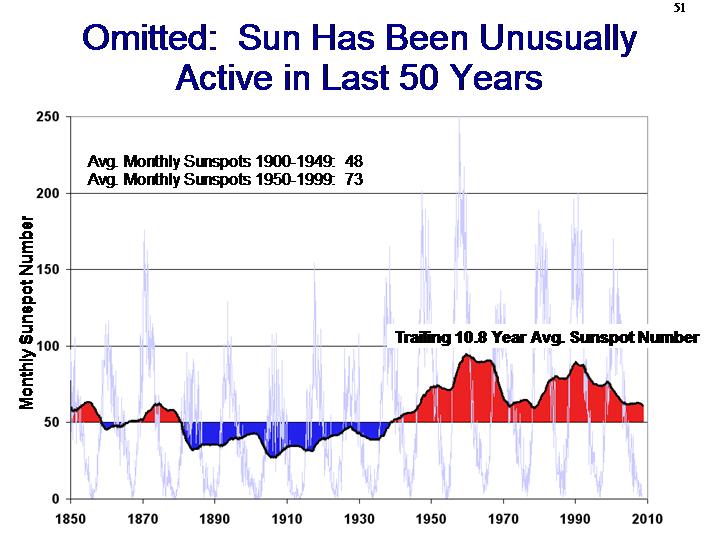
1.  Over the last 40 years, or at least over the portion from 1975-1995 when we saw most of the temperature increase, the sun was at its most active this century, as measured by sunspot numbers.  The PDO, which has close links to temperature, was in its warm cycle.  We likely were continuing to see long-term cyclical recovery from the little ice age.  And anthropogenic land use changes were increasing both urban and rural temperatures.  But he claims that the net effect of non-CO2 factors would have been negative?  This is roughly equivalent to Obama’s jobs claims numbers, saying that he saved jobs that would otherwise have been lost.  It’s appeal is that it makes a useful political point while being impossible to prove.

2.  Hansen is basically repeating the IPCC position that there could be no possible natural explanation for the the 0.2C per decade temperature increases from 1975-2000  — ie that such a pace of temperature increase has to be due to CO2 alone (80-120% in my mind equates to CO2 alone).  But world temperatures increased from 1910 to 1940 by 0.2C per decade, in a period almost certainly only minimally influenced by CO2  (see below).  So natural effects can cause warming in the 1930’s but not in the 1980’s because, why?

temperature-chart1

I often use this chart with audiences:

slide48

3.  I am positive that Hansen would argue that natural effects are currently (and temporarily) canceling out some of the warming.  He would say this as a way to deflect criticism that the world has stopped warming over the last decade (something the CRU emails admit they don’t understand, though they won’t admit this publicly**).  But Hansen et al. think we should be seeing 0.2C a decade or more in CO2 warming that is apparently being overcome by natural effects.  So natural effects have enough variability to cancel out 0.2C of warming but not enough to cause 0.2C of warming?  Huh?

This is sort of a special theme this week on this blog, as the topic keeps coming up.  In short, climate scientists need the climate to be alternately sensitive and insensitive, unstable and stable, driven by nature and not driven by nature, all depending on the period they are trying to explain.   All these wildly contradictory assumptions are required to try to keep the hypothesis of very high sensitivities to CO2 alive.

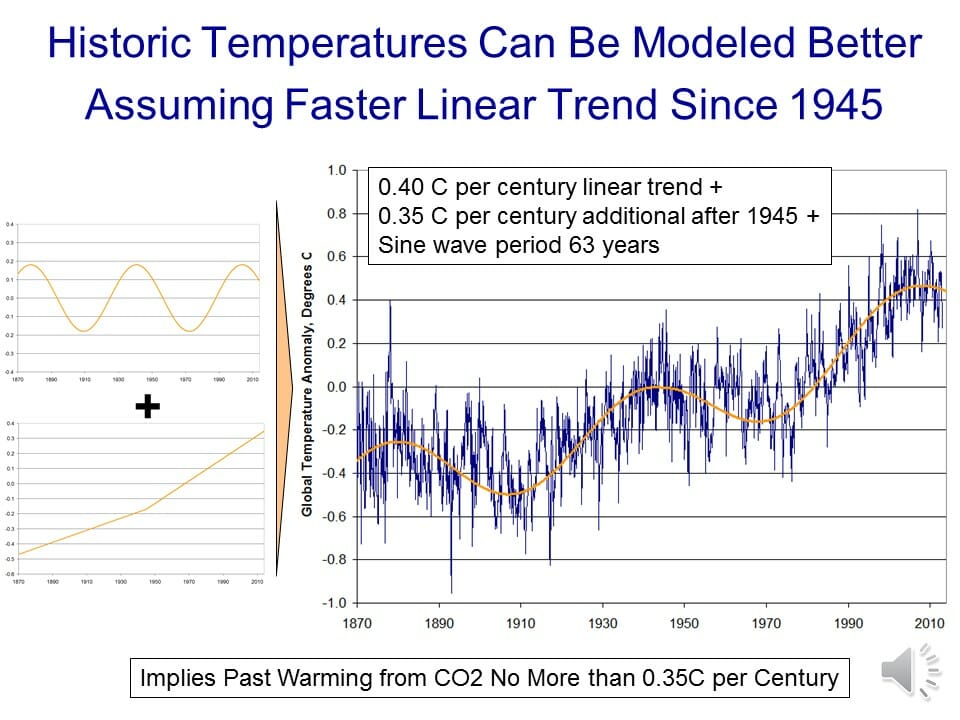
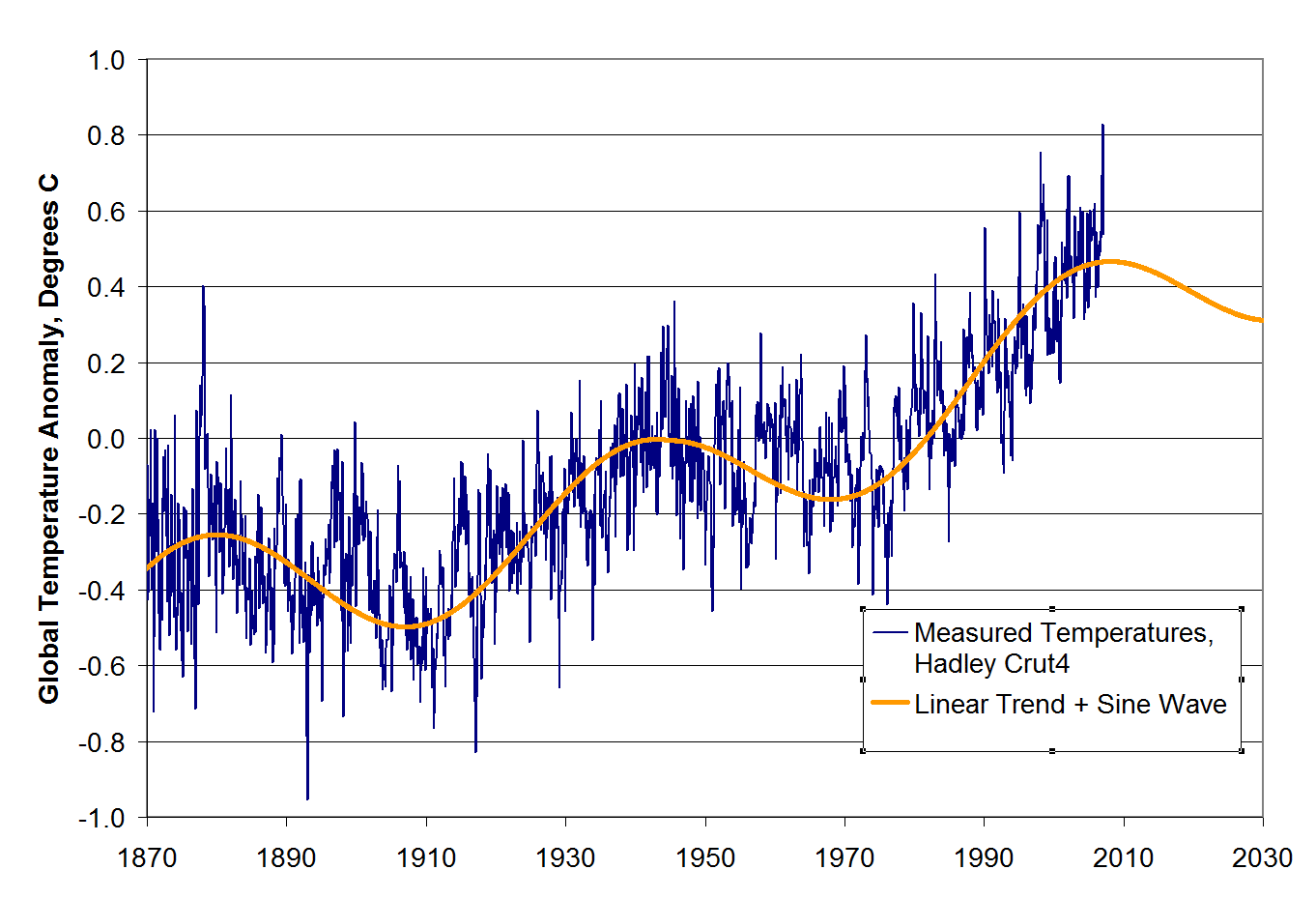
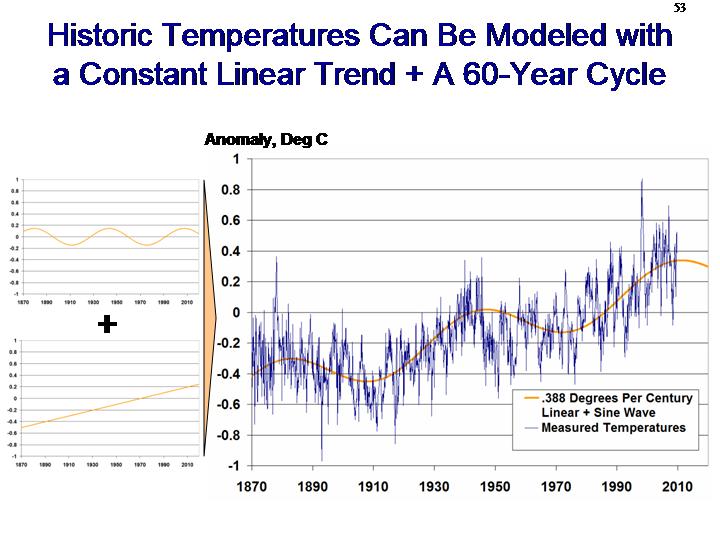
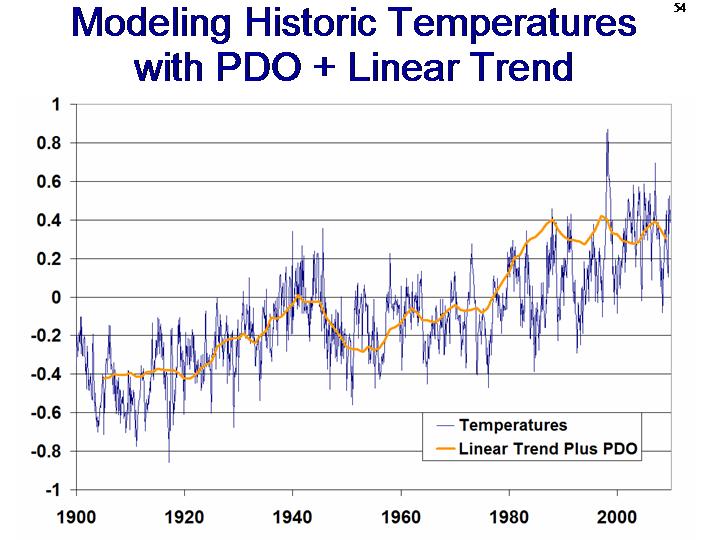
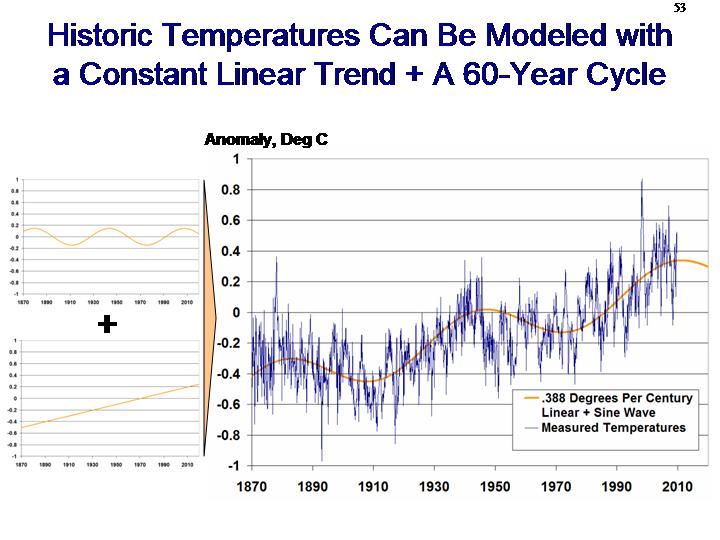
Here, by the way, was my attempt to explain the last 100 years of temperature with a cyclical wave plus a small linear trend:

slide53

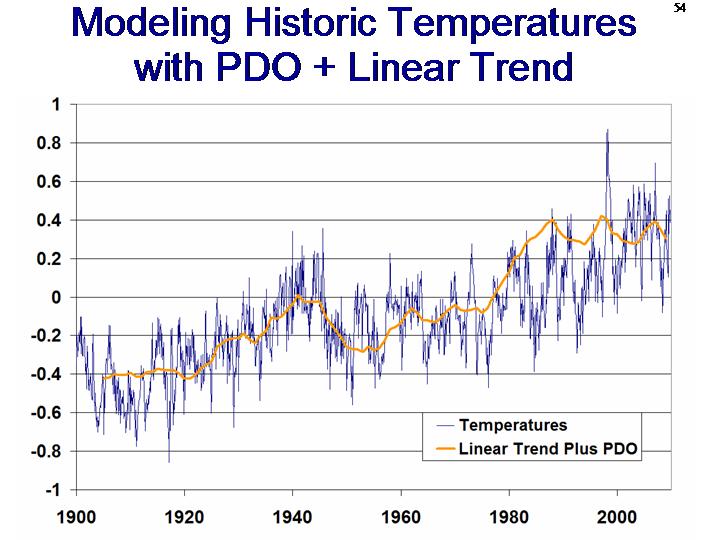
Not bad, huh?  Here is a similar analysis using a linear trend plus the PDO

slide54

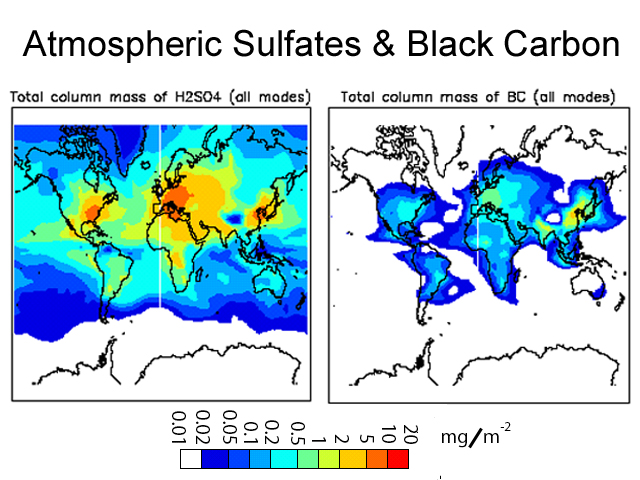
My answer seems at least as plausible as Gavin’s.  Here is where I did this analysis in more depth. If I really had an official climate scientist decoder ring, I would blame the gap between measured temperatures and my simplified model in orange during the 1980’s on aerosols.  I don’t know how much if any they affect the climate, but neither do climate scientists and that does not stop them from using it as the universal model plug to improve historic correlations.

By the way, for reference, here is the sunspot cycle:

slide51

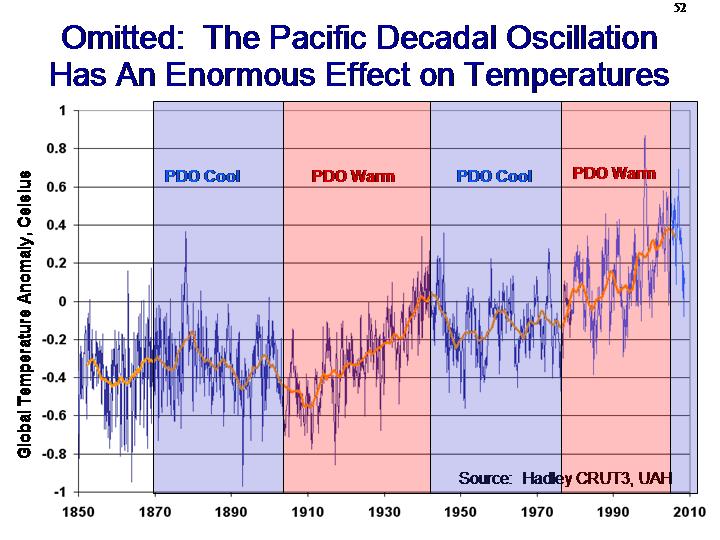
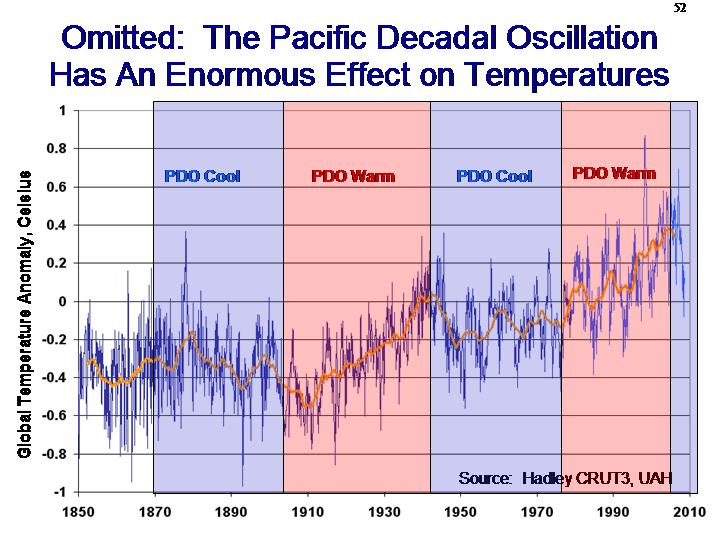
Here is the world temperature graph overlayed with the PDO

slide52

And finally here is some evidence (from ice core analysis) that we may just still be recovering from a period that could well have been the coldest period in the last 5000 years  (notice the regular millennial trend as well).

slide50

But CO2 explains 80-120% of the warming?  The time is hopefully coming when smart people stop taking such statements on faith and demand proof.

**Postscript-  Last year I attended a fantastic series of lectures and discussions at ASU called the Origins Conference.  One thing that I observed there was the scientists, in talking about things like the origins of the universe, were quick to admit where they didn’t understand things — in fact they sort of were gleeful about it, like something that they didn’t understand was a new toy under the Christmas tree.  And for real scientists, I suppose it is.  This is not at all what we see in the CRU emails.

Cognitive Dissonance

Mann’s got an interesting problem.  His various hockey sticks show incredibly low temperature variability until about 1850 or so.  But his and his counterparts models assume the climate temperature system is dominated by very high positive feedbacks that multiply even tiny changes to forcings into large temperature swings.  These two points of view are extraordinarily hard to reconcile.

Similarly, climate alarmists assume that some sort of natural phenomenon is hiding or masking warming for the last decade.  Given their forecasts, this has to be a pretty muscular phenomenon, but at the same time they have to argue that natural factors are not muscular enough to have cause much or any of the temperature increases in the 1980s and 1990s.

The ability to handle cognitive dissonance is important in climate science.

Today’s Double-Speak Translation

As a public service, I will translate the double speak coming out of Phil Jones and the CRU

SCIENTISTS at the University of East Anglia (UEA) have admitted throwing away much of the raw temperature data on which their predictions of global warming are based.

It means that other academics are not able to check basic calculations said to show a long-term rise in temperature over the past 150 years.
The UEA’s Climatic Research Unit (CRU) was forced to reveal the loss following requests for the data under Freedom of Information legislation.

The data were gathered from weather stations around the world and then adjusted to take account of variables in the way they were collected. The revised figures were kept, but the originals — stored on paper and magnetic tape — were dumped to save space when the CRU moved to a new building…

In a statement on its website, the CRU said: “We do not hold the original raw data but only the value-added (quality controlled and homogenised) data.”

By “value-added,” the CRU means raw data where arbitrary scaling factors and adjustments have been added to the data in a totally opaque and non-replicable sort of way.  From past experience in other locations (see this post on New Zealand and the US), the adjustments to the raw data tend to drive 80-100% of the global warming signal.  In other words, in areas where we have been able to check, these data adjustments account for 80+% of what the scientists call “global warming.”  Without these adjustments, warming has been more modest or non-existent.

By destroying the raw data and thereby hiding the amount of massaging and adjustment that has been made to the data (“value add”) we are therefore unlike to be able to scrutinize the source of 80% of the warming signal.  More from Anthony Watts here.

Update:  This does not mean that there has been no warming, just that it has been exaggerated.  Satellites have shown warming over the last 30 years and are unaffected by the same biases and issues as at the CRU.  But the whole point is the exaggeration.  Skeptics generally don’t think there is no warming from man’s CO2, just that it is greatly exaggerated.  And this matters.  Ten degrees of warming vs. a half degree of warming over the next century have very very different policy implications.  See my video here for more.

“The Trick”

Steve McIntyre explains the “trick” referred to in the CRU emails.  The trick is subtle, which allows the scientists to weasel out, saying things that are technically true but in essence false and misleading.

Most of the proxy series are smoothed in some way.  Most smoothing algorithms adjust a data point by averaging in data both forwards and backwards in the series.  A simple algorithm puts high weights on nearby data points in this averaging and relatively lower weights on data points further away.

The problem occurs when the series reaches its end.  There are not points forward in the data series to average.  By the last point in the series, fully half the data necessary for smoothing does not exist.  There are various techniques for handling this, all of which have trade-offs and compromises (at the end of the day, you can’t create a signal when there is no data, no matter how clear one’s math tends to be).

The trick involved taking instrumental temperature records and using these records to provide data after the end point for smoothing purposes.  This tends to force the smoothed curves upwards at the end, when there is no such data in the proxy trend to substantiate this.  The perpetrators of this trick can argue with a semi-straight face that they did not “graft” the instrumental temperature record onto the data, but the instrumental temperature records does in fact affect the data series by contributing as much as half of the data for the smoothed curve in the end years.
Another Problem

I have always considered the “we-don’t-graft” claim disingenuous for another reason.  This is driven in large part because I have spent a lot of time not just manipulating data, but thinking about the most effective ways to represent it in graphical form.

To this end, I have always thought that while folks like Mann and Briffa have not technically grafted the instrumental data, they have effectively done so in their graphical representations — which is the form in which 99.9% of the population have consumed their data.

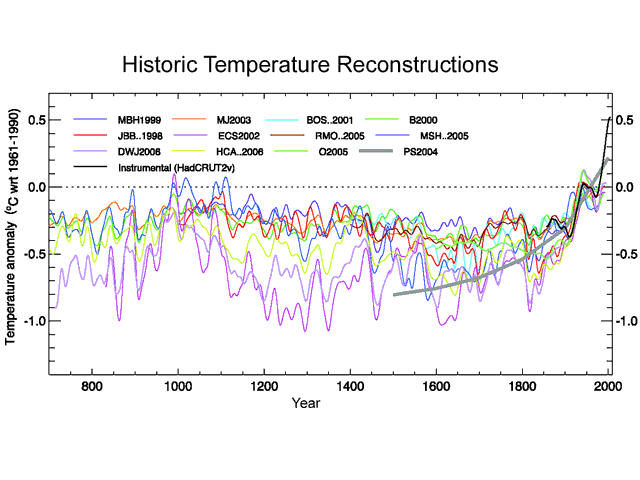
Below is the 1000-year temperature reconstruction (from proxies like tree rings and ice cores) in the Fourth IPCC Assessment.  It shows the results of twelve different studies, one of which is the Mann study famously named “the hockey stick.”

S_1000years

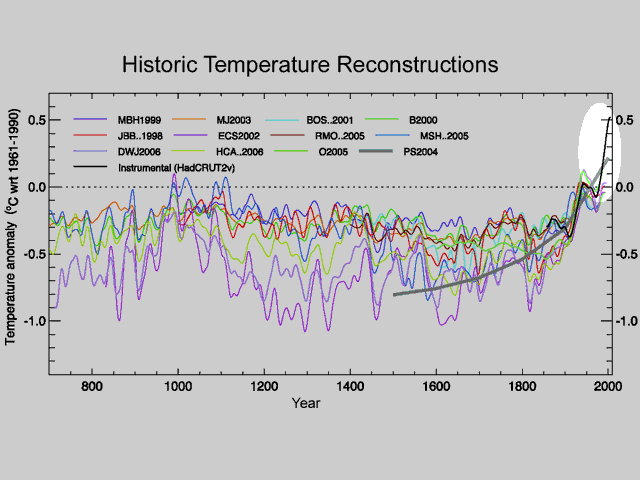
All the colored lines are the proxy (tree ring, ice cores, sediments, etc) study results.  The black line is the instrumental temperature record from the Hadley CRU.  There is no splice here – they have not joined proxy to instrument.  But they have effectively done so by overlaying the lines on top of each other.  The visual impact that says hockey stick is actually driven by this overlay.

S_1000years_inflection_high

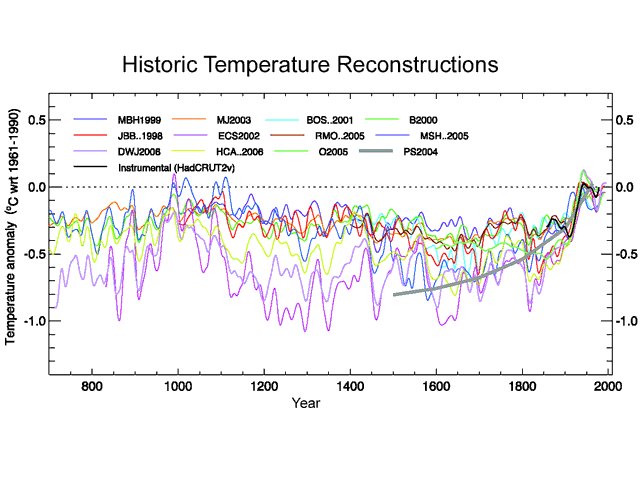
To prove it, lets remove the black instrumental temperature line as well as the gray line which I think is some kind of curve fitted to all of the above.  This is what we get:

S_1000years_inflection

Pretty different visual impact, huh?  The hockey stick is gone.  So in fact, the visual image of a hockey stick is driven by the overlay of the instrumental record on the proxies.  The hockey stick inflection point occurs right at the point the two lines join, raising the distinct possibility the inflection is due to incompatibility of the two data sources rather than a natural phenomenon.

More here.

Temperature Cycles

I have always been fascinated with the chart below, and the apparent strong correlation of global temperature changes and ocean cycles — particularly considering that ocean cycles are not included in climate cycles but never-the-less climate scientists act as if these models are accurate.

slide52

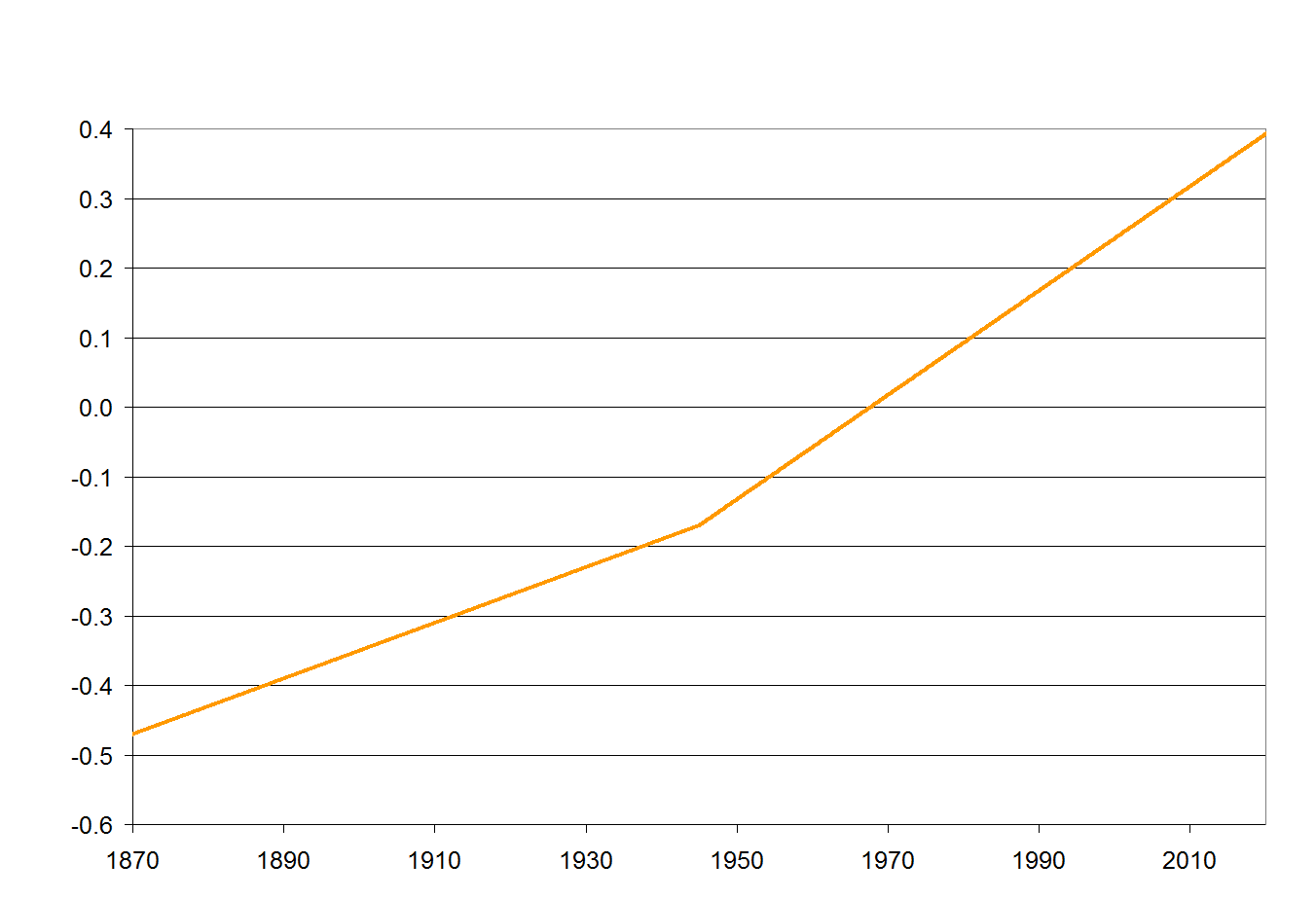
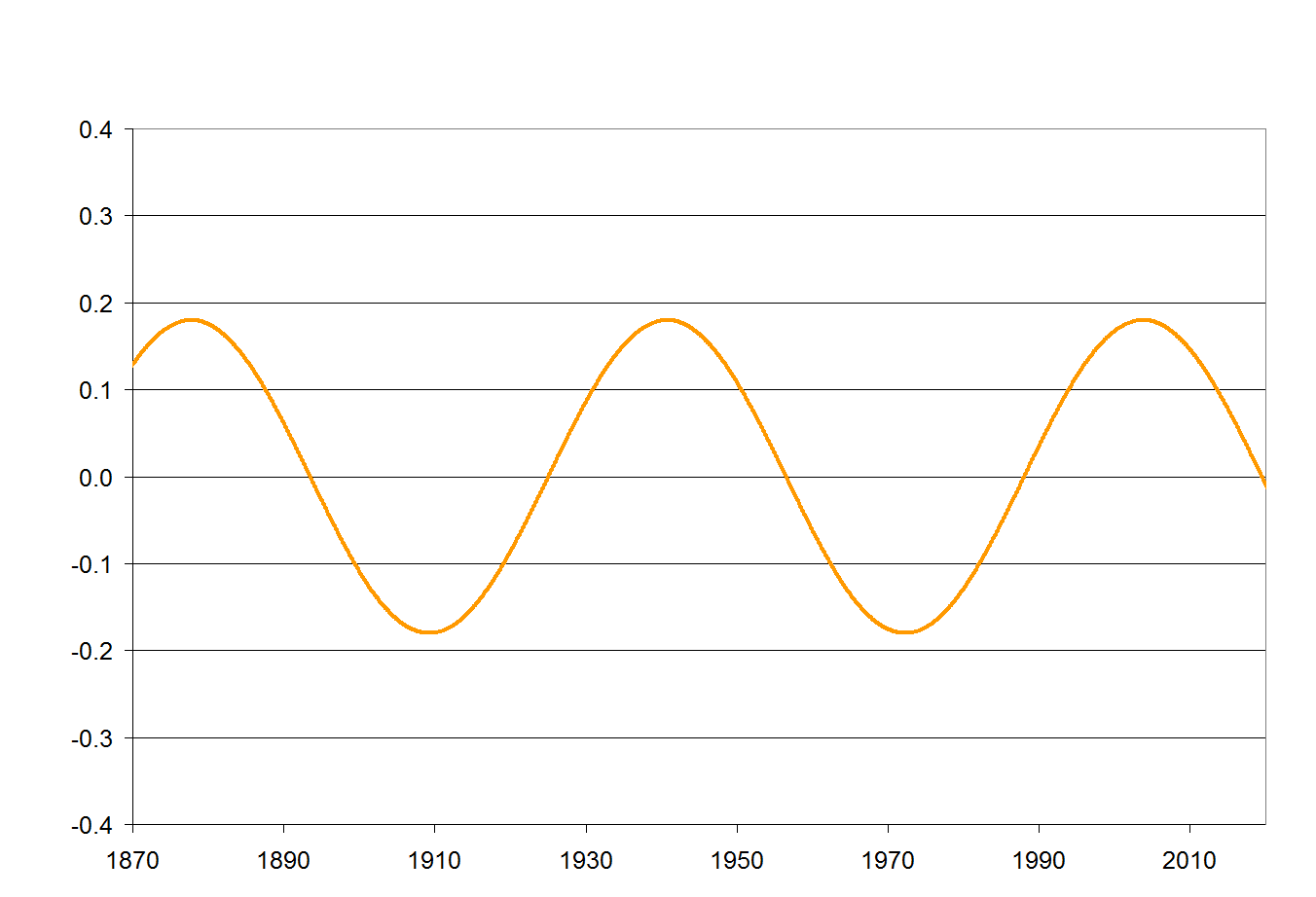
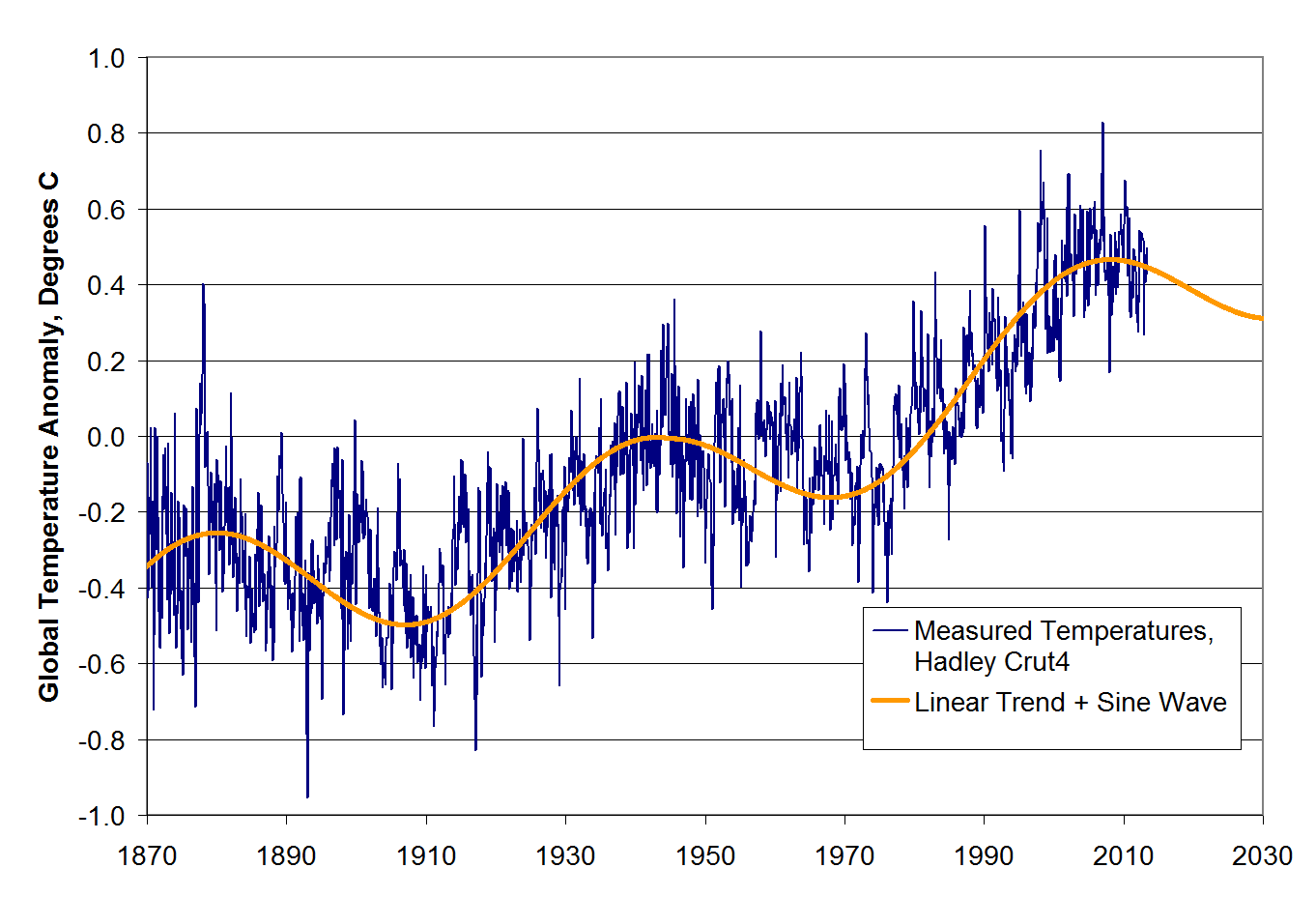
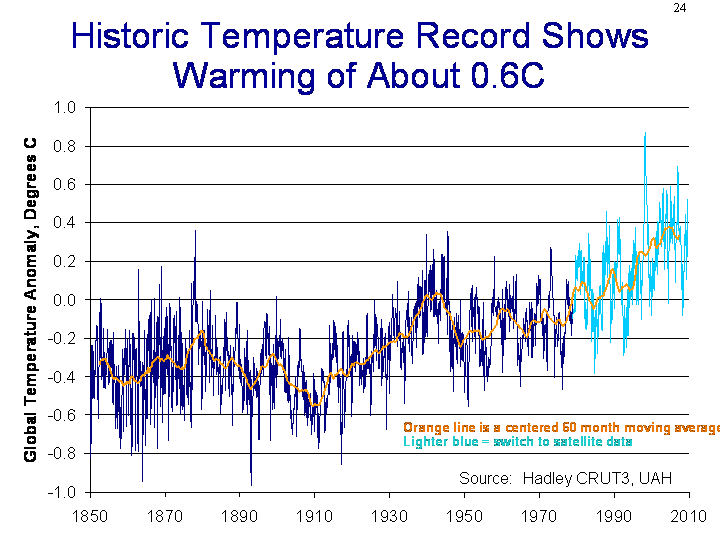
So, just for the fun of it, I tried to see if I could fit a linear trend plus a sine wave to historic temperature (similar to Klyashtorin and Lyubushin, 2003).  This is what we might see if temperature were a function of a constant recovery from the little ice age plus ocean cycles.  It is not the fit we would expect from an anthropogenic-driven model.  This is what I got  (temperature history a blend of Hadley CRUT3 and UAH satellite as shown here):

slide53

I didn’t spend a lot of time on it, and this is what I got — about 0.04C per decade linear trend plus a cycle.  This is one of those things that I can’t figure out if it is insightful or meaningless, but I thought I would share it with you this holiday week, since things are slow around the office here.

As a final set, I tried it again with a linear trend plus the PDO.

slide54

Update: The formula for the first chart is -0.55+0.005*(year-1861)+0.145*cos((2*pi*(year-1861)/64.1453)-1.8)

The formula for the second chart is -0.05+0.008*(year-1900)+0.2*PDO

Can’t Be Explained by Natural Causes

The fact that CO2 in the atmosphere can cause warming is fairly settled.  The question is, how much?  Is CO2 the leading driver of warming over the past century, or just an also-ran?

Increasingly, scientists justify the contention that CO2 was the primary driver of warming since 1950 by saying that they have attempted to model the warming of the last 50 years and they simply cannot explain the warming without CO2.

This has always struck me as an incredibly lame argument, as it implies that the models are an accurate representation of nature, which they likely are not.  We know that significant natural effects, such as the PDO and AMO are not well modelled or even considered at all in these models.

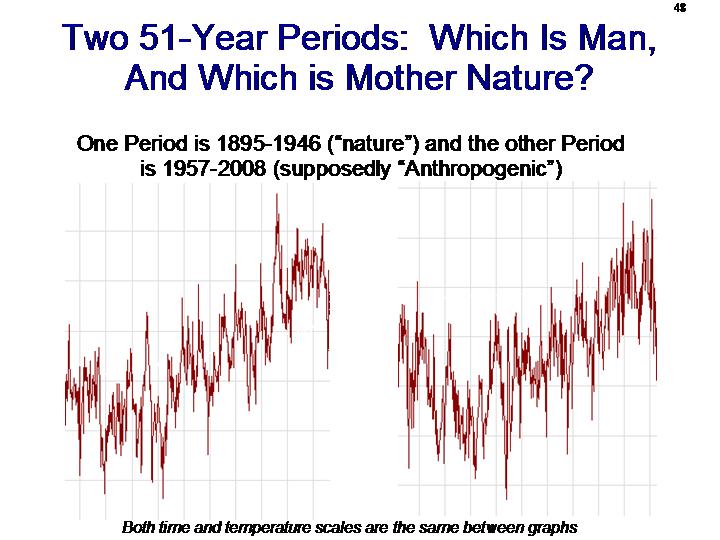
But for fun, lets attack the problem in a different way.  Below are two global temperature charts.  Both have the same scale, with time on the X-axis and temperature anomaly on the Y.   One is for the period from 1957-2008, what I will call the “anthropogenic” period because scientists claim that its slope can only be explained by anthropogenic factors.  The other is from 1895-1946, where CO2 emissions were low and whose behavior must almost certainly be driven by “nature” rather than man.

Sure, I am just a crazy denier, but they look really similar to me.  Why is it that one slope is explainable by natural factors but the other is not?  Especially since the sun in the later period was more active than it was in the earlier “natural” period.  So, which is which?

slide48

Continue reading ‘Can’t Be Explained by Natural Causes’ »

Regression Abuse

As I write this, I realize I go a long time without getting to climate.  Stick with me, there is an important climate point.

The process goes by a number of names, but multi-variate regression is a mathematical technique (really only made practical by computer processing power) of determining a numerical relationship between one output variable and one or more other input variables.

Regression is absolutely blind to the real world — it only knows numbers.  What do I mean by this?  Take the famous example of Washington Redskins football and presidential elections:

For nearly three quarters of a century, the Redskins have successfully predicted the outcome of each and every presidential election. It all began in 1933 when the Boston Braves changed their name to the Redskins, and since that time, the result of the team’s final home game before the election has always correctly picked who will lead the nation for the next four years.
And the formula is simple. If the Redskins win, the incumbent wins. If the Redskins lose, the challenger takes office.

Plug all of this into a regression and it would show a direct, predictive correlation between Redskins football and Presidential winners, with a high degree of certainty.  But we denizens of the real world would know that this is insane.  A meaningless coincidence with absolutely no predictive power.

You won’t often find me whipping out nuggets from my time at the Harvard Business School, because I have not always found a lot of that program to be relevant to my day-to-day business experience.  But one thing I do remember is my managerial economics teacher hammering us over and over with one caveat to regression analysis:

Don’t use regression analysis to go on fishing expeditions.  Include only the variables you have real-world evidence really affect the output variable to which you are regressing.

Let’s say one wanted to model the historic behavior of Exxon stock.  One approach would be to plug in a thousand or so variables that we could find in economics data bases and crank the model up and just see what comes out.  This is a fishing expedition.  With that many variables, by the math, you are almost bound to get a good fit (one characteristic of regressions is that adding an additional variable, no matter how irrelevant, always improves the fit).   And the odds are high you will end up with relationships to variables that look strong but are only coincidental, like the Redskins and elections.

Instead, I was taught to be thoughtful.  Interest rates, oil prices, gold prices, and value of the dollar are all sensible inputs to Exxon stock price.  But at this point my professor would have a further caveat.  He would say that one needs to have an expectation of the sign of the relationship.  In other words, I should have a theory in advance not just that oil prices affect Exxon stock price, but whether we expect higher oil prices to increase or decrease Exxon stock price.   In this he was echoing my freshman physics professor, who used to always say in the lab — if you are uncertain about the sign of a relationship, then you don’t really understand the process at all.

So lets say we ran the Exxon stock price model expecting higher oil prices to increase Exxon stock price, and our regression result actually showed the opposite, a strong relationship but with the opposite sign – higher oil prices seem to correlate better with lower Exxon stock price.  So do we just accept this finding?  Do we go out and bet a fortune on it tomorrow?  I sure wouldn’t.

No, what we do instead is take this as sign that we don’t know enough and need to research more.  Maybe my initial assumption was right, but my data is corrupt.  Maybe I was right about the relationship, but in the study period some other more powerful variable was dominating  (example – oil prices might have increased during the 1929 stock market crash, but all the oil company stocks were going down for other reasons).  It might be there is no relation between oil prices and Exxon stock prices.  Or it might be I was wrong, that in fact Exxon is dominated by refining and marketing rather than oil production and actually is worse off with higher oil prices.    But all of this points to needed research – I am not going to write an article immediately after my regression results pop out and say “New Study: Exxon stock prices vary inversely with oil prices” without doing more work to study what is going on.

Which brings us to climate (finally!) and temperature proxies.  We obviously did not have accurate thermometers measuring temperature in the year 1200, but we would still like to know something about temperatures.  One way to do this is to look at certain physical phenomenon, particularly natural processes that result in some sort of annual layers, and try to infer things from these layers.  Tree rings are the most common example – tree ring widths can be related to temperature and precipitation and other climate variables, so that by measuring tree ring widths (each of which can be matched to a specific year) we can infer things about climate in past years.

There are problems with tree rings for temperature measurement (not the least of which is that more things than just temperature affect ring width) so scientists search for other “proxies” of temperature.  One such proxy are lake sediments in certain northern lakes, which are layered like tree rings.  Scientists had a theory that the amount of organic matter in a sediment layer was related to the amount of growth activity in that year, which in term increased with temperature  (It is always ironic to me that climate scientists who talk about global warming catastrophe rely on increased growth and life in proxies to measure higher temperature).  Because more organic matter reduces x-ray density of samples, an inverse relationship between X-ray density and temperature could be formulated — in this case we will look at the Tiljander study of lake sediments.   Here is one core result:

picture1

The yellow band with lower X-ray density (meaning higher temperatures by the way the proxy is understood) corresponds pretty well with the Medieval Warm Period that is fairly well documented, at least in Europe (this proxy is from Finland).  The big drop in modern times is thought by most (including the original study authors) to be corrupted data, where modern agriculture has disrupted the sediments and what flows into the lake, eliminating its usefulness as a meaningful proxy.  It doesn’t mean that temperatures have dropped lately in the area.

But now the interesting part.  Michael Mann, among others, used this proxy series (despite the well-know corruption) among a number of others in an attempt to model the last thousand years or so of global temperature history.   To simplify what is in fact more complicated, his models regress each proxy series like this against measured temperatures over the last 100 years or so.  But look at the last 100 years on this graph.  Measured temperatures are going up, so his regression locked onto this proxy and … flipped the sign.  In effect, it reversed the proxy.  As far as his models are concerned, this proxy is averaged in with values of the opposite sign, like this:

picture2

A number of folks, particularly Steve McIntyre, have called Mann on this, saying that he can’t flip the proxy upside down.  Mann’s response is that the regression doesn’t care about the sign, and that its all in the math.

Hopefully, after our background exposition, you see the problem.  Mann started with a theory that more organic material in lake sediments (as shown by lower x-ray densities) correlated with higher temperatures.  But his regression showed the opposite relationship — and he just accepted this, presumably because it yielded the hockey stick shape he wanted.  But there is absolutely no physical theory as to why our historic understanding of organic matter deposition in lakes should be reversed, and Mann has not even bothered to provide one.  In fact, he says he doesn’t even need to.

This mistake (fraud?) is even more egregious because it is clear that the jump in x-ray values in recent years is due to a spurious signal and corruption of the data.  Mann’s algorithm is locking into meaningless noise, and converting it into a “signal” that there is a hockey stick shape to the proxy data.

As McIntyre concludes:

In Mann et al 2008, there is a truly remarkable example of opportunistic after-the-fact sign selection, which, in addition, beautifully illustrates the concept of spurious regression, a concept that seems to baffle signal mining paleoclimatologists.

Postscript: If you want an even more absurd example of this data-mining phenomenon, look no further than Steig’s study of Antarctic temperatures.   In the case of proxies, it is possible (though unlikely) that we might really reverse our understanding of how the proxy works based on the regression results. But in Steig, they were taking individual temperature station locations and creating a relationship between them to a synthesized continental temperature number.  Steig used regression techniques to weight various thermometers in rolling up the continental measure.  But five of the weights were negative!!

bar-plot-station-weights

As I wrote then,

Do you see the problem?  Five stations actually have negative weights!  Basically, this means that in rolling up these stations, these five thermometers were used upside down!  Increases in these temperatures in these stations cause the reconstructed continental average to decrease, and vice versa.  Of course, this makes zero sense, and is a great example of scientists wallowing in the numbers and forgetting they are supposed to have a physical reality.  Michael Mann has been quoted as saying the multi-variable regression analysis doesn’t care as to the orientation (positive or negative) of the correlation.  This is literally true, but what he forgets is that while the math may not care, Nature does.

Some Common Sense on Treemometers

I have written a lot about historic temperature proxies based on tree rings, but it all boils down to “trees make poor thermometers.”  There are just too many things, other than temperature, that can affect annual tree growth.  Anthony Watts has a brief article from one of his commenter that discusses some of these issues in a real-life way.  This in particular struck me as a strong dose of common sense:

The bristlecone records seemed a lousy proxy, because at the altitude where they grow it is below freezing nearly every night, and daytime temperatures are only above freezing for something like 10% of the year. They live on the borderline of existence, for trees, because trees go dormant when water freezes. (As soon as it drops below freezing the sap stops dripping into the sugar maple buckets.) Therefore the bristlecone pines were dormant 90% of all days and 99% of all nights, in a sense failing to collect temperature data all that time, yet they were supposedly a very important proxy for the entire planet. To that I just muttered “bunkum.”

He has more on Briffa’s increasingly famous single hockey stick tree.

More Hockey Stick Hyjinx

Update: Keith Briffa responds to the issues discussed below here.

Sorry I am a bit late with the latest hockey stick controversy, but I actually had some work at my real job.

At this point, spending much time on the effort to discredit variations of the hockey stick analysis is a bit like spending time debunking phlogiston as the key element of combustion.  But the media still seems to treat these analyses with respect, so I guess the effort is necessary.

Quick background:  For decades the consensus view was that earth was very warm during the middle ages, got cold around the 17th century, and has been steadily warming since, to a level today probably a bit short of where we were in the Middle Ages.  This was all flipped on its head by Michael Mann, who used tree ring studies to “prove” that the Medieval warm period, despite anecdotal evidence in the historic record (e.g. the name of Greenland) never existed, and that temperatures over the last 1000 years have been remarkably stable, shooting up only in the last 50 years to 1998 which he said was likely the hottest year of the last 1000 years.  This is called the hockey stick analysis, for the shape of the curve.

Since he published the study, a number of folks, most prominently Steve McIntyre, have found flaws in the analysis.  He claimed Mann used statistical techniques that would create a hockey stick from even white noise.  Further, Mann’s methodology took numerous individual “proxies” for temperatures, only a few of which had a hockey stick shape, and averaged them in a way to emphasize the data with the hockey stick.  Further, Mann has been accused of cherry-picking — leaving out proxy studies that don’t support his conclusion.  Another problem emerged as it became clear that recent updates to his proxies were showing declining temperatures, what is called “divergence.”  This did not mean that the world was not warming, but did mean that trees may not be very good thermometers.  Climate scientists like Mann and Keith Briffa scrambled for ways to hide the divergence problem, and even truncated data when necessary.  More hereMann has even flipped the physical relationship between a proxy and temperature upside down to get the result he wanted.

Since then, the climate community has tried to make itself feel better about this analysis by doing it multiple times, including some new proxies and new types of proxies (e.g. sediments vs. tree rings).  But if one looks at the studies, one is struck by the fact that its the same 10 guys over and over, either doing new versions of these studies or reviewing their buddies studies.  Scrutiny from outside of this tiny hockey stick society is not welcome.  Any posts critical of their work are scrubbed from the comment sections of RealClimate.com (in contrast to the rich discussions that occur at McIntyre’s site or even this one) — a site has even been set up independently to archive comments deleted from Real Climate.  This is a constant theme in climate.  Check this policy out — when one side of the scientific debate allows open discussion by all comers, and the other side censors all dissent, which do you trust?

Anyway, all these studies have shared a couple of traits in common:

  • They have statistical methodologies to emphasize the hockey stick
  • They cherry pick data that will support their hypothesis
  • They refuse to archive data or make it available for replication

The some extent, the recent to-do about Briffa and the Yamal data set have all the same elements.  But this one appears to have a new one — not only are the data sets cherry-picked, but there is growing evidence that the data within a data set has been cherry picked.

Yamal is important for the following reason – remember what I said above about just a few data sets driving the whole hockey stick.  These couple of data sets are the crack cocaine to which all these scientists are addicted.  They are the active ingredient.  The various hockey stick studies may vary in their choice of proxy sets, but they all include a core of the same two or three that they know with confidence will drive the result they want, as long as they are careful not to water them down with too many other proxies.

Here is McIntyre’s original post.   For some reason, the data set Briffa uses falls off to ridiculously few samples in recent years (exactly when you would expect more).  Not coincidentally, the hockey stick appears exactly as the number of data points falls towards 10 and then 5 (from 30-40).  If you want a longer, but more layman’s view, Bishop Hill blog has summarized the whole storyUpdateMore here, with lots of the links I didn’t have time this morning to find.

Postscript: When backed against the wall with no response, the Real Climate community’s ultimate response to issues like this is “Well, it doesn’t matter.”  Expect this soon.

Update: Here are the two key charts, as annotated by JoNova:

rcs_chronologies1v2

And it “matters”

yamal-mcintyre-fig2

More Proxy Hijinx

Steve McIntyre digs into more proxy hijinx from the usual suspects.  This is a pretty good summary of what he tends to find, time and again in these studies:

The problem with these sorts of studies is that no class of proxy (tree ring, ice core isotopes) is unambiguously correlated to temperature and, over and over again, authors pick proxies that confirm their bias and discard proxies that do not. This problem is exacerbated by author pre-knowledge of what individual proxies look like, leading to biased selection of certain proxies over and over again into these sorts of studies.

The temperature proxy world seems to have developed into a mono-culture, with the same 10 guys creating new studies, doing peer review, and leading IPCC sub-groups.  The most interesting issue McIntyre raises is that this new study again uses proxy’s “upside down.”  I explained this issue more here and here, but a summary is:

Scientists are trying to reconstruct past climate variables like temperature and precipitation from proxies such as tree rings.  They begin with a relationship they believe exists based on a physical understanding of a particular system – ie, for tree rings, trees grow faster when its warm so tree rings are wider in warm years.  But as they manipulate the data over and over in their computers, they start to lose touch with this physical reality.

…. in one temperature reconstruction, scientists have changed the relationship opportunistically between the proxy and temperature, reversing their physical understanding of the process and how similar proxies are handled in the same study, all in order to get the result they want to get.

So Why Bother?

I just watched Peter Sinclair’s petty little video on Anthony Watt’s effort to survey and provide some level of quality control on the nation’s surface temperature network.  Having participated in the survey, I was going to do a rebuttal video from my own experience, but I just don’t have the time, but I want to offer a couple of quick thoughts.

  • Will we ever see an alarmist be able to address any skeptics critique of AGW science without resorting to ad hominem attacks?  I guess the whole “oil industry funding” thing is a base requirement for any alarmist article, but this guy really gets extra credit for the tobacco industry comparison.  Seriously, do you guys really think this addresses the issue?
  • I am fairly sure that Mr. Watt would not deny that the world has warmed over the last 100 years, though he might argue that warming has been exaggerated somewhat.  Certainly satellites are immune to the biases and problems Mr. Watt’s group is identifying, and they still show warming  (though less than the surface temperature networks is showing).
  • The video tries to make Watt’s volunteers sound like silly children at camp, but in fact weather measurement and data collection in this country have a long history of involvement and leadership by volunteers and amateurs.
  • The core point that really goes unaddressed is that the government, despite spending billions of dollars on AGW-related projects, is investing about zero in quality control of the single most critical data set to the current public policy decisions.   Many of the sites are absolutely inexcusable, EVEN against the old goals of reporting weather rather than measuring climate change.  I surveyed the Tucson site – it is a joke.
  • Mr. Sinclair argues that the absolute value of the temperatures does not matter as much as their changes over time.  Fine, I would agree.  But again, he demonstrates his ignorance.  This is an issue Anthony and most of his readers discuss all the time.  When, for example, we talk about the really biased site at Tucson, it is always in the context of the fact that 100 years ago Tucson was a one horse town, and so all the urban heat biases we might find in a badly sited urban location have been introduced during the 20th century measurement period.  These growing biases show up in the measurements as increasing temperatures.  And the urban heat island effects are huge.  My son and I personally measured about 10F in the evening.  Even if this was only at Tmin, and was 0 effect at Tmax  (daily average temps are the average of Tmin and Tmax) then this would still introduce a bias of 5F today that was surely close to zero a hundred years ago.
  • Mr. Sinclair’s knowledge about these issues is less than one of our readers might have had 3 years ago.  He says we should be satisfied with the data quality because the government promises that it has adjusted for these biases.  But these very adjustments, and the inadequacy of the process, is one reason for Mr. Watt’s efforts.  If Mr. Sinclair had bothered to educate himself, he would know that many folks have criticized these adjustments because they are done blind, without any reference to actual station quality or details, by statistical processes.  But without the knowledge of which stations have better installations, the statistical processes tend to spread the bias around like peanut butter, rather than really correct for it, as demonstrated here for Tucson and the Grand Canyon (both of these stations I have personally visited).
  • The other issue one runs into in trying to correct for a bad site through adjustments is the signal to noise problem.  The world global warming signal over the last 100 years has been no more than 1 degree F.  If urban heat biases are introducing a 5,8, or 10 degree bias, then the noise, and thus the correction factor, is 5-10 times larger than the signal.   In practical terms, this means a 10-20% error in the correction factor can completely overwhelm the signal one is trying to detect.  And since most of the correction factors are not much better than educated guesses, their errors are certainly higher than this.
  • Overall Mr. Sinclair’s point seems to be that the quality of the stations does not matter.  I find that incredible, and best illustrated with an example.  The government makes decisions about the economy and interest rates and taxes and hundreds of other programs based on detailed economic data.  Let’s say that instead of sampling all over Arizona, they just sampled in one location, say Paradise Valley zip code 85253.  Paradise Valley happens to be (I think) the wealthiest zip code in the state.  So, if by sampling only in Paradise Valley, the government decides that everyone is fine and no one needs any government aid, would Mr. Sinclair be happy?  Would this be “good enough?”  Or would we demand an investment in a better data gathering network that was not biased towards certain demographics to make better public policy decisions involving hundreds of billions of dollars?

GCCI #5: The Dog That Didn’t Bark

The GCCI is mainly focused on creating a variety of future apocalyptic narratives.  However, it was interesting none-the-less for what was missing:  No hockey stick, and no Co2/temperature 600,000 year ice core chart.  Have we finally buried these chestnuts, or were they thought unnecessary as the report really expends no effort defending the existence of warming.

Forgetting About Physical Reality

Sometimes in modeling and data analysis one can get so deep in the math that one forgets there is a physical reality those numbers are supposed to represent.  This is a common theme on this site, and a good example was here.

Jeff Id, writing at Watts Up With That, brings us another example from Steig’s study on Antarctic temperature changes.  In this study, one step Steig takes is to reconstruct older, pre-satellite continental temperature  averages from station data at a few discrete stations.  To do so, he uses more recent data to create weighting factors for the individual stations.  In some sense, this is basically regression analysis, to see what combination of weighting factors times station data since 1982 seems to be fit with continental averages from the satellite.

Here are the weighting factors the study came up with:

bar-plot-station-weights

Do you see the problem?  Five stations actually have negative weights!  Basically, this means that in rolling up these stations, these five thermometers were used upside down!  Increases in these temperatures in these stations cause the reconstructed continental average to decrease, and vice versa.  Of course, this makes zero sense, and is a great example of scientists wallowing in the numbers and forgetting they are supposed to have a physical reality.  Michael Mann has been quoted as saying the multi-variable regression analysis doesn’t care as to the orientation (positive or negative) of the correlation.  This is literally true, but what he forgets is that while the math may not care, Nature does.

For those who don’t follow, let me give you an example.  Let’s say we have market prices in a number of cities for a certain product, and we want to come up with an average.  To do so, we will have to weight the various local prices based on sizes of the city or perhaps populations or whatever.  But the one thing we can almost certainly predict is that none of the individual city weights will be negative.  We won’t, for example, ever find that the average western price of a product goes up because one component of the average, say the price in Portland, goes down.  This flies in the face of our understanding of how an arithmetic average should work.

It may happen that in a certain time periods, the price in Portland goes down in the same month as the Western average went up, but the decline in price in Portland did not drive the Western average up — in fact, its decline had to have actually limited the growth of the Western average below what it would have been had Portland also increased.   Someone looking at that one month and not understanding the underlying process might draw the conclusion that prices in Portland were related to the Western average price by a negative coefficient, but that conclusion would be wrong.

The Id post goes on to list a number of other failings of the Steig study on Antarctica, as does this post.  Years ago I wrote an article arguing that while the GISS and other bodies claim they have a statistical method for eliminating individual biases of measurement stations in their global averages, it appeared to me that all they were doing was spreading the warming bias around a larger geographic area like peanut butter.  Steig’ study appears to do the same thing, spreading the warming from the Antarctic Peninsula across the whole continent, in part based on its choice to use just three PC’s, a number that is both oddly small and coincidentally exactly the choice required to get the maximum warming value from their methodology.

Numbers Divorced from Reality

This article on Climate Audit really gets at an issue that bothers many skeptics about the state of climate science:  the profession seems to spend so much time manipulating numbers in models and computer systems that they start to forget that those numbers are supposed to have physical meaning.

I discussed the phenomenon once before.  Scientists are trying to reconstruct past climate variables like temperature and precipitation from proxies such as tree rings.  They begin with a relationship they believe exists based on an understanding of a particular system – ie, for tree rings, trees grow faster when its warm so tree rings are wider in warm years.  But as they manipulate the data over and over in their computers, they start to lose touch with this physical reality.

In this particular example, Steve McIntyre shows how, in one temperature reconstruction, scientists have changed the relationship opportunistically between the proxy and temperature, reversing their physical understanding of the process and how similar proxies are handled in the same study, all in order to get the result they want to get.

McIntyre’s discussion may be too arcane for some, so let me give you an example.  As a graduate student, I have been tasked with proving that people are getting taller over time and estimating by how much.  As it turns out, I don’t have access to good historic height data, but by a fluke I inherited a hundred years of sales records from about 10 different shoe companies.  After talking to some medical experts, I gain some confidence that shoe size is positively correlated to height.  I therefore start collating my 10 series of shoe sales data, pursuing the original theory that the average size of the shoe sold should correlate to the average height of the target population.

It turns out that for four of my data sets, I find a nice pattern of steadily rising shoe sizes over time, reflecting my intuition that people’s height and shoe size should be increasing over time.  In three of the data sets I find the results to be equivical — there is no long-term trend in the sizes of shoes sold and the average size jumps around a lot.  In the final three data sets, there is actually a fairly clear negative trend – shoe sizes are decreasing over time.

So what would you say if I did the following:

  • Kept the four positive data sets and used them as-is
  • Threw out the three equivocal data sets
  • Kept the three negative data sets, but inverted them
  • Built a model for historic human heights based on seven data sets – four with positive coefficients between shoe size and height and three with negative coefficients.

My correlation coefficients are going to be really good, in part because I have flipped some of the data sets and in part I have thrown out the ones that don’t fit initial bias as to what the answer should be.  Have I done good science?  Would you trust my output?  No?

Well what I describe is identical to how many of the historical temperature reconstruction studies have been executed  (well, not quite — I have left out a number of other mistakes like smoothing before coefficients are derived and using de-trended data).

Mann once wrote that multivariate regression methods don’t care about the orientation of the proxy. This is strictly true – the math does not care. But people who recognize that there is an underlying physical reality that makes a proxy a proxy do care.

It makes no sense to physically change the sign of the relationship of our final three shoe databases.  There is no anatomical theory that would predict declining shoe sizes with increasing heights.  But this seems to happen all the time in climate research.  Financial modellers who try this go bankrupt.  Climate modellers who try this to reinforce an alarmist conclusion get more funding.  Go figure.