Sorry Dr. Schmidt, But I am Not Feeling Guilty Yet (Part 1)

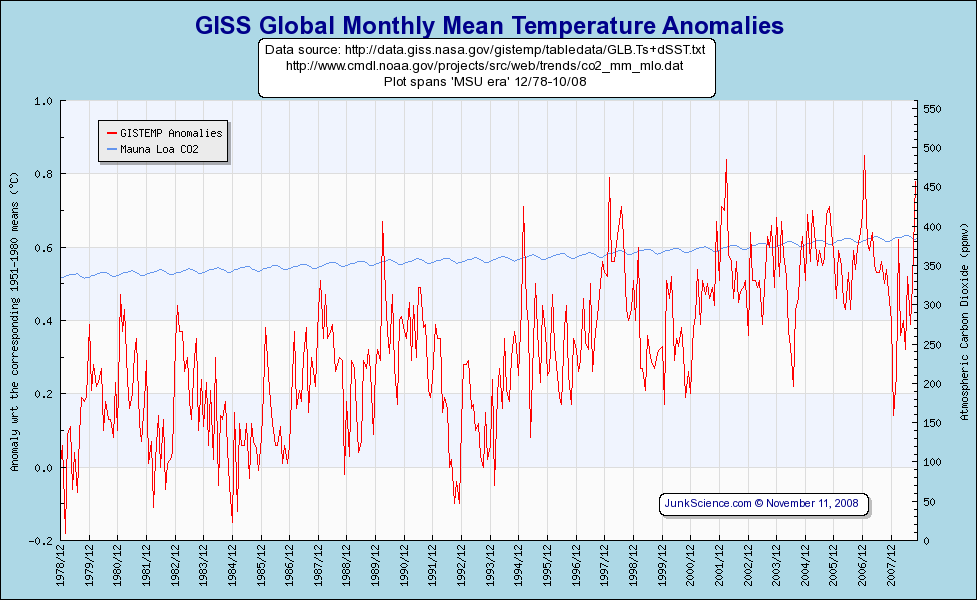
By accident, I have been drawn into a discussion surrounding a fairly innocent mistake made by NASA’s GISS in their October global temperature numbers.  It began for me when I compared the October GISS and UAH satellite numbers for October, and saw an incredible diversion.  For years these two data sets have shown a growing gap, but by tiny increments.  But in October they really went in opposite directions.  I used this occasion to call on the climate community to make a legitimate effort at validating and reconciling the GISS and satellite data sets.

Within a day of my making this post, several folks started noticing some oddities in the GISS October data, and eventually the hypothesis emerged that the high number was the result of reusing September numbers for certain locations in the October data set. Oh, OK.  A fairly innocent and probably understandable mistake, and far more minor than the more systematic error a similar group of skeptics, (particularly Steve McIntyre, the man whose name the GISS cannot speak) found in the GISS data set a while back.  The only amazing thing to me was not the mistake, but the fact that there were laymen out there on their own time who figured out the error so quickly after the data release.  I wish there were a team of folks following me around, fixing material errors in my analysis before I ran too far with it.

So Gavin Schmidt of NASA comes out a day or two later and says, yep, they screwed up.  End of story, right?  Except Dr. Schmidt chose his blog post about the error to lash out at skeptics.  This is so utterly human — in the light of day, most will admit it is a bad idea to lash out at your detractors in the same instant you admit they caught you in an error (however minor).  But it is such a human need to try to recover and sooth one’s own ego at exactly this same time.  And thus we get Gavin Schmidt’s post on RealClimate.com, which I would like to highlight a bit below.

He begins with a couple of paragraphs on the error itself.  I will skip these, but you are welcome to check them out at the original.  Nothing about the error seems in any way outside the category of “mistakes happen.”  Had the post ended with something like “Many thanks to the volunteers who so quickly helped us find this problem,” I would not even be posting.  But, as you can guess, this is not how it ends.

It’s clearly true that the more eyes there are looking, the faster errors get noticed and fixed. The cottage industry that has sprung up to examine the daily sea ice numbers or the monthly analyses of surface and satellite temperatures, has certainly increased the number of eyes and that is generally for the good. Whether it’s a discovery of an odd shiftin the annual cycle in the UAH MSU-LT data, or this flub in the GHCN data, or the USHCN/GHCN merge issue last year, the extra attention has led to improvements in many products. Nothing of any consequence has changed in terms of our understanding of climate change, but a few more i’s have been dotted and t’s crossed.

Uh, OK, but it is a bit unfair to characterize the “cottage industry” looking over Hansen’s and Schmidt’s shoulders as only working out at the third decimal place.  Skeptics have pointed out what they consider to be fundamental issues in some of their analytical approaches, including their methods for compensating statistically for biases and discontinuities in measurement data the GISS rolls up into a global temperature anomaly.  A fairly large body of amateur and professional work exists questioning the NOAA and GISS methodologies which often result in manual adjustments to the raw data larger in magnitude than the underlying warming signal tyring to be measured.  I personally think there is a good case to be made that the GISS approach is not sufficient to handle this low signal to noise data, and that the GISS has descended in to “see no evil, hear no evil” mode in ignoring the station survey approach being led by Anthony Watt.  Just because Schmidt does not agree doesn’t mean that the cause of climate science is not being advanced.

The bottom line, as I pointed out in my original post, is that the GISS anomaly and the satellite-measured anomaly are steadily diverging.  Given some of the inherent biases and problems of surface temperature measurement, and NASA’s commitment to space technology as well as its traditional GISS metric, its amazing to me that Schmidt and Hansen are effectively punting instead of doing any serious work to reconcile the two metrics.  So it is not surprising that into this vacuum left by Schmidt rush others, including us lowly amateurs.
By the way, this is the second time in about a year when the GISS has admitted an error in their data set, but petulently refused to mention the name of the person who helped them find it.

But unlike in other fields of citizen-science (astronomy or phenology spring to mind), the motivation for the temperature observers is heavily weighted towards wanting to find something wrong. As we discussed last year, there is a strong yearning among some to want to wake up tomorrow and find that the globe hasn’t been warming, that the sea ice hasn’t melted, that the glaciers have not receded and that indeed, CO2is not a greenhouse gas. Thus when mistakes occur (and with science being a human endeavour, they always will) the exuberance of the response can be breathtaking – and quite telling.

I am going to make an admission here that Dr. Schmidt very clear thinks is evil:  Yes, I want to wake up tomorrow to proof that the climate is not changing catastrophically.  I desperately hope Schmidt is overestimating future anthropogenic global warming.  Here is something to consider.  Take two different positions:

  1. I hope global warming theory is correct and the world faces stark tradeoffs between environmental devastation and continued economic growth and modern prosperity
  2. I hope global warming theory is over-stated and that these tradeoffs are not as stark.

Which is more moral?  Why do I have to apologize for being in camp #2?  Why isn’t it equally “telling” that Dr. Schmidt apparently puts himself in camp #1.

Of course, we skeptics would say the same of Schmidt.  As much as we like to find a cooler number, we believe he wants to find a warmer number.  Right or wrong, most of us see a pattern in the fact that the GISS seems to constantly find ways to adjust the numbers to show a larger historic warming, but require a nudge from outsiders to recognize when their numbers are too high.  The fairest way to put it is that one group expects to see lower numbers and so tends to put more scrutiny on the high numbers, and the other does the opposite.

Really, I don’t think that Dr. Schmidt is a very good student of the history of science when he argues that this is somehow unique to or an aberration in modern climate science.  Science has often depended on rivalries to ensure that skepticism is applied to both positive and negative results of any experiment.  From phlogistan to plate techtonics, from evolution to string theory, there is really nothing new in the dynamic he describes.

A few examples from the comments at Watt’s blog will suffice to give you a flavour of the conspiratorial thinking: “I believe they had two sets of data: One would be released if Republicans won, and another if Democrats won.”, “could this be a sneaky way to set up the BO presidency with an urgent need to regulate CO2?”, “There are a great many of us who will under no circumstance allow the oppression of government rule to pervade over our freedom—-PERIOD!!!!!!” (exclamation marks reduced enormously), “these people are blinded by their own bias”, “this sort of scientific fraud”, “Climate science on the warmer side has degenerated to competitive lying”, etc… (To be fair, there were people who made sensible comments as well).

Dr. Schmidt, I am a pretty smart person.  I have lots of little diplomas on my wall with technical degrees from Ivy League universities.  And you know what – I am sometimes blinded by my own biases.  I consider myself a better thinker, a better scientist, and a better decision-maker because I recognize that fact.  The only person who I would worry about being biased is the one who swears that he is not.

By the way, I thought the little game of mining the comments section of Internet blogs to discredit the proprietor went out of vogue years ago, or at least has been relegated to the more extreme political  blogs like Kos or LGF.  Do you really think I could not spend about 12 seconds poking around environmentally-oriented web sites and find stuff just as unfair, extreme, or poorly thought out?

The amount of simply made up stuff is also impressive – the GISS press release declaring the October the ‘warmest ever’? Imaginary (GISS only puts out press releases on the temperature analysis at the end of the year). The headlines trumpeting this result? Non-existent. One clearly sees the relief that finally the grand conspiracy has been rumbled, that the mainstream media will get it’s comeuppance, and that surely now, the powers that be will listen to those voices that had been crying in the wilderness.

I am not quite sure what he is referring to here.  I will repeat what I wrote.  I said “The media generally uses the GISS data, so expect stories in the next day or so trumpeting ‘Hottest October Ever.'”  I leave it to readers to decide if they find my supposition unwarranted.  However, I encourage the reader to consider the 556,000 Google results, many media stories, that come up in a search for the words “hottest month ever.”  Also, while the GISS may not issue monthly press releases for this type of thing, the NOAA and British Met Office clearly do, and James Hansen has made many verbal statements of this sort in the past.

By the way, keep in mind that that Dr. Schmidt likes to play Clinton-like games with words.  I recall one episode last year when he said that climate models did not use the temperature station data, so they cannot be tainted with any biases found in the stations.  Literally true, I guess, because the the models use gridded cell data.  However, this gridded cell data is built up, using a series of correction and smoothing algorithms that many find suspect, from the station data.  Keep this in mind when parsing Dr. Schmidt.

Alas! none of this will come to pass. In this case, someone’s programming error will be fixed and nothing will change except for the reporting of a single month’s anomaly. No heads will roll, no congressional investigations will be launched, no politicians (with one possible exception) will take note. This will undoubtedly be disappointing to many, but they should comfort themselves with the thought that the chances of this error happening again has now been diminished. Which is good, right?

I’m narrowly fine with the outcome.  Certainly no heads should roll over a minor data error.  I’m not certain no one like Watt or McIntyre suggested such a thing.  However, the GISS should be embarrassed that they have not addressed and been more open about the issues in their grid cell correction/smoothing algorithms, and really owe us an explanation why no one there is even trying to reconcile the growing differences with satellite data.

In contrast to this molehill, there is an excellent story about how the scientific community really deals with serious mismatches between theory, models and data. That piece concerns the ‘ocean cooling’ story that was all the rage a year or two ago. An initial analysisof a new data source (the Argo float network) had revealed a dramatic short term cooling of the oceans over only 3 years. The problem was that this didn’t match the sea level data, nor theoretical expectations. Nonetheless, the paper was published (somewhat undermining claims that the peer-review system is irretrievably biased) to great acclaim in sections of the blogosphere, and to more muted puzzlement elsewhere. With the community’s attention focused on this issue, it wasn’t however long before problemsturned up in the Argo floats themselves, but also in some of the other measurement devices – particularly XBTs. It took a couple of years for these things to fully work themselves out, but the most recent analysesshow far fewer of the artifacts that had plagued the ocean heat content analyses in the past. A classic example in fact, of science moving forward on the back of apparent mismatches. Unfortunately, the resolution ended up favoring the models over the initial data reports, and so the whole story is horribly disappointing to some.

OK, fine, I have no problem with this.  However, and I am sure that Schmidt would deny this to his grave, but he is FAR more supportive of open inspection of measurement sources that disagree with his hypothesis (e.g. Argo, UAH) than he is willing to tolerate scrutiny of his methods.  Heck, until last year, he wouldn’t even release most of his algorithms and code for his grid cell analysis that goes into the GISS metric, despite the fact he is a government employee and the work is paid for with public funds.  If he is so confident, I would love to see him throw open the whole GISS measurement process to an outside audit.  We would ask the UAH and RSS guys to do the same.  Here is my prediction, and if I am wrong I will apologize to Dr. Schmidt, but I am almost positive that while the UAH folks would say yes, the GISS would say no.  The result, as he says, would likely be telling.

Which brings me to my last point, the role of models. It is clear that many of the temperature watchers are doing so in order to show that the IPCC-class models are wrong in their projections. However, the direct approach of downloading those models, running them and looking for flaws is clearly either too onerous or too boring. Even downloading the output (from here or here) is eschewed in favour of firing off Freedom of Information Act requests for data already publicly available – very odd. For another example, despite a few comments about the lack of sufficient comments in the GISS ModelE code (a complaint I also often make), I am unaware of anyone actually independently finding any errors in the publicly available Feb 2004 version (and I know there are a few). Instead, the anti-model crowd focuses on the minor issues that crop up every now and again in real-time data processing hoping that, by proxy, they’ll find a problem with the models.

I say good luck to them. They’ll need it.

Red Alert!  Red Alert!  Up to this point, the article was just petulant and bombastic.  But here, Schmidt becomes outright dangerous, suggesting a scientific process that is utterly without merit.  But I want to take some time on this, so I will pull this out into a second post I will label part 2.
This is Getting Absurd

Update: The gross divergence in October data reported below between the various metrics is explained by an error, as reported at the bottom.  The basic premise of the post, that real scientific work should go into challenging these measurement approaches and choosing the best data set, remains.

The October global temperature data highlights for me that it is time for scientists to quit wasting time screwing around with questions of whether global warming will cause more kidney stones, and address an absolutely fundamental question:  Just what is the freaking temperature?

Currently we are approaching the prospect of spending hundreds of billions of dollars, or more, to combat global warming, and we don’t even know its magnitude or real trend, because the major temperature indices we possess are giving very different readings.  To oversimplify a bit, there are two competing methodologies that are giving two different answers.  NASA’s GISS uses a melding of surface thermometer readings around the world to create a global temperature anomaly.  And the UAH uses satellites to measure temperatures of the lower or near-surface troposhere.  Each thinks it has the better methodology  (with, oddly, NASA fighting against the space technology).  But they are giving us different answers.

For October, the GISS metric is showing the hottest October on record, nearly 0.8C hotter than it was 40 years ago in 1978 (from here).

giss_global

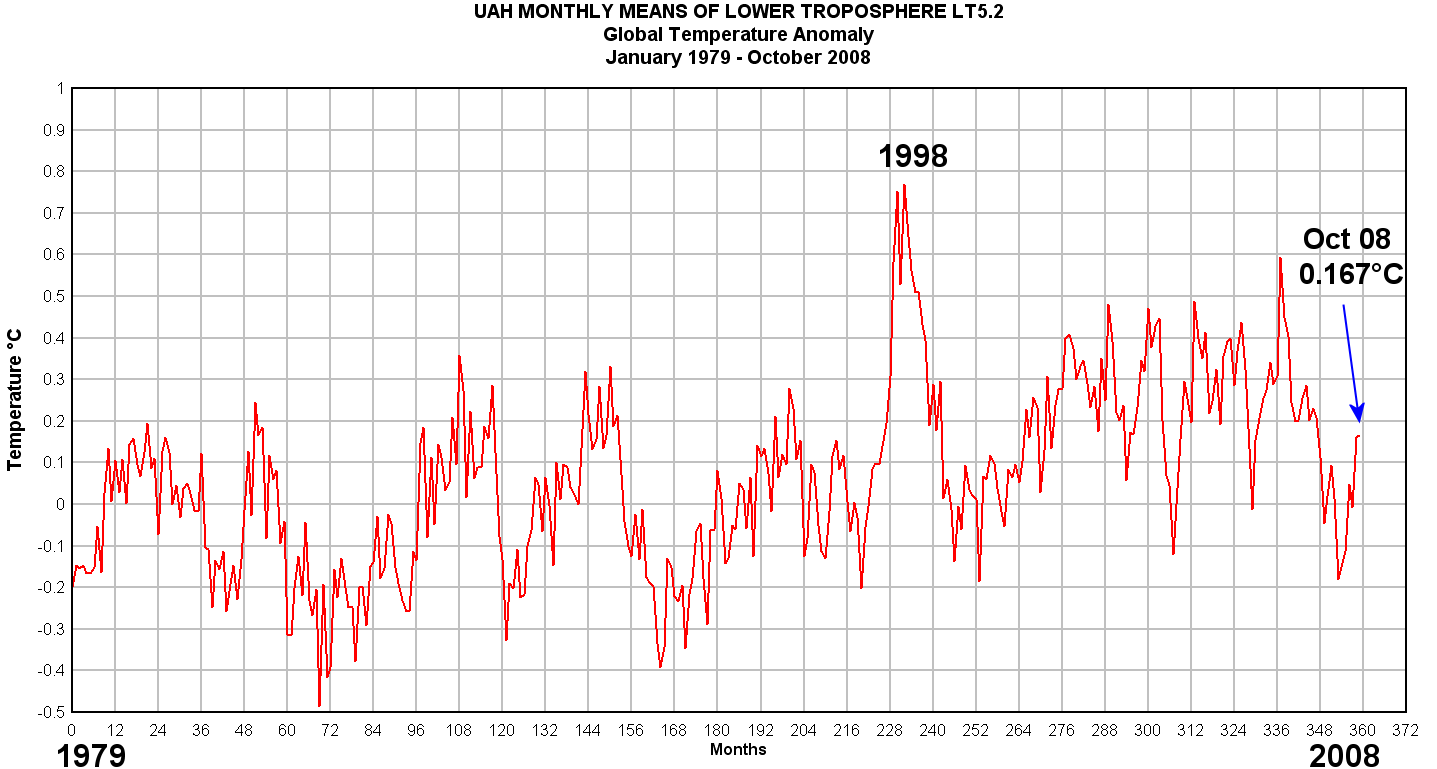
However, the satellites are showing no such thing, showing a much cooler October, and a far smaller warming trend over the last 40 years (from here)

uah_global

So which is right?  Well, the situation is not helped by the fact that the GISS metric is run by James Hansen, considered by skeptics to be a leading alarmist, and the UAH is run by John Christy, considered by alarmists to be an arch-skeptic.  The media generally uses the GISS data, so expect stories in the next day or so trumpeting “Hottest October Ever,” which the Obama administration will wave around as justification for massive economic interventions.  But by satellite it will only be the 10th or so hottest in the last 30, and probably cooler than most other readings this century.

It is really a very frustrating situation.  It is as if two groups in the 17th century had two very different sets of observations of planetary motions that resulted in two different theories of gravity,

Its amazing to me the scientific community doesn’t try to take this on.  If the NOAA wanted to do something useful other than just creating disaster pr0n, it could actually have a conference on the topic and even some critical reviews of each approach.  Why not have Christy and Hansen take turns in front of the group and defend their approaches like a doctoral thesis?  Nothing can replace surface temperature measurement before 1978, because we do not have satellite data before then.  But even so, discussion of earlier periods is important given issues with NOAA and GISS manual adjustments to the data.

Though I favor the UAH satellite data (and prefer a UAH – Hadley CRUT3 splice for a longer time history), I’ll try to present as neutrally as possible the pros and cons of each approach.

GISS Surface Temperature Record

+  Measures actual surface temperatures

+  Uses technologies that are time-tested and generally well-understood

+  Can provide a 100+ year history

– Subject to surface biases, including urban heat bias.  Arguments rage as to the size and correctability of these biases

– Coverage can range from dense to extremely spotty, with as little as 20KM and as much as 1000KM between measurement sites

– Changing technologies and techniques, both at sea and on land, have introduced step-change biases

– Diversity of locations, management, and technology makes it hard to correct for individual biases

– Manual adjustments to the data to correct errors and biases are often as large or larger than the magnitude of the signal (ie global warming) trying to be measured.  Further, this adjustment process has historically been shrouded in secrecy and not subject to much peer review

– Most daily averages based on average of high and low temperature, not actual integrated average

UAH Satellite Temperature Record

+  Not subject to surface biases or location biases

+  Good global coverage

+  Single technology and measurement point such that discovered biases or errors are easier to correct

–  Only 40 years of history

–  Still building confidence in the technology

–  Coverage of individual locations not continuous – dependent on satellite passes.

–  Not measuring the actual surface temperature, but the lower troposphere (debate continues as to whether these are effectively the same).

–  Single point of failure – system not robust to the failure of a single instrument.

–  I am not sure how much the UAH algorithms have been reviewed and tested by outsiders.

Update: Well, this is interesting.  Apparently the reason October was so different between the two metrics was because one of the two sources made a mistake that substantially altered reported temperatures.  And the loser is … the GISS, which apparently used the wrong Russian data for October, artificially inflating temperatures.  So long “hottest October ever,” though don’t hold your breath for the front-page media retraction.

Another Urban Heat Island Example

I do not claim that urban heat island effects are the only cause of measured surface warming — after all, satellites are largely immune to UHI and have measured a (small) warming trend since they began measuring temperature in 1979.

But I do think that the alarmist efforts to argue that UHI has no substantial, uncorrectable effect on surface temperature measurement is just crazy.  Even if one tries to correct for it, the magnitude can be so substantial (up to 10 degrees or more F) that even a small error in correcting for the effect yields big errors in trying to detect an underlying warming signal.

Just as a quick example, let’s say the urban heat island effect in a city can be up to 10 degrees F.  And, let’s say by some miracle you came up with a reliable approach to correct for 95% of this effect  (and believe me, no one has an approach this good).  This means that there would still be a 0.5F warming bias or error from the UHI effect, an amount roughly of the order of magnitude of the underlying warming signal we are trying to detect (or falsify).

When my son and I ran a couple of transects of the Phoenix area around 10PM one winter evening, we found the city center to be 7 to 10 degrees F warmer than the outlying rural areas.  Anthony Watts did a similar experiment this week in Reno (the similarity is not surprising, since he suggested the experiment to me in the first place).  He too found about a 10 degree F variation.  This experiment was a follow-on to this very complete post showing the range of issues with surface temperature measurement, via one example in Reno.

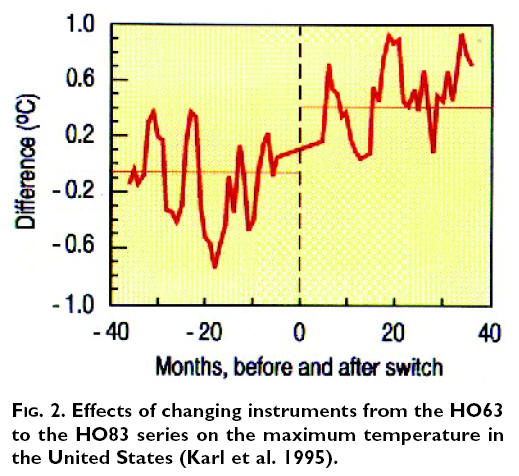
By the way, in the latter article he had this interesting chart with the potential upward bias added by an instrumentation switch at many weather stations

climate_station_move

This kind of thing happens in the instrumentation world, and is why numbers have to be adjusted from the raw data  (though these adjustments, even if done well, add error, as described above).  What has many skeptics scratching their heads is that despite this upward bias in the instrumentation switch, and the upward bias from many measurement points being near growing urban areas, the GISS and NOAA actually have an increasingly positive adjustment factor for the last couple of decades, not a negative one  (net of red, yellow, and purple lines here).   In other words, the GISS and NOAA adjustment factors imply that there is a net growing cooling bias in the surface temperature record in the last couple of decades that needs to be corrected.  This makes little sense to anyone whose main interest is not pumping up the official numbers to try to validate past catastrophic forecasts.

Update: The NOAA’s adjustment numbers imply a net cooling bias in station locations, but they do have a UHI correction component.  That number is about 0.05C, or 0.03F.  This implies the average urban heat island effect on measurement points over the last 50 years is less than 1/300th of the UHI effect we measured in Reno and Phoenix.  This seems really low, especially once one is familiar with the “body of work” of NOAA measurement stations as surveyed at Anthony’s site.

Sun, PDO, and CO2

For those who have not seen it, Roy Spencer has a new paper on the PDO, clouds and temperature history.

I have never explicitly stated this, but my sense is that medium to long scale 20th century temperature trends can be explained mostly through three drivers:

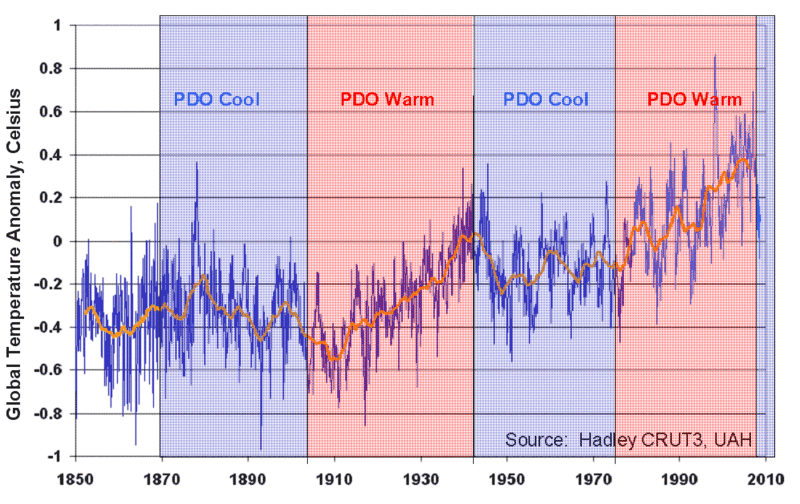
1.  A cyclical variation driven by multi-decade oceanic cycles like the Pacific Decadal Oscillation (PDO):

Pdo

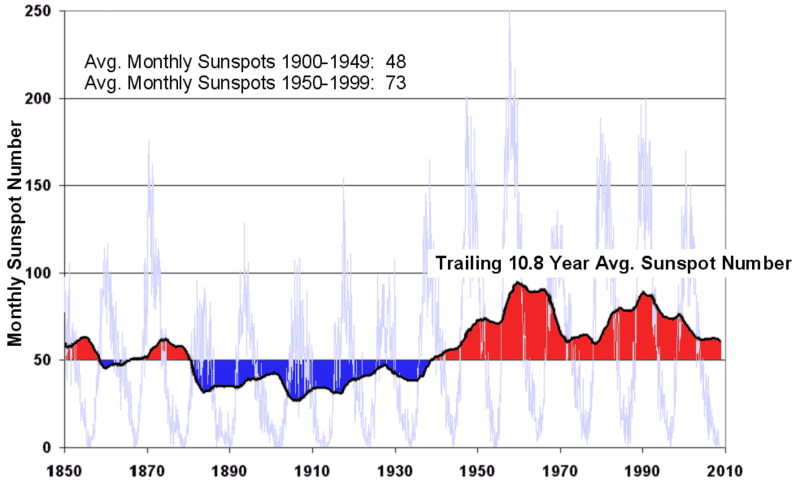
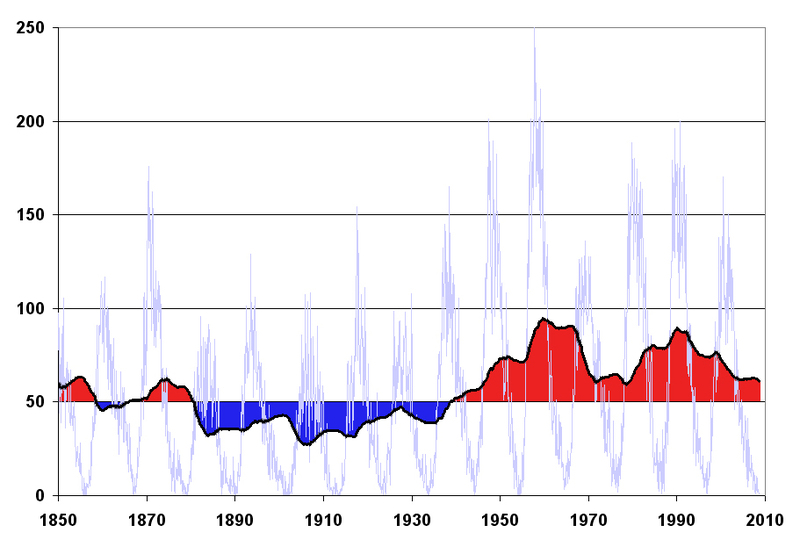
2.  Changes in solar output, either directly as increased heating or indirectly via a variety of theories on things like cosmic rays and cloud formation:

Sunspot2

3.  A long term trend of up to +0.05C per decade that may include a CO2-warming component. 

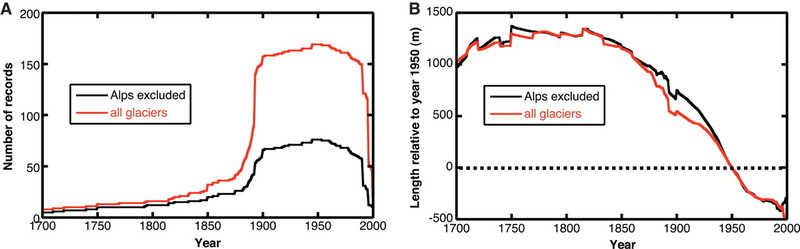
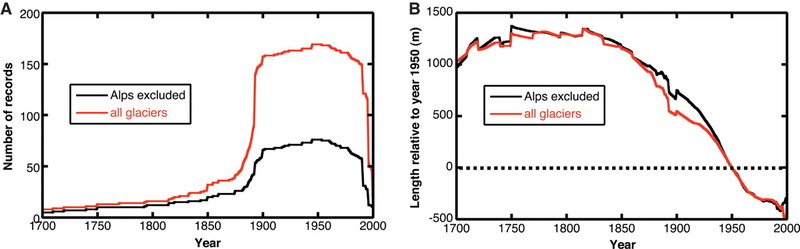
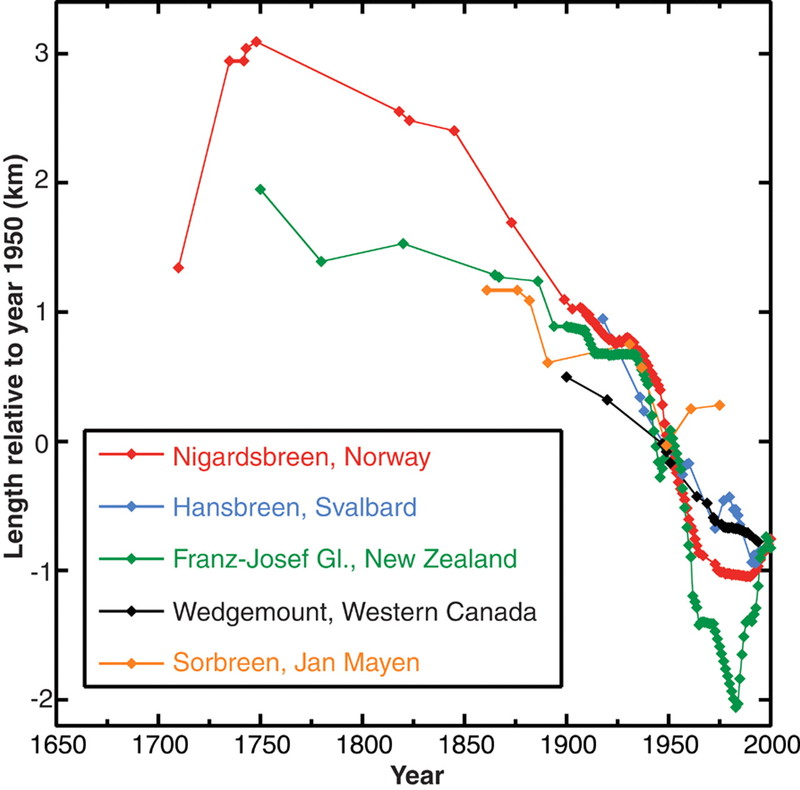
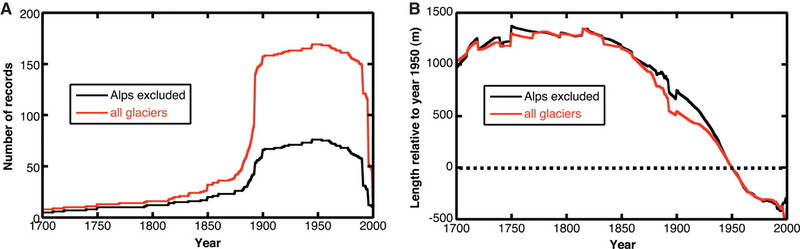
I am willing to posit a CO2 impact net of feedbacks of perhaps 0.5-1.0C over the next century.  This may appear low, but is the only scale of number reasonably supported by history.  Any higher number would result in temperatures way too high historically.  And even assuming a number this high runs into the following problem:  There was probably a trend of about this magnitude emerging from the little ice age 200+ years ago and extending into the 20th century.  You can see it in the glacier numbers below:  (source)

Glacier_length_2_2

Those that want to assign the temperature trend, once the sun and the PDO are removed, post-1950 to CO2, need to explain what effect was causing the nearly exact same trend from 1800-1950, and why that trend conveniently switched off at the exact moment man's CO2 takes over.  In the context of the glacier chart, what was causing the glaciers to retreat in 1880, and why is that effect not the one at work today?

Global Warming … Accelerating?

A week or two ago a “study” by the World Wildlife Fund got a lot of play in the media.  Its key conclusion:

The report says that the 2007 report from the Intergovernmental Panel on Climate Change (IPCC) – a study of global warming by 4,000 scientists from more than 150 countries which alerted the world to the possible consequences of global warming – is now out of date.

WWF’s report, Climate Change: Faster, stronger, sooner, has updated all the scientific data and concluded that global warming is accelerating far beyond the IPCC’s forecasts.

As an example it says the first tipping point may have already been reached in the Arctic where sea ice is disappearing up to 30 years ahead of IPCC predictions and may be gone completely within five years – something that hasn’t occurred for 1m years. This could result in rapid and abrupt climate change rather than the gradual changes forecast by the IPCC.

This is not at all an uncommon meme.  If one searches “global warming accelerating” on Google, one gets 1,100,000 hits.  The #1 hit says:

Global warming is accelerating three times more quickly than feared, a series of startling, authoritative studies has revealed.

I actually believe there is a small upward temperature trend due to CO2, on the order of 0.05 – 0.1C per decade.  But it is staggering to me that so many people can insist, with a straight face, that warming is “accelerating” or, crazier, that it is “worse than forecast.”

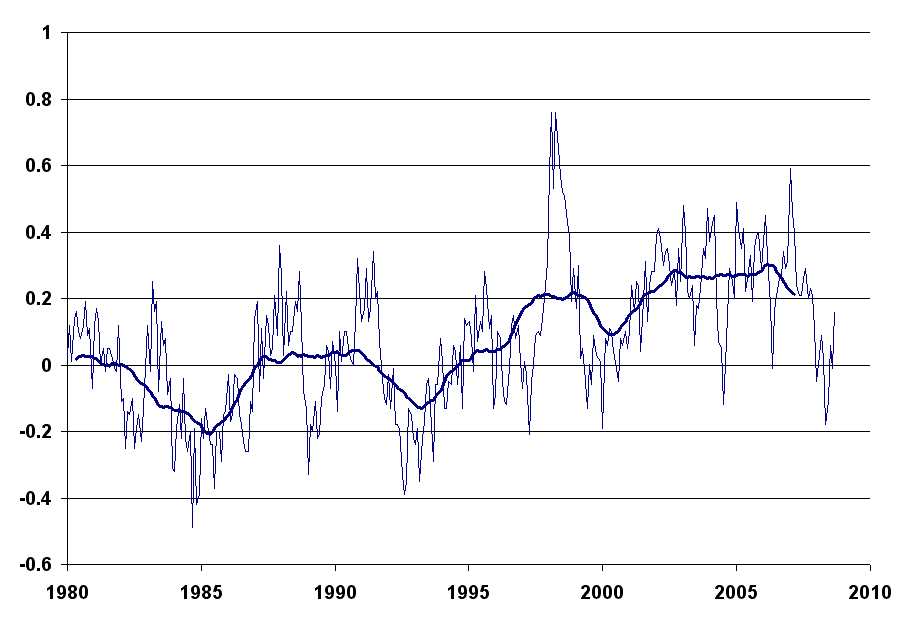
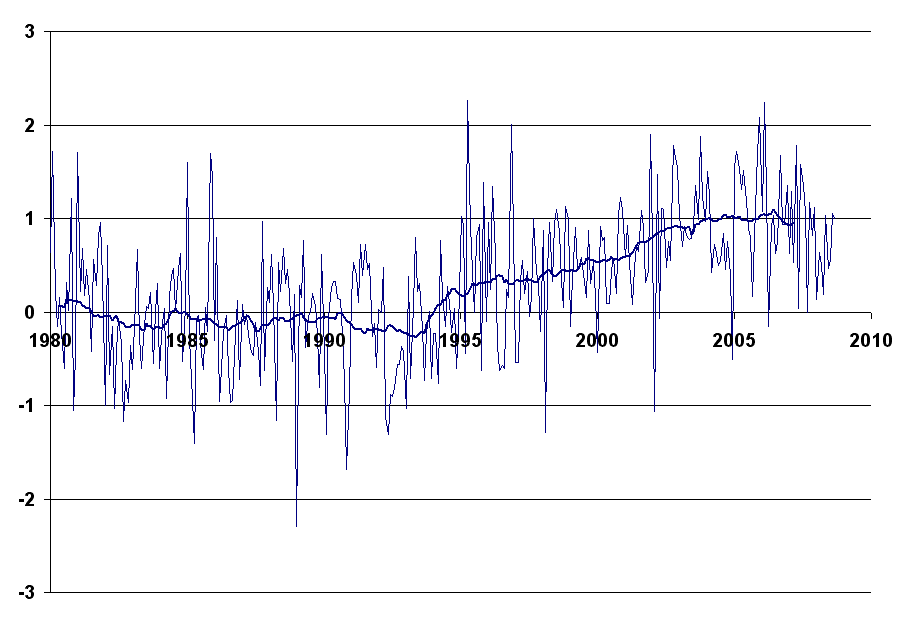
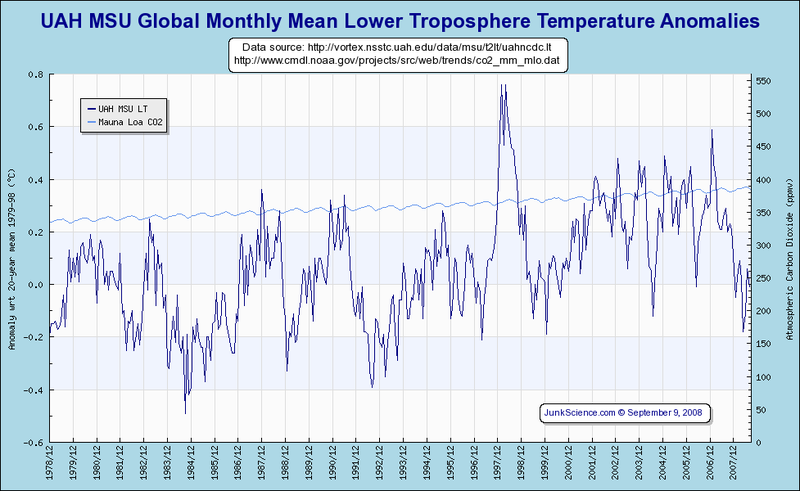
Let’s take the acceleration first.  Here is the recent temperature trend from the UAH satellite data (all the smoothed lines you will see are 36-month moving averages centered on the middle month).

uah_global

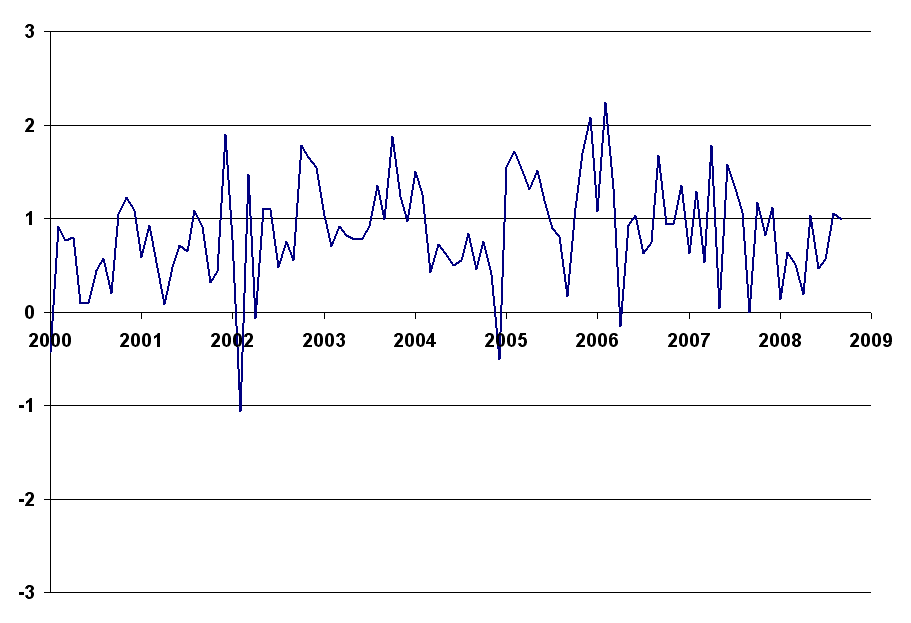
It is possible to argue that there is a warming trend here, but never-the-less it is impossible to see “acceleration,” particularly since 2001.  There is an implication in the article that the acceleration has occurred since the last couple of IPCC reports, so let’s zoom into the period since the 3rd and 4th IPCC reports:

arctic_temp_10_year

No acceleration.  Not even any warming  (for 8 years!  where is that story in the press?)

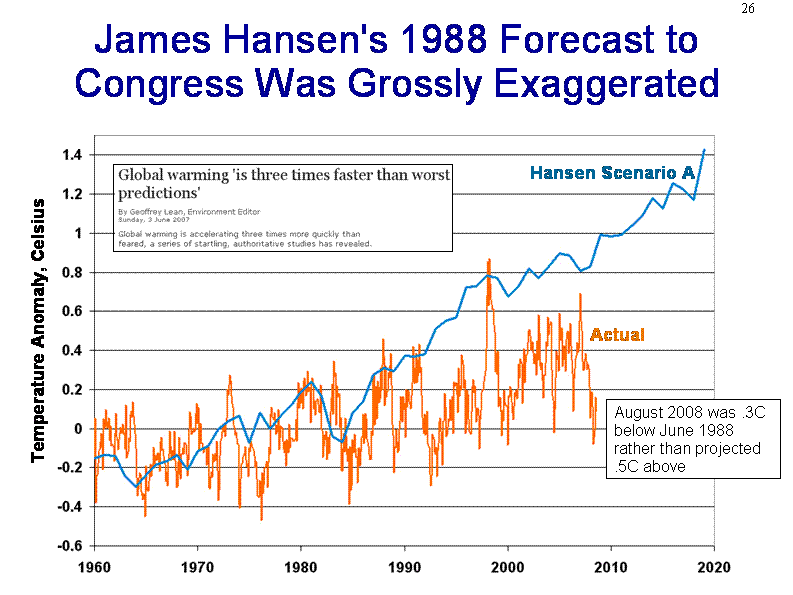
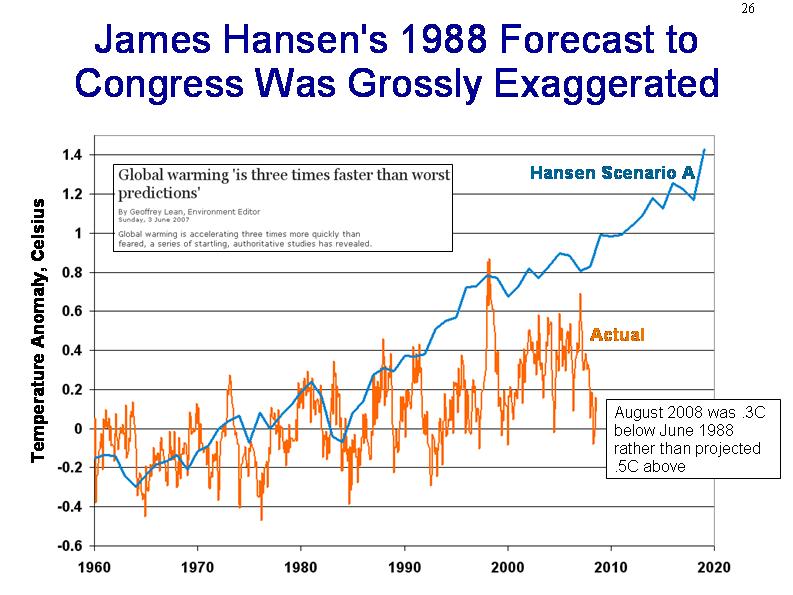
But how about the proposition that temperatures are rising faster than forecasts?  This is patently absurd.  We can go back to just about every IPCC and alarmist projection and show that temperatures are well less than forecast, but lets use James Hansen’s forecasts to Congress in 1988 because it gives us 20 years of data to work with (actual data is a blend of Hadley CRUT3 and UAH satellite as discussed here.)

hansen_forecast

I always get folks who insist that I am making a mistake by using the Hansen A scenario because Hansen at the time described it as extreme.  But in fact, world CO2 production has been even greater than the Hansen A scenario.  Hansen A underestimates the inputs, and still grossly overestimates the output.  The only real discussion one can find on the IPCC forecasts is whether one can argue the actuals are barely poking their nose up into the low end of the forecast confidence intervals or not.

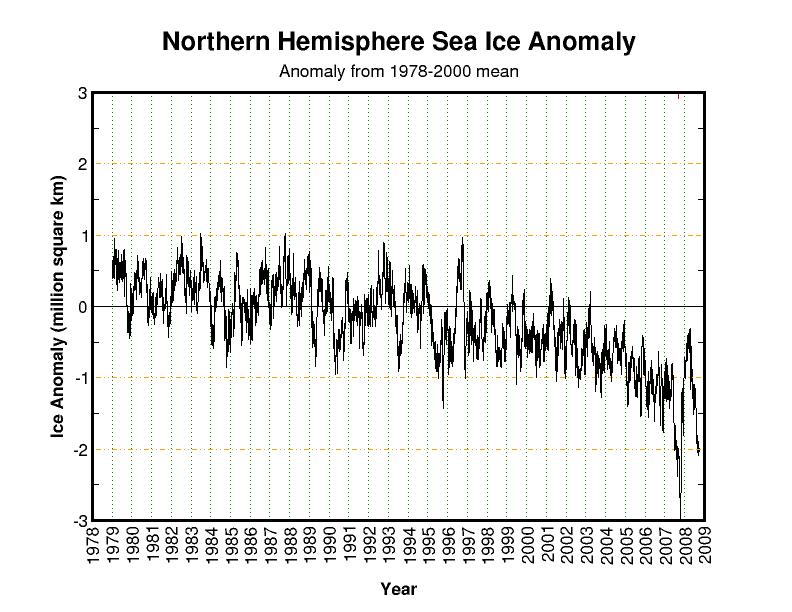
The one piece of evidence most of these folks making the “accelerating” argument use is sea ice extent in the North Pole.  The media has been full of stories about disappearing sea ice, and in fact in 2007 the North Pole had the lowest sea ice extent in the last 30 years, though coincidently in the same year the South Pole had the highest sea ice extent in 30 years.  But there is a logical fallacy here.  The fact that the statement “global warming causes sea ice to retreat” is true does not mean the statement “sea ice retreat means the globe is warming” has to be true.  And in fact, we see from the data above, this is not true.  It is amazing to me that in the conflict between “thermometers” and “sea ice extent at one pole” as measures for global temperature, sea ice extent seems to trump thermometer readings.  Particularly when this sea ice signal only exists at one of the two poles.

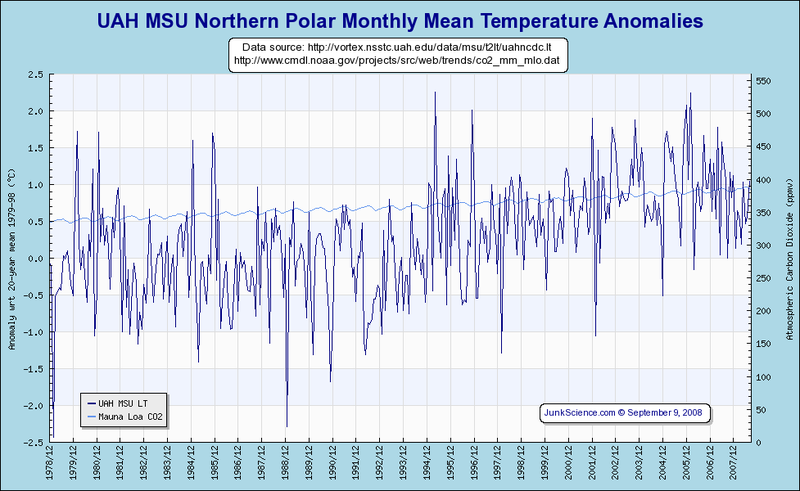
There is no question that the Arctic has warmed more than the rest of the planet.  In fact, much of the rise in global averages is driven by the Arctic  (and all of it is driven by the norther hemisphere above the tropics — the rest of the world has no warming signal over the last 30 years).  Below we can see the satellite measurement of the temperature anomaly in the Arctic:

arctic_temperature

A one degree rise over a couple of decades is indeed substantial.  In fact, though, during the last couple of years, we have actually seen either flat temperatures or, perhaps, a cooling trend.  Here is a closeup:

arctic_temp_10_year

So it might be that we should look for other explanations of unusually large sea ice retreats in the summers of 2007 and 2008.  It has been suggested by NASA that winds and ocean currents are in part to blame, and by others that black carbon deposits on the ice from Chinese coal plants may also be increasing summer melt.

Whatever the case, there are a lot of good reasons to believe we are not seeing an “acceleration” in global warming.  And a lot of very, very good reasons to believe we are not reaching a “tipping point.”  Tipping point implies that we have entered a regime where the climate is dominated by runaway positive feedback.  I have addressed this topic many times, and will not address it right now, but in short all of the catastrophe in climate models is due not to the assumption of CO2 as a greenhouse gas (which actually tends to yield modest warming in models) but the assumption that the Earth’s climate is dominated by substantial positive feedbacks.  I discuss the entire topic of positive feedbacks and climate forecasts in the video below:

Update – if we add glaciers here in addition to sea ice, we see the same slow retreating trend.  However, the trend goes back 200 years!  That’s 150 years longer than man has been producing substantial CO2 emissions.  (source)

Glacier_length_2_2

New Typepad Editor Bugged

I am working on several new posts, but the new Typepad editor is really buggy.  For some reason, Typepad put this particular blog (but not my others) on the new editor, probably as an involuntary beta.  The new editor is much, much slower, and has fatal bugs that make use of images in posts virtually impossible.

This is actually a problem with online applications I had not considered before.  When I heard iTunes 8 was initially bugged or learned to hate Vista, I would just avoid making the "upgrade."  But with online services, I have no choice but to accept the new version, even if I consider it worse (as is so often the case nowadays in software).

Arctic and Greenland Ice

Arctic Sea ice and Greenland glaciers have been on a slow retreating trend for decades, perhaps centuries (at least since the little ice age).  This should not be surprising.  First, glaciers all around the world have been steadily retreating since 1800:

Glacier_length_2_2

Also, the Arctic has been the hot spot of the world over the last 30 years or so:

Uahmsunpol

Increasing far more than global averages:

Uahmsuglobe

So the question is not necessarily why Arctic Sea ice continues to retreat – this appears part of a long term trend that in fact pre-dates things like, say, man’s production of substantial amounts of CO2.  But the more worrisome question has been, why has this retreat seemed to have accelerated the past several years:

Currentanom

Its hard to fully correlate recent activity with Arctic temperatures.  In fact, in the last three or four years (see above) we have seen decreasing Attic temperatures, not increasing ones.  But never-the-less, this ice picture is often used as exhibit #1 to prove anthropogenic warming.  The "tipping point is near" cry supporters of the theory that Earth’s climate, unlike nearly every other long-term stable natural system, is dominated by positive feedback (and ignoring anecdotal evidence that the Arctic experienced similar melting in the 1930s).

Well, last year, there was some preliminary findings form NASA that said that the unusual low ice pack in 2008 may have been due to shifting wind patterns.  Now, Anthony Watts points us to two new studies that both conclude something other than global warming and CO2 may be behind recent ice pack trends in the Arctic.

Observations over the past decades show a rapid acceleration of several outlet glaciers in Greenland and Antarctica1. One of the largest changes is a sudden switch of Jakobshavn Isbræ, a large outlet glacier feeding a deep-ocean fjord on Greenland’s west coast, from slow thickening to rapid thinning2 in 1997, associated with a doubling in glacier velocity3. Suggested explanations for the speed-up of Jakobshavn Isbræ include increased lubrication of the ice-bedrock interface as more meltwater has drained to the glacier bed during recent warmer summers4 and weakening and break-up of the floating ice tongue that buttressed the glacier5. Here we present hydrographic data that show a sudden increase in subsurface ocean temperature in 1997 along the entire west coast of Greenland, suggesting that the changes in Jakobshavn Isbræ were instead triggered by the arrival of relatively warm water originating from the Irminger Sea near Iceland. We trace these oceanic changes back to changes in the atmospheric circulation in the North Atlantic region. We conclude that the prediction of future rapid dynamic responses of other outlet glaciers to climate change will require an improved understanding of the effect of changes in regional ocean and atmosphere circulation on the delivery of warm subsurface waters to the periphery of the ice sheets.

When Computer Models Are Treated Like Reality

On April 28, 2004, the SEC made a significant change in policy in the regulation of large investment banks.  On that day, they "decided to allow the five largest US investment banks to substitute advanced mathematical risk models for traditional capital requirements."  Al Gore has touted the "success" of such models as a reason to feel confident that computer models can accurately predict long-term climate trends.

But it turns out, as everyone is discovering this week, that computer models are not reality.  In fact, computer models are extraordinarily sensitive to their inputs, and small changes in their inputs, or the narrowing of models to ignore certain factors, can make them worse than useless.  Computer models are also very easy to force to a preferred conclusion.

Why Kyoto Used 1990 as a Base Year

I have made this point several times, but the 1990 reference date for Kyoto was not just picked randomly.  In fact, on its face, it was a bit odd for a treaty negotiated in 1997 to use a 1990 base year.   But 1990 allowed signatory countries to claim credit for alot of improvements in CO2 output that had nothing to do with the treaty.  For example, in Germany, 1990 was after unification but before wildly inefficient east German factories had been shut down.  In England, 1990 was just before a concerted effort to substitute North Sea oil and nuclear to shut down Midlands coal use.  In France and Japan, 1990 was the beginning of a period of slow economic growth (and, as an added special bonus, punished the US because it was the beginning of strong economic growth here).

Here is further proof:

In an odd twist on market economics, Europe’s ex-communist states are starting to exploit a new market. Thanks to the Kyoto climate-change agreement, they can, in effect, now make money off the pollution their onetime central planners were willing to tolerate as the price for rapid industrialization and universal employment.

Ukraine, Hungary, the Czech Republic and other countries of the region not exactly renowned for clean air have made or are close to signing deals to sell the rights to emit greenhouse gases, and their main customer is environmentally friendly Japan.

This carbon windfall dropped into Central and East Europe’s lap because the Kyoto Protocol sets 1990 as the reference year for future reductions in greenhouse gas emissions. The socialist states at that time were producing gargantuan amounts of CO2 and other gases implicated in global warming from unfiltered coal-fired power plants and factories; when those unprofitable industries withered, countless thousands of workers went on the dole — but the air got cleaner. In the coming years, in line with European Union mandates, would-be members gradually adopted better environmental policies. It’s the difference between the often unspeakably bad air of 1990 and the comparatively clean air of today that allows them to sell "carbon credits" potentially worth billions of euros.

In effect, signatory countries are still making their Kyoto goals with actions that had nothing to do with Kyoto, in this case the modernization and/or shut down of communist-era industry.  This continues the charade that a) Europe is actually making real progress on CO2 emissions, which it is not and b) emissions reductions are cheap.

Update:  Before the treaty, but for which the treaty supporters claim credit by selecting 1990 as the base year, signatory countries had large CO2 reductions due to the forces at work detailed above:

CO2 Emissions Changes, 1990-1995

EU -2.2%
Former Communist -26.1%
Germany -10.7%
UK -6.9%
Japan 7.2%
US 6.4%

Since the treaty was actually signed, from 1997 to 2005, countries that ratified the treaty had emissions rise 21%.  When the treaty was signed in 1997, they signatories knew they had this pool of 1990-1995 emissions reductions to draw on to claim victory.  To this day, this is the only improvement they can show, improvement that occured before the treaty and through steps unrelated, in the main, to CO2 abatement.

RCRC Climate Presentation

I made a 30-minute presentation to the California Regional Council of Rural Counties yesterday.   The audience was mainly county supervisors and other officials from about 30 rural counties.  The presentation was the skeptical counterpoint to a presentation by Joe Nation, who among other accomplishments was an author of AB32, the California global warming abatement law.  Download RCRC_Global_Warming_Presentation_update_Sept-25-2008.ppt .  Some of the charts may not be self-explanatory, so I am working on a YouTube video with my speech overlaid on the slides.

It was an interesting experience for me because the audience was hugely sympathetic to my pitch, but frustrated because, for them, it was beside the point:  They were already committed by AB32 to take drastic and expensive action under AB32.  The only policy recommendation I made in my speech was to lament the obsession with cap-and-trade and make a plea for a carbon tax.  The discussion afterward pretty much made my point for me, with every member lamenting the absurdities that are emerging in the CARB regulation process.  Even Mr. Nation admitted that the CARB is setting up programs that are preferentially regulating those with the least political muscle and pushing policies which make no sense in any kind of cost-benefit analysis for fighting CO2.  Mr. Nation said that when he was in the legislature, he tried a carbon tax first but could not get it out of committee, even a small one that would have raised gas taxes about 5 cents.  It seems politicians have no problem enacting huge taxes (which is what AB32 does) as long as those taxes are not called a tax and are hidden from the view of the general public (at least until prices start to rise and businesses start to exit the state).

I thought Mr. Nation did a perfectly reasonable job, and I agreed with much of what he presented.  I differed only, of course, in the amount of past warming I was willing to ascribe to CO2 and the amount of future warming from CO2 that we might expect.  However, this was the first time I have ever seen a global warming catastrophist be explicit that CO2 only causes a bit of future warming, and that most is from positive feedbacks multiplying the greenhouse effect.  Kudos for him for highlighting this, and this certainly fed into my pitch well.

The one area where I thought he made an explicit factual mistake in his presentation was in evaluating Hansen’s forecast to Congress in 1988.  He argued that one shouldn’t judge Hansen by his "A" scenario (which is WAY off) because Hansen said at the time that this was based on unrealistically high assumptions.  But in Hansen’s appendix, he says that the A scenario is based on 1.5% a year future growth in CO2 output.  In fact, the world has grown CO2 output by 1.75 % a year in the last 20 (source), so in fact the A scenario is, if anything, low.  The B and C scenarios should be treated as totally irrelevant.  This is a mistake I think Lucia made at the Blackboard, considering B and C at all.  These scenarios differ in their CO2 forecasts, not the model parameters, so the scenario closest to actual CO2 output should be chosen and the rest are irrelevant.  By the way, here is my chart.  As I did with many of my charts, I like to counterpoint the data against media reports (the box in the upper left).  This helps later in the discussion when the disconnect people have between what I have said and what they have heard inevitably crops up.

Hansen_forecast_1988

I was pleased that Russ Steele of NC Media Watch was there to say hi and observe the proceedings.  Thanks Russ — I enjoy your blog and am sorry that I did not recognize you in my pre-presentation stress. 

Update:  Russ has a more complete roundup of the discussion

Update 2:  The actuals in the chart above are UAH satellite numbers, with the anomaly shifted up about 0.1C to match zero values with the Hansen forecast data.

Computer Models

Al Gore has argued that computer models can be trusted to make long-term forecasts, because Wall Street has been using such models for years.  From the New York Times:

In fact, most Wall Street computer models radically underestimated the risk of the complex mortgage securities, they said. That is partly because the level of financial distress is “the equivalent of the 100-year flood,” in the words of Leslie Rahl, the president of Capital Market Risk Advisors, a consulting firm.

But she and others say there is more to it: The people who ran the financial firms chose to program their risk-management systems with overly optimistic assumptions and to feed them oversimplified data. This kept them from sounding the alarm early enough.

Top bankers couldn’t simply ignore the computer models, because after the last round of big financial losses, regulators now require them to monitor their risk positions. Indeed, if the models say a firm’s risk has increased, the firm must either reduce its bets or set aside more capital as a cushion in case things go wrong.

In other words, the computer is supposed to monitor the temperature of the party and drain the punch bowl as things get hot. And just as drunken revelers may want to put the thermostat in the freezer, Wall Street executives had lots of incentives to make sure their risk systems didn’t see much risk.

“There was a willful designing of the systems to measure the risks in a certain way that would not necessarily pick up all the right risks,” said Gregg Berman, the co-head of the risk-management group at RiskMetrics, a software company spun out of JPMorgan. “They wanted to keep their capital base as stable as possible so that the limits they imposed on their trading desks and portfolio managers would be stable.”

Tweaking model assumptions to get the answer you want from them?  Unheard of!

We Can’t Think of Anything Else It Could Be

I am still reading the new Douglas and Christy paper, so I won’t comment on it yet, but you can see Anthony Watts thoughts here.

However, in reading Anthony’s site this morning, I was struck by a quote in another one of his posts.  For a while, I have been telling folks that the main argument behind anthropogenic global warming is "we have looked at everything else, and we can’t think of what else it could be other than man."  Lacking positive correlation between CO2 and major shifts in temperature  (particularly when ice core evidence collapsed under the weight of the 800 year lag), scientists instead argue that they have gone through a long checklist (sun, clouds, volcanoes, etc) and have convinced themselves none of these others have caused late 20th century warming, so it must be man — that’s all that is left.

Here is an example, from Anthony’s site:

Bill Chameides, dean of Duke University’s Nicholas School of the Environment and Earth Sciences, said Spencer’s arguments are what magicians call “ignoratio elenchi” or logical fallacy.”We’ve looked at every possible form of heat, including clouds, and the only source of heat is greenhouse gases,” he said, adding it’s insulting that Spencer would suggest scientists are paid to come to this conclusion. “Scientists make their reputation on debunking theories.”

Well, a number of folks would beg to differ that scientists have truly eliminated every other possible cause, particularly Mr. Sun (more than really eliminating these effects, they seem to be seeking excuses to ignore them).  In fact, climate models of late have admitted that they don’t even include the Pacific Decadal Osculation in their models, or didn’t until recently.  So much for thinking of everything.

But if Mr. Chameides wants to talk in terms of logical fallacies, I will as well:  Just because scientists cannot image another cause does not mean that another cause does not exist.  Can you imagine the first astrophysicists to discover pulsars to say "well, we can’t think of anything else that would cause this phenomenon, so it must be space aliens."  Well, come to think of it, some people did say that.  But it turned out to be absurd, and after some decades of effort, we think we now understand pulsars.  But it is a bizarre form of arrogance to assume that it is not possible in our current degree of climate knowledge that there is some factor we don’t even know about.

Long Postscript:  I am working on a powerpoint presentation for next week on anthropogenic global warming, but here are two charts from that presentation that get at the "we can’t think of anything other than man that might be causing late 20th century warming."  The first is the correlation between 20th century temperature and the PDO cycle  (temperature numbers are Hadley CRUT3 and UAH combined as described here).   By the way, there seems to be some argument over exactly where and how often to call the turns in the PDO early in the 20th century — I have used one frequent estimate but others exist.Pdo 

The second interesting analysis is a sunspot number chart.  To highlight recent increases in activity, I have overlaid on the monthly International sunspot numbers (light blue) a 9.8 year moving average (in black) of sunspot numbers (9.8 selected as an average cycle length).  In the chart below, selection of the 50 average sunspot number as a reference value is arbitrary, but serves to visually demonstrate the increase in solar activity over the last 50 years.

Sunspot2

The average monthly sunspot number from 1900-1949 was 48.  The average monthly number from 1950-1999 was 73.1, an increase of 52%.

Some of this increase is real, but some may be a measurement bias related to the ability to better detect smaller spots.  Anyone have any sources on how large this latter effect might be?  We are talking about an enormous percentage increase in the last half of the century, so my guess is that it is not all due to this bias.

Retreating Glaciers

One of the panicky claims of global warming catastrophists is that some sort of "unprecedented" melting and retreat of glaciers is occurring tied to anthropogenic global warming.  I have seen anecdotal evidence for a while that this melting of glaciers began long before the 1950-present "anthropogenic" era, but I had not seen anything systematic on the topic until I discovered this study by  L. Oerlemans et al as published in Science in 2005.  Download Oerlemans 2005 as pdf.  His results look like this (click to enlarge):

Glacier_length_2_2

His data for the last decade is a little squirrelly because the data sets he uses are slow to update, but the overall picture is pretty clear — a pretty steady 150+ year history of steady retreat, with the only change is slope being a flattening rather than an acceleration of the curve.  Here are a few individual glaciers he highlights:

Glacier_length

One is again left in a quandary – if recent glacial retreats are due to anthropogenic warming, then what cased the retreats before 1950 or so?  And, whatever caused the earlier retreats, what made this natural effect "switch off" at the exact same instant that anthropogenic effects took over?   

Update:  Here is a piece of annecdotal evidence to match, a map from Alaska Geogrpahic on the retreat of the glaciers at Glacier Bay

Image054

Retreating Glaciers

One of the panicky claims of global warming catastrophists is that some sort of "unprecedented" melting and retreat of glaciers is occurring tied to anthropogenic global warming.  I have seen anecdotal evidence for a while that this melting of glaciers began long before the 1950-present "anthropogenic" era, but I had not seen anything systematic on the topic until I discovered this study by  L. Oerlemans et al as published in Science in 2005.  Download Oerlemans 2005 as pdf.  His results look like this (click to enlarge):

Glacier_length_2_2

His data for the last decade is a little squirrelly because the data sets he uses are slow to update, but the overall picture is pretty clear — a pretty steady 150+ year history of steady retreat, with the only change is slope being a flattening rather than an acceleration of the curve.  Here are a few individual glaciers he highlights:

Glacier_length

One is again left in a quandary – if recent glacial retreats are due to anthropogenic warming, then what cased the retreats before 1950 or so?  And, whatever caused the earlier retreats, what made this natural effect "switch off" at the exact same instant that anthropogenic effects took over?   

Update:  Here is a piece of annecdotal evidence to match, a map from Alaska Geogrpahic on the retreat of the glaciers at Glacier Bay

Image054

Light Posting

Sorry for the light posting.  I have not lost interest, I have just been extremely busy.  Relevant to climate, I am working on a 30-minute presentation for a climate debate I am participating in soon at Lake Tahoe.  Once that is done, the material I have developed for it should drive a number of new posts.