Archive for the ‘Uncategorized’ Category.

Weird

What an odd world we live in when environmental activists feel the need to write about how horrible grass and open parks can be for the environment.

You may recently have come to accept that lawns are bad for the planet.

Isn’t it amazing someone can assume his readers accept this statement so much that he can use it as a starting point?  He goes on to discuss when public spaces are and are not bad for the environment.

It is incredible to me that somehow we have reached a world where absurdly dense urban living a la Manhattan is considered the most environmentally friendly way for humans to live.  All just another way in which an obsession with CO2 has corrupted the environmental movement.  I have predicted it before but will say it again — some day, the environmentalists will look back on their global warming hysteria as a couple of lost decades in their own movement, when focus on real environmental issues were kicked to the curb in favor of going all in on trace concentrations of carbon dioxide.

Global Warming “Accelerating”

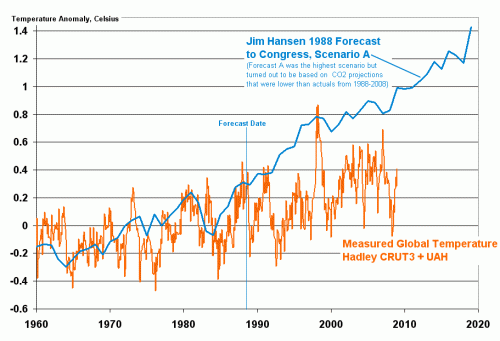
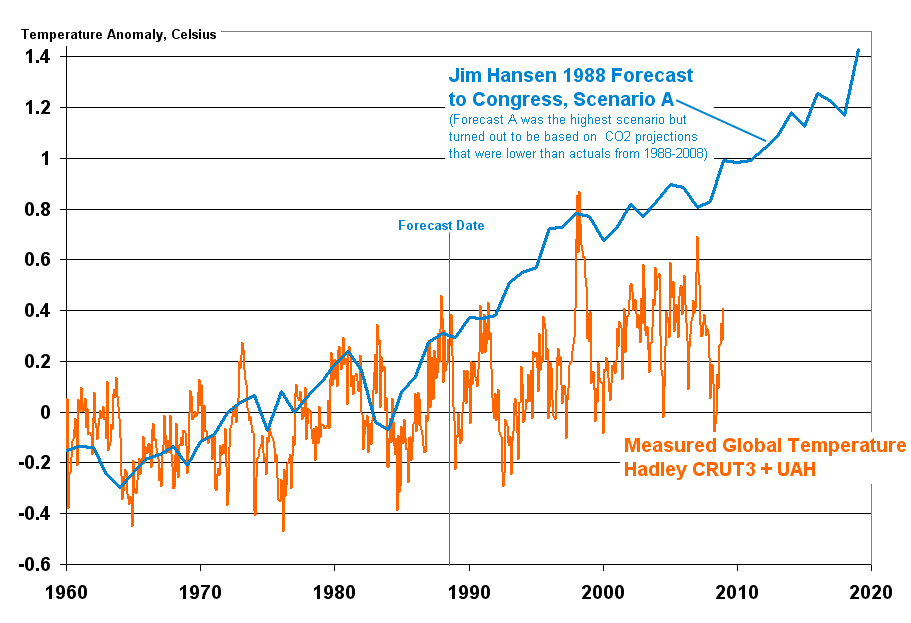
I have written a number of times about the “global warming accelerating” meme.  The evidence is nearly irrefutable that over the last 10 years, for whatever reason, the pace of global warming has decelerated (click below to enlarge)
hansenjan20091

This is simply a fact, though of course it does not necessarily “prove” that the theory of catastrophic anthropogenic global warming is incorrect.  Current results continue to be fairly consistent with my personal theory, that man-made CO2 may add 0.5-1C to global temperatures over the next century (below alarmist estimates), but that this warming may be swamped at times by natural climactic fluctuations that alarmists tend to under-estimate.

Anyway, in this context, I keep seeing stuff like this headline in the WaPo

Scientists:  Pace of Climate change Exceeds Estimates

This headline seems to clearly imply that the measured pace of actual climate change is exceeding previous predictions and forecasts.   This seems odd since we know that temperatures have flattened recently.  Well, here is the actual text:

The pace of global warming is likely to be much faster than recent predictions, because industrial greenhouse gas emissions have increased more quickly than expected and higher temperatures are triggering self-reinforcing feedback mechanisms in global ecosystems, scientists said Saturday.

“We are basically looking now at a future climate that’s beyond anything we’ve considered seriously in climate model simulations,” Christopher Field, founding director of the Carnegie Institution’s Department of Global Ecology at Stanford University, said at the annual meeting of the American Association for the Advancement of Science.

So in fact, based on the first two paragraphs, in true major media tradition, the headline is a total lie.  In fact, the correct headline is:

“Scientists Have Raised Their Forecasts for Future Warming”

Right?  I mean, this is all the story is saying, is that based on increased CO2 production, climate scientists think their forecasts of warming should be raised.  This is not surprising, because their models assume a direct positive relationship between CO2 and temperature.

The other half of the statement, that “higher temperatures are triggering self-reinforcing feedback mechanisms in global ecosystems” is a gross exaggeration of the state of scientific knowledge.  In fact, there is very little good understanding of climate feedback as a whole.  While we may understand individual pieces – ie this particular piece is a positive feedback – we have no clue as to how the whole thing adds up.  (see my video here for more discussion of feedback)

In fact, I have always argued that the climate models’ assumptions of strong positive feedback (they assume really, really high levels) is totally unrealistic for a long-term stable system.  In fact, if we are really seeing runaway feedbacks triggered after the less than one degree of warming we have had over the last century, it boggles the mind how the Earth has staggered through the last 5 billion years without a climate runaway.

All this article is saying is “we are raising our feedback assumptions higher than even the ridiculously high assumptions we were already using.”  There is absolutely no new confirmatory evidence here.

But this creates a problem for alarmists

For you see, their forecasts have consistently demonstrated themselves to be too high.  You can see above how Hansen’s forecast to Congress 20 years ago has played out (and the Hansen A case was actually based on a CO2 growth forecast that has turned out to be too low).  Lucia, who tends to be scrupulously fair about such things, shows the more recent IPCC models just dancing on the edge of being more than 2 standard deviations higher than actual measured results.

But here is the problem:  The creators of these models are now saying that actual CO2 production, which is the key input to their model, is far exceeding their predictions.  So, presumably, if they re-ran their predictions using actual CO2 data, they would get even higher temperature forecasts. Further, they are saying that the feedback multiplier in their models should be higher as well.  But the forecasts of their models are already high vs. observations — this will even cause them to diverge further from actual measurements.

So here is the real disconnect of the model:  If you tell me that modelers underestimated the key input (CO2) in their models,  and have so far overestimated the key output (Temperature), I would have said the conclusion to this article is that climate sensitivity must be lower than what was embedded in the models.  But they are saying exactly the opposite.  How is this possible?

Postscript: I hope readers understand this, but it is worth saying because clearly reporters do not understand this:  There is no way that climate change from CO2 can be accelerating if global warming is not accelerating.  There is no mechanism I have ever heard by which CO2 can change the climate without the intermediate step of raising temperatures.  Co2–>temperature increase–>changes in the climate.

Update: Chart originally said 1998 forecast.  Has been corrected to 1988.

Update#2: I am really tired of having to re-explain the choice of using Hansen’s “A” forecast, but I will do it again.  Hansen had forecasts A, B, C, with A being based on more CO2 than B, and B with more CO2 than C.  At the time, Hansen said he thought the A case was extreme.  This is then used by his apologists to say that I am somehow corrupting Hansen’s intent or taking him out of context by using the A case, because Hansen himself at the time said the A case was probably high.

But the only difference between A, B, and C were not the model assumptions of climate sensitivity or any other variable — they only differed in the amount of Co2 growth and the number of volcano eruptions (which have a cooling effect via aerosols).  We can go back and decide for ourselves which case turned out to be the most or least conservative.   As it turns out, all three cases UNDERESTIMATED the amount of CO2 man produced in the last 20 years.  So, we should not really use any of these lines as representative, but Scenario A is by far the closest.  The other two are way, way below our actual CO2 history.

The people arguing to use, say, the C scenario for comparison are being disingenuous.  The C scenario, while closer to reality in its temperature forecast, was based on an assumption of a freeze in Co2 production levels, something that obviously did not occur.

The Magic Correlation

This discussion, including the comments, over at Climate Audit, really is amazing.  Just when you think all the procedural errors that could be mined from the Mann hockey stick have been pulled to the surface, another gem emerges.

Here is how I understand it (please correct me if I am wrong in the comments):  Michael Mann uses a variety of proxies to reconstruct history  (he actually pre-screens them to only use the ones that will give him the answer he wants, but that is another problem that has been detailed in other posts).  To be able to tell temperature with these proxies (since their original measurements are things like mm of tree ring width, not degrees) they must be scaled based on periods in which the thermometer-measured surface temperature record overlaps the proxy record.

Apparently, when making these calibrations, he used the surface temperature record from 1850-1995, but also did other runs with sub-periods of this, such as 1850-1949 and 1896-1995.  OK so far.  Well, McIntyre believes he has found that when running these correlations, the sign of the correlation factor for a single proxy actually changes.

What does this mean?  Well, lets assume proxy 1 is tree ring width from a particular tree, and a calibration based on 1850-1995 has such-and-such ring width data correlated at x per degree.   This means that an increase in ring width of X implies a temperature increase of one.  But, when calibrating on one of the other periods, the exact same proxy has a calibration of -Y.  This means that an increase in the ring width of Y yields a temperature DECREASE of one.

I had a professor of physics back in undergrad who used to just drive me crazy with his insistence on good error estimations in the lab  (which he was right to emphasize, just proving I was not meant for the lab).  He used to say that if your error range crossed zero, in other words, if your range of possible answers included both positive and negative numbers, then you really did not understand a process.  You don’t understand a relationship, he would say, if you don’t even know the sign.  Well, Mann has gotten over this little problem, I guess, because he is perfectly able to have the same physical process have exactly opposite relationships with temperature depending on what 50 year period he is working with.

OK, so Steve caught him with one bad proxy.  Heck, he has over a thousand others.  But now McIntyre is reporting in the comments he has found 308 such cases, where Mann has correlations that change signs like this.  Wow.

Postscript: By the way, one of the most fundamental rules of regression analysis is that when you throw a variable into the regression, you should have some theoretical reason for doing so.  This is because every single variable you add, no matter how spurious, is going to improve the fit of a regression (trust me on this, it’s in the math).

In the case of proxy regressions, it is simply unacceptable to rely on the regression for the sign.  You rely on physics for the sign, not the regression.   If you don’t even know the sign of the relationship between your proxy and temperature, then you don’t understand the proxy well enough physically to justify even calling it a proxy.

This is a big, big deal in financial modelling.  I can’t tell you how often it is emphasized in financial modelling to make sure you have a working theory as to how and why a variable should affect a regression, and then when you get the result, you need to test it against your original theory.  And if they are too far apart, you need to doubt the computer result.  Because in financial modelling, if you get too much confidence in regressions against spurius data, you can go bankrupt  (in climate, it instead seems to lead to fame, large grants, and hanging out with vice-presidents).

Update: Oops, I missed the first post on this at Climate Audit, which discusses the issues in my postscript in more depth.  This is a good example, and it is not surprising they revert to a financial example as I did, as financial modelers have the greatest immediate incentives not to fool themselves.

We (the authors of this paper) have identified a weather station whose temperature readings predict daily changes in the value of a specific set of stocks with a correlation of r=-0.87. For $50.00, we will provide the list of stocks to any interested reader. That way, you can buy the stocks every morning when the weather station posts a drop in temperature, and sell when the temperature goes up. Obviously, your potential profits here are enormous. But you may wonder: how did we find this correlation? The figure of -.87 was arrived at by separately computing the correlation between the readings of the weather station in Adak Island, Alaska, with each of the 3315 financial instruments available for the New York Stock Exchange (through the Mathematica function FinancialData) over the 10 days that the market was open between November 18th and December 3rd, 2008. We then averaged the correlation values of the stocks whose correlation exceeded a high threshold of our choosing, thus yielding the figure of -.87. Should you pay us for this investment strategy? Probably not: Of the 3,315 stocks assessed, some were sure to be correlated with the Adak Island temperature measurements simply by chance – and if we select just those (as our selection process would do), there was no doubt we would find a high average correlation. Thus, the final measure (the average correlation of a subset of stocks) was not independent of the selection criteria (how stocks were chosen): this, in essence, is the non-independence error. The fact that random noise in previous stock fluctuations aligned with the temperature readings is no reason to suspect that future fluctuations can be predicted by the same measure, and one would be wise to keep one’s money far away from us, or any other such investment advisor

Update #2: I guess I have to issue a correction.  I have argued that climate scientists tend to be unique in trying to avoid criticism by labeling critics as “un-scientific”.  In retrospect, it does not appear climate scientists are unique:

The iconoclastic tone have attracted coverage on many blogs, including that of Newsweek. Those attacked say they have not had the chance to argue their case in the normal academic channels. “I first heard about this when I got a call from a journalist,” comments neuroscientist Tania Singer of the University of Zurich, Switzerland, whose papers on empathy are listed as examples of bad analytical practice. “I was shocked — this is not the way that scientific discourse should take place.”

“Anti-Scientific”

From Joe Romm, via Tom Nelson

The finalist list is out for the 2008 Weblog awards “Best Science Blog,” and two of the ten finalists are anti-scientific websites primarily devoted to spreading disinformation (and noninformation) on global warming– just like 2007.

The 2007 “competition” ended up being yet another classic exercise in the right wing perverting an otherwise reasonable web idea — online voting for the best science blog. As Desmogblog explained in a post titled, The “Vast Right Wing Conspiracy” beating “Vast Left Wing” Voting for Best Science Weblog, the right wing voted en masse for Climate Audit and the rational people all voted for Discover magazine’s excellent Bad Astronomy Blog. In the end, the process was so controverisal that the Awards folk simply called it a tie — saying each blog ended up with exactly 20,000 votes.

The Weblog Awards should not be legitimizing anti-scientific denialism.

As a student of history, I try really hard to never use the word “unprecedented.”  For example, those who think the partisan bickering we have today is somehow at a peak should go back to any American paper in 1855 and take a gander at the vitriol that flew back and forth.

But I must say I do find it difficult to find a good historical analog for this whole “anti-scientific” knock on climate skeptics.  I can understand accusing others of being wrong on a topic in science.   For example, it took decades for plate tectonics theory to catch on outside of small fringes of the geologic community, but I don’t remember folks accusing others of being anti-scientific.

This is particularly true in the case of the two blogs Mr. Romm mentions.   Here are a couple of quick thoughts:

  • Steve McIntyre, at Climate Audit, spends most of his time trying (in great, statistical depth) trying to replicate work by scientists such as Michael Mann and James Hansen, and critiques their work when he thinks he finds flaws.  Mann and Hansen spend much of their time trying to stonewall Mr. McIntyre and prevent him from having access to their data (most of which was collected and analyzed at taxpayer expense, either directly or through government grants).  Which of these parties seems closer to the spirit of science.
  • Anthony Watt argued for years with the government operators of the surface temperature measurement network that their system had location biases that were not being taken into account, and that were much large than being acknowledged.  When the operators of these systems were uninterested in pursuing the matter, Watt started a volunteer effort to survey and photograph these stations to the location biases, where they may exist, would be visible and available for anyone who wished to see.
  • Only one side in this debate ever argues that the other should be banned from even speaking or being heard.  I think you know which one that is.  So which side is the one that is “anti-science” — the one that is happy to mix it up in open debate or the one that is trying to get its opposition silenced?

Again, Watt and McIntyre could be wrong, but their sites are often scientific.  I could easily name 10 climate skeptic sites that, while I wouldn’t call them anti-science, are certainly a-scientific, focusing more on polemic than data.  But I could do the exact same on the alarmist side.  Certainly Watt and McIntyre’s sites are not in this category.

Here is the best analogy I can come up with (one which, not being religious myself, hopefully I can portray with a bit of detachment).   During the reformation, the Catholic Church accused critics of the Church of being anti-Christian.  But the religious skeptics were not anti-Christian per se, they merely contested the Church’s (and the Pope’s) ability to speak with absolute authority on religious matters.  In this case, the priests of the Church were upset that their monopoly to speak for Church doctrine was being challenged. They challenged their opposition as being anti-religious, but what they were was actually against the established Church, doctrine, and priesthood.

And by the way, is any actual adult human being with more than a year experience blogging really surprised that voting on the Internet

More on the Sun

I wouldn’t say that I am a total sun hawk, meaning that I believe the sun and natural trends are 100% to blame for global warming. I don’t think it unreasonable to posit that once all the natural effects are unwound, man-made CO2 may be contributing a 0.5-1.0C a century trend (note this is far below alarmist forecasts).

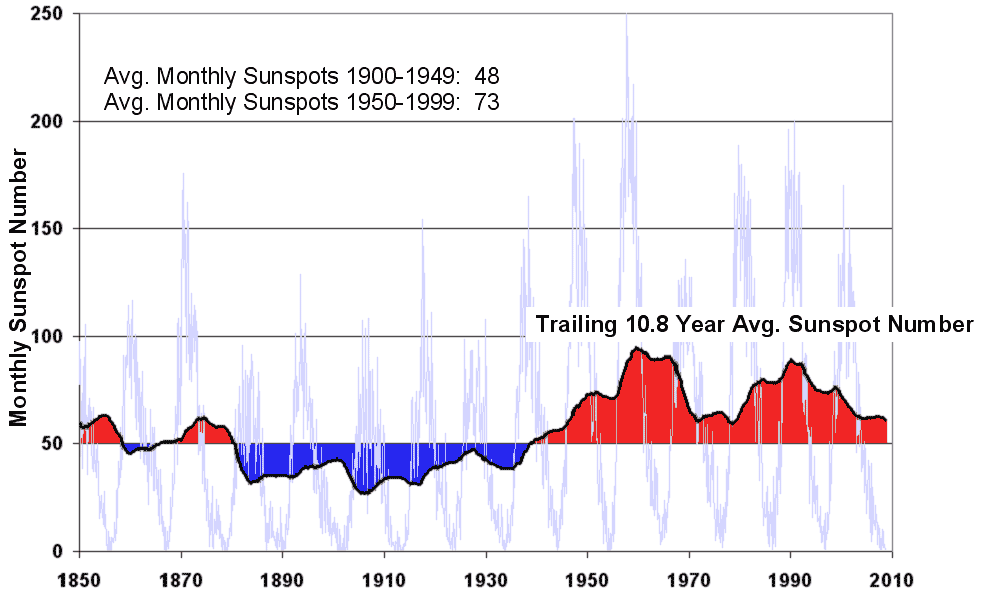
But the sun almost had to be an important fact in late 20th century warming. Previously, I have shown this chart of sunspot activity over the last century, demonstrating a much higher level of solar activity in the second half than the first (the 10.8 year moving average was selected as the average length of a 20th century sunspot cycle).
sunspot2

Alec Rawls has an interesting point to make about how folks are considering the sun’s effect on climate:

Over and over again the alarmists claim that late 20th century warming can’t be caused by the solar-magnetic effects because there was no upward trend in solar activity between 1975 and 2000, when temperatures were rising. As Lockwood and Fröhlich put it last year:

Since about 1985,… the cosmic ray count [inversely related to solar activity] had been increasing, which should have led to a temperature fall if the theory is correct – instead, the Earth has been warming. … This should settle the debate.

Morons. It is the levels of solar activity and galactic cosmic radiation that matter, not whether they are going up or down. Solar activity jumped up to “grand maximum” levels in the 1940’s and stayed there (averaged across the 11 year solar cycles) until 2000. Solar activity doesn’t have to keep going up for warming to occur. Turn the gas burner under a pot of stew to high and the stew will heat. You don’t have to keep turning the flame up further and further to keep getting heating!

Update: A commenter argues that I am simplistic and immature in this post.  I find this odd, I guess, for the following reason.  One group tends to argue that the sun is largely irrelevant to the past century’s temperature increases.  Another argues that the sun is the main or only driver.  I argue that the evidence seems to point to it being a mix, with the sun explaining some but not all of the 20th century increase, and I am the one who is simplistic?

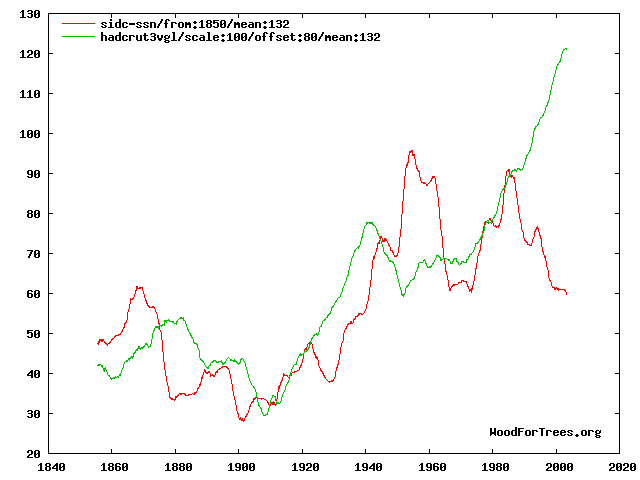
The commenter links to this graph, which I will include.  It is a comparison of the Hadley CRUT3 global temperature index (green) and sunspot numbers (red):

mean-132

Since I am so ridiculously immature, I guess I don’t trust myself to interpret this chart, but I would have happily used this chart myself had I had access to it originally.  Its wildly dangerous to try to visually interpret data and data correlations, but I don’t think it is unreasonable to say that there might be a relationship between these two data sets.  Certainly not 100%, but then again the same could easily be said of the relationship of temperature to Co2.  The same type of inconsistencies the commenter points out in this correlation could easily be made for Co2 (e.g., why, if CO2 was increasing, and in fact accelerating, were temps in 1980 lower than 1940?

The answer, of course, is that climate is complicated.  But I see nothing in this chart that is inconsistent with the hypothesis that the sun might have been responsible for half of the 20th century warming.  And if Co2 is left with just 0.3-0.4C warming over the last century, it is a very tough road to get from past warming to sensitivities as high as 3C or greater.  I have all along contended that Co2 will likely drive 0.5-1.0C warming over the next century, and see nothing in this chart that makes me want to change that prediction.

Update #2: I guess I must be bored tonight, because commenter Jennifer has inspired me to go beyond my usual policy of not mixing it up much in the comments section.  A lengthy response to her criticism is here.

Whew! Done.

OK, I think I have finally, successfully migrated both my blogs from the Typepad ASP service to self-hosted Wordpress. Many of you on feeds may have gotten a one-time slug of about 10 old posts in your feed (sorry). This was an artifact of the change of feed sources toFeedburner and should not happen again. Overall, I am very pleased with the results. The sites look better , they are easier to modify, they run faster, and the back-end interface is MUCH better. Most of you don’t care, but I will post on the process I followed to migrate as a repayment to others whose past such posts helped me through the process.

If you are getting this post, you should not have to change any of your settings. Enjoy.

Don’t Count Those Skeptics Out

From Mark Scousen in "Making Modern Economics"

Ironically, by the time of the thirteenth edition [of Paul Samuelsons popular economics textbook], right before the Berlin Wall was torn down, Samuleson and Nordhaus confidently declared, "The Soviet economy is proof that, contrary to what many skeptics believed [a reference to Mises and Hayek], a socialist command economy can function and even thrive."  From this online excerpt.


Meet the Future

Environazis

Eleboat2

Tower

Hat Tip to a reader.  I am envisioning a "Team America:  World Police" sequel.

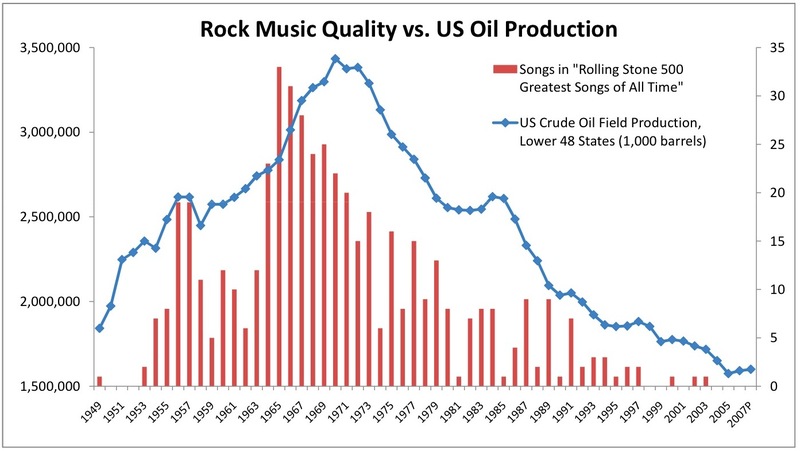
From the Correlation Not Equal Causation Department

Rs500usoilproduction1

More here.  Maybe we can get Mann to calculate some correlation statistics for this.

Climate Tourism

While driving between some of the campgrounds we run in Inyo and Mono County, California, I stumbled across the White Mountain bristle-cone pine forest.  I just couldn’t resist checking it out.  Of course, it through me off my schedule for an hour or so, but its not the first time that bristle-cones have been a source of divergence ;=)

PS-  I had a crappy rent car, but if you have a sports car and are near Highway 168 east of Big Pine, CA, you should definitely give it a test drive.  It would be a real hoot to drive with the right car.

Comments on NOAA USP Draft

As promised, here are my comments on the USP Global Climate Change draft.  I simply did not have the time to plow through the entire NOAA/NASA CCSP climate change report, so I focused on the 28-page section labeled Global Climate Change.  Even then, I was time-crunched, so most of my comments are cut-and-pastes from my blog, and many lack complete citations.  I would feel bad about that, except the USP report itself is very clearly a haphazard cut-and-paste from various sources and many of its comments and charts totally lack citations and sources (I challenge you to try to figure out even simple things, like where the 20th century temperature data on certain charts came from).

Nice Animation

This is a pretty cool animation of world weather patterns over the last 24 hours.  There are more here, at Anthony Watt’s weather information company.

Another Assessment of Hansen’s Predictions

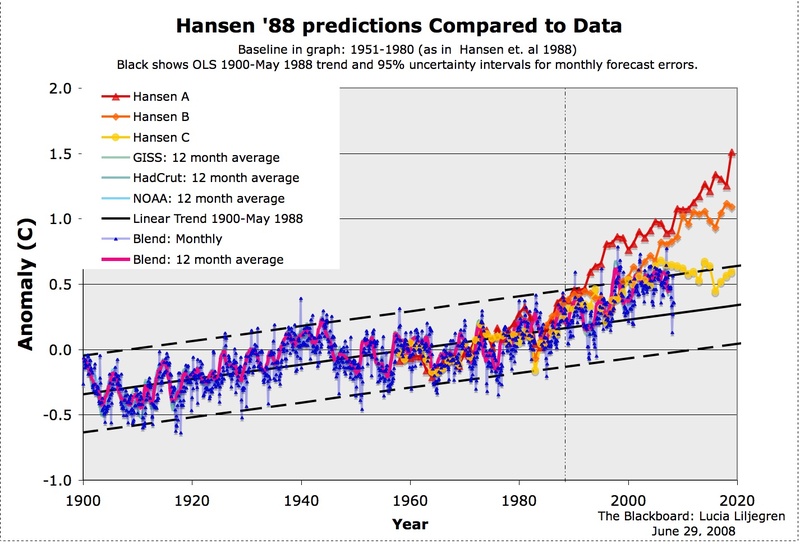
The Blackboard has done a bit more work to do a better assessment of Hansen’s forecast to Congress 20 years ago on global warming than I did in this quick and dirty post here.  To give Hansen every possible chance, the author has evaluated Hansen’s forecast against Hansen’s preferred data set, the surface temperature measurements of the Hadley Center and his own GISS  (left to other posts will be irony of a scientist at the Goddard Institute of Space Studies at NASA preferring klunky surface temperature measurements over satellite measurements, but the surface measurements are biased upwards and so give Hansen a better shot at being correct with his catastrophic warming forecasts).

Here is the result of their analysis:

Hansenlineartrend

All three forecasts are high. 

Don’t be too encouraged at Hansen’s prediction power when you observe the yellow line is not too far off. The yellow line represented a case where there was a radical effort to reduce CO2, something we have not seen.  Note that these are not different cases for different climate sensitivities to CO2 — my reading of Hansen’s notes is that these all use the same sensitivity, just with different CO2 production forecast inputs. In fact, based on our actual CO2 ouput in the last 20 years, we should use a case between the orange and the red to evaluate Hansen’s predictive ability.

Polar Bears and Combustion

The biggest danger to polar bears may not be combustion, but incomplete combustion.  Inefficient or incomplete combustion can lead to carbon particles or dense hydrocarbons going up the smokestack (or exhaust pipe).  We commonly call this soot.  It is one reason white marble buildings in cities look so dingy, and it is a pollution problem we have done a lot with in the US but is way down the priority scale in places like China.

It turns out, though, that soot may have more to do with melting ice and rising arctic temperatures than CO2, and this is actually good news:

“Belching from smokestacks, tailpipes and even forest fires, soot—or black carbon—can quickly sully any snow on which it happens to land. In the atmosphere, such aerosols can significantly cool the planet by scattering incoming radiation or helping form clouds that deflect incoming light. But on snow—even at concentrations below five parts per billion—such dark carbon triggers melting, and may be responsible for as much as 94 percent of Arctic warming.

“Impurities cause the snow to darken and absorb more sunlight,” says Charlie Zender, a climate physicist at the University of California, Irvine. “A surprisingly large temperature response is caused by a surprisingly small amount of impurities in snow in polar regions.”

Zender, physicist Mark Flanner and other colleagues built a model to examine how soot impacts temperature in the Arctic and Antarctic regions. Temperatures in the northern polar region have already risen by 1.6 degrees Celsius (2.88 degrees Fahrenheit) since the dawn of the Industrial Revolution. The researchers incorporated information on soot produced by burning fossil fuels, wood and other biofuels, along with that naturally produced by forest fires and then checked their model predictions against global measurements of soot levels in polar snow from Sweden to Alaska to Russia and in Antarctica as well as in nonpolar areas such as the Tibetan Plateau….

Whereas forest fires contribute to the problem—the effect noticeably worsens in years with widespread boreal wildfires—roughly 80 percent of polar soot can be traced to human burning, adding as much as 0.054 watt of energy per square meter of Arctic land, according to the research published this week in the Journal of Geophysical Research. When the snow melts, it exposes dark land below it, further accelerating regional warming. “Black carbon in snow causes about three times the temperature change as carbon dioxide in the atmosphere,” Zender says. “The climate is more responsive to this than [to] anything else we know.”

If correct, this is an incredibly powerful finding, for a couple of reasons.  First, over the last 30 years since we have had good satellite temperature measurements, the vast majority of the warming has been in the Arctic, with temperatures flat to down in the tropics and the Antarctic.  This has never made much sense in the context of greenhouse warming theory (though its proponents have tied themselves into pretzels trying to explain it) since global warming theory (as embodied in the last IPCC report) holds that the largest temperature gains should be in the lower troposphere over the tropics, and offers no reason why the warming in the Artic should be orders of magnitude larger than in the Antarctic. 

But this soot theory turns it all around.  By this theory, the warming of the Arctic partially results from the loss of ice, rather than the other way around.  And no one would deny that the Artic should have much more soot than the Antarctic, since Northern Hemisphere industrial output dwarfs that of the Southern Hemisphere (and most all soot stays in the hemisphere in which it was created).  This would help explain the differential vs the tropics (soot has less effect on warming when it falls on a rain forest than on snow) as well as the differential between Artic and Antarctic.

But the theory is powerful for another reason:  It would be MUCH easier to engage in a global effort to reduce soot substantially.  While CO2 is a necessary bi-product of combustion, soot is not.  Better furnace design and exhaust gas scrubbing, as well as some gasoline reformulations and internal combustion tweaks, would make an enormous dent in soot production, an effort I would gladly support.

Postscript:  You may actually have heard of black carbon in the context of global warming.  Over the last decade, when climate alarmists began running their catastrophic warming models backwards, they found they vastly over-predicted past warming.  To save their models (god forbid anyone would rethink the theory) they cast about for potential man-made cooling effects that might be masking or offsetting man-made warming.  In this context, they settled on sulfur dioxide aerosols and black carbon as cooling agents (which they are, at least to some extent).  Not having a good theory on how much cooling the cause, they could assign arbitrarily large numbers to them, in effect making them the "plug" to get their models to fit history.

With a bit more research, scientists are beginning to admit the cooling effect can’t be that great.  The reason is that unlike CO2, black carbon and aerosols break down and come to earth  (as soot and acid rain) relatively quickly, so that they have only limited, local effects in the areas in which they are produced.  At most, a third of the world’s land area or about 8% of the entire earth’s surface had any kind of concentrations of these in the atmosphere.  To have a cooling effect of .5-1.0C (which is what they needed, at a minimum, to make their models work running backwards) would imply aerosols were cooling these selected areas of effect by 6-12 degrees Celsius, which was totally improbable.  Besides, almost all of these aerosols are in the norther hemisphere, but it has been the southern hemisphere that has been cooler. 

Price / Value of Solar

I have a big four thousand square foot roof in one of the greatest solar sites in the world (6 equivilent hours of full sun a day) that is just begging for solar panels.  Except that even with substantial government subsidies, the payback numbers are awful. Lynne Keisling reports that this may be about to change:

There are a couple of very interesting recent solar developments that have substantial economic implications. First, the blue sky stuff: courtesy of Slashdot, a team of researchers in the Netherlands have demonstrated avalanche effects in semiconductors that can be used in solar cells (here’s the original article). Avalanche effects mean that instead of having a 1:1 relationship between a photon and an electron, in which 1 photon releases 1 electron, it’s physically possible in these nano-scale semiconducting materials to have 2:1 or even 3:1 — 2 or 3 electrons released per photon in the material. This means twofold or threefold increase in the possible energy intensity of the solar cell material. These nanocrystals are even inexpensive to manufacture. How cool is that?

What are the economic implications of this new material and new knowledge? The low energy intensity of solar cells has been a factor in making solar a less cost-effective means of generating electricity than fossil fuels, which are extremely energy intensive. This avalanche effect can mean smaller, more energy intensive solar cells, which changes the cost structure for solar. I think it will certainly shift the long-run average cost curve downward, which creates an opportunity for solar retailers to reduce prices. A lower solar retail price shifts the price ratio between solar power and all other electricity power sources. For example, the price ratio between solar-generated and coal-generated electricity would shift such that at the margin, consumers would substitute out of coal-powered electricity and into solar-powered electricity. If I were better at generating the isoquant and indifference curve graphs electronically, I’d show it here graphically … but the logic is straightforward.

Unfortunately, we have been hearing this for years.  I price solar out on my home just about once per year, and the numbers have not changed for a while.  Here’s hpoing….

Phoenix Misses Record Low. Kindof. Sortof.

This morning, Phoenix hit 51F, just missing the record of 49F last set in 1965.  But as I mentioned in my previous post on the record high we hit (just four days ago!), the growth of the Phoenix urban heat island in the last 4 decades has a lot to do with how these records are set and not set. 

The Phoenix urban heat island has been measured many times, including by my son in a recent science project.  In that project we measured an urban warming of 8-10F around midnight vs. the outlying areas of the city.  We have not measured the daytime heat island effect, but others have, such that it is not hard to imagine that the record high set four days ago would not have been a record when the city was smaller.  Today, we can similarly argue that we could have easily had a record low last night, since we only missed by 2 degrees, had it not been for the heat island effect.  While 2 vs. 8-10 degrees seems compelling, we also had a lot of wind last night that tends to break up the urban heat island effect, so we can never be sure.

Victory of Ignorance

Well, I guess we all expected it, but it is no less galling to see polar bears listed by the US Government as a threatened species.  This despite rising polar bear populations and no evidence that a smaller Arctic ice cap will have a negative effect on the bears.   This is, even by admission of its supporters, mainly intended as an open license to sue any one or group over anything that has any element of economic growth.  Freeway projects in Arizona, power plants in Florida, desperately needed new refineries in Texas, oil drilling in the Gulf of Mexico, and even a new shopping mall in California can now be held up in court as a danger to polar bears.

Here are a few reactions.  From my Princeton classmate Henry Payne:

Once again, my profession — journalism — failed its fundamental duty to report the facts Wednesday as the Interior Department bowed to political pressure from green groups to declare polar bears an threatened species due to global warming. This, despite the fact that bear populations have increased from 5,000–10,000 in the early 1970s to between 20,000 and 25,000 today (during the very period their habitat was allegedly shrinking). This is in part due to concentrated efforts to impose harvesting controls that have allowed this once-overhunted species to recover.


Indeed, Dr. Mitchell Taylor, a bear biologist with the Canadian government, wrote in 2006: “There is no need to panic. Of the 13 populations of polar bears in Canada, 11 are stable or increasing in number. They are not going extinct, or even appear to be affected at present.”


This data is readily available in the public record, and yet a review of reports from America’s two leading print sources found nary a mention. The Associated Press completely ignored the bear population data and any critics of the decision. As for The New York Times, reporter Felicity Barringer also ignored the data, but at least alluded to it by quoting M. Reed Hopper of the Pacific Legal Foundation (which is suing the Department of the Interior over the decision) at the very end of her article as saying: “Never before has a thriving species been listed nor should it be.”

From the Wall Street Journal:

Polar bears are not the fragile, vulnerable creatures of liberal iconography. They have thrived in the Arctic for thousands of years, both through periods when their sea-ice habitat was smaller, and larger, than it is now. They will continue to adapt – and the Endangered Species Act can’t make the slightest difference.

Such realities haven’t prevented green showboaters from claiming victory after the Bush Administration designated the polar bear as a "threatened" species yesterday. And it is a kind of victory, though the ruling itself is mostly symbolic – at least for now. However, this is really the triumph of bad legislation over the democratic process.

From the SPPI via Q&O:

Although two polar bear subpopulations (Western Hudson Bay and Southern Beaufort Sea) no longer appear to be viable due to reduction in sea ice habitat, polar bears as a species do not appear to be threatened by extinction in the foreseeable future from either a demographic or an ecological perspective.

[...]

Current and historical polar bear subpopulation performance demonstrates that viable polar bear subpopulations have persisted and generally increased throughout the current period of climate warming …

The popular notion that polar bears are declining or already expatriated worldwide has been initiated and perpetuated by environmental organizations and individuals who apparently believe that current subpopulation numbers and trends are an insufficient basis for an appropriate status determination. … Anecdotal information, although useful and interesting, is not equivalent to scientific information based on valid statistical analysis of sample data.

From TJIC:

Let’s just all ignore the Canadian government study that showed that polar bear population is up over the last two decades.

Let’s also ignore the fact that arctic sea ice grew faster in 2008 than ever before : 58,000 square miles of sea ice per day, for 10 days straight.

“Because polar bears are vulnerable to this loss of habitat, they are, in my judgment, likely to become endangered in the foreseeable future – in this case 45 years,” Kempthorne said at a news conference in Washington.

So if short term, potentially random variations are taken as a trend, and if we extend that trend out half a century, then polar bears are “likely” to become endangered … and therefore they are declared endangered now

From Marc Sheppard:

Now consider this — taken but a miniscule regulatory step further, a family motoring about in an SUV in Texas could be cited not only for polluting under the Clean Air Act, but as their “pollution” has been regulated as a global warming contributor, they could be further fined under the Endangered Species Act for harming the protected polar bear.
Did I mention that penalties for such ESA transgressions can be a maximum fine of up to $50,000 or imprisonment for one year, or both — per violation?

The Benefits of Warming

Keith Sherwood and Craig Idso of CO2 Science, as published at ICECAP:

In the introduction to their illuminating paper, the authors (Zhang, etal 2007) say they previously studied “a long span of Chinese history and found that the number of war outbreaks and population collapses in China is significantly correlated with Northern Hemisphere temperature variations and that all of the periods of nationwide unrest, population collapse, and drastic change occurred in the cold phases of this period.” In their current study, they write that they “extend the earlier study to the global and continental levels between AD 1400 and AD 1900.” This they do by using high-resolution paleoclimate data to explore “at a macroscale” the effects of climate change on the outbreak of war and population decline in the pre-industrial era as discerned by analyses of historical socioeconomic and demographic data.

In describing their findings, the five scientists say their newest analyses, like their earlier ones, show that “cooling impeded agricultural production, which brought about a series of serious social problems, including price inflation, then successively war outbreak, famine, and population decline.” And they suggest, as they put it, that “worldwide and synchronistic war-peace, population, and price cycles in recent centuries have been driven mainly by long-term climate change,” wherein warm periods were supportive of good times and cooling led to bad times, some of which (in our opinion) could arguably be described as a descent into hell.

Frequent readers of this site will know that I have often pointed out how researchers who publish results that refute the catastrophist storyline often feel obliged to tag on to their paper a pro forma statement of support for the catastrophist position, even if nothing in their results support such a conclusion.  My sense is that this is similar to Copernicus singing the praises of the Catholic Church to try to forestall their wrath over his science.  Sherwood and Idso find something similar in Zhang:

Interestingly, after having presented an essentially ironclad case for their finding that warmer periods throughout human history have almost always been more conducive to good times than bad times throughout the majority of the Northern Hemisphere, Zhang et al. conclude their paper by suggesting just the opposite, i.e., that bad times would likely follow any future global warming that might occur, throwing all of their findings to the wind and listing as their reason for doing so the usual litany of unduly-catastrophic consequences that climate alarmists insist will follow any temperature increase that might occur, while stating that “the current high global average temperature (which has never been experienced in the last two millennia) is continuing to rise at an accelerated speed.”

If Journalists Could Do The Numbers, They Wouldn’t Have Been Journalism Majors

From Dominic Lawson via Tom Nelson:

One thing is clear; the British public does need educating about this: even one of The Independent’s most intelligent commentators wrote here last week that "The mini-windmill on David Cameron’s new house is an economical way for an individual household to generate electricity, even contribute to the national grid". Well, that’s if you consider it economical to spend thousands of pounds on a roof-top turbine that produces – even according to its supporters – no more than 1 megawatt hour per year, worth £40 unsubsidised on the wholesale electricity market. As a contribution to reducing CO2 emissions it’s about as cost-effective and meaningful as cycling to the House of Commons while having your chauffeur-driven car follow you with your briefcase, suit and black lace-up shoes.

Ash and Ice

A number of scientists have suggested that melting ice in the Arctic and rising Arctic temperatures may have as much to do with ash deposits (mainly from man-made combustion) than from other causes.  In particular, plants in China are not well-designed to capture the combustion by-products as well as we do here in the US.  Mike Smith has an interesting set of photos of the quite rapid melting effect ash can have on snow pack. 

There is actually good news here.  The problem with CO2 abatement (vs. abatement of about any other pollutant you can think of) is that CO2 is fundamental to the combustion process.  We can eliminate most of the SO2 or ash pollution from coal burning, but not the CO2.  As I posted just yesterday, I would love to see an effort to clean up the Chinese coal plants — this ash issue is just another reason.  Unfortunately, global warming alarmists are working against this goal.  First, they focus attentino on getting China to get rid of coal plants altogether, a non-starter.  But second, warming alarmists don’t want the Chinese to clean up their coal plants, because they fear that this would make it politically easier for them to keep them running.