
It is almost impossible to avoid stories about Arctic sea at the lowest recorded level. The National Geographic, who should know better, had the temerity to headline "Arctic Ice at All-Time Low". All-time? Really? In the 6 billion year history of the earth, this is the least ice ever in the Arctic? Well, no, it’s the least since we have started measuring it. So when was that? Only since about 1979 when we had sattelites that could make this measurement. OK, so its the least ice in about 25-30 years.
To a one, scientists and media making this observation about Arctic sea ice use it as a leading indicator of catastrophic global warming. The National Geographic even suggests it is evidence that we are at a tipping point, or a cusp of rapid acceleration of warming.
There is little doubt the Arctic has been warming the last 30 years or so, but some doubt whether it is warmer even than the 1940’s. Be that as it may, last I checked there were two poles with sea ice. It’s funny no one ever mentions the South Pole. Do you think that they just forgot? Or could it be that the facts don’t conviniently fit the storyline? Luboš Motl picks up the story:
Some analysts have speculated that the new record could be evidence of global warming. But is it? Even though it may sound very complicated, it turns out that the Earth is round. At the global scale, there is not one polar region but, in fact, two. There is also sea ice on the Southern Hemisphere. It turns out that the Antarctic sea ice area reached 16.2 million squared kilometers in 2007 – a new absolute record high since the measurements started in 1979
The data is here:
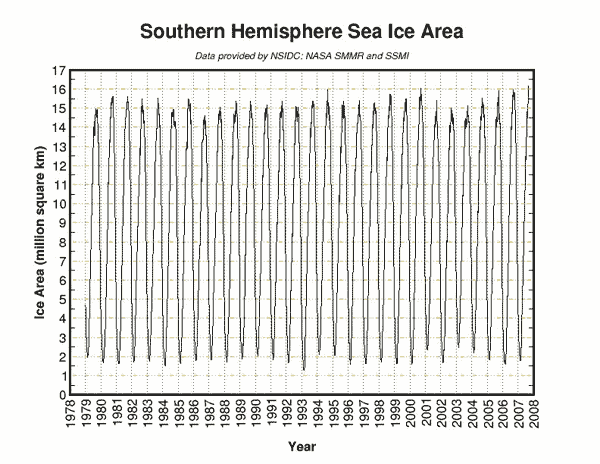
If you watched An Inconvinient Truth, you will be saying, "this can’t be right." In that movie, Al Gore and company showed compelling films of melting and warming in Antarctica. Well, it turns out that most of Antarctica is seeing more snowfall and ice formation and the same or colder temperatures, but one small area, about 2% of the landmass on the Antarctic penninsula, is seeing warming. Guess which area the movie chose to focus on?
Even if the Antarctic were warming, most climate scientists expect snow and ice pack to increase there, not decrease. Yes, warmer weather melts ice, but Antarctica is so freaking cold a few degrees are no more likely to melt ice than steel is to melt in the Arizona sunshine. But warmer weather does vaporize more water, which is expected to fall as snowpack in Antarctica. That is why despite Al Gore’s claims that oceans will rise 20 feet or more, serious scientists don’t expect much more than a foot, even with warming numbers far higher than I think are credible. That’s because ice melting in Greenland and other glaciers is offset by increasing snow pack in Antarctica (melting sea ice has no effect on ocean levels, since the ice floats, for the same reason that ice melting in your glass of water will not cause the glass to overflow).
By the way, since we are talking about retreating ice, here is a picture showing the retreat of the Glaciers at beautiful Glacier Bay, Alaska.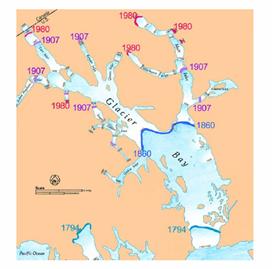
So most of the retreat of the glaciers occured between 1794 and 1907, which is fairly hard to correlate with man’s use of fossil fuels or global CO2 levels.
While I find the information you present to be quite logical and convincing, the impending climate disaster/immediate action required movement continues on.
For example the David Suzuki foundation. Suzuki is a scientist and held in high regard here in Canada and he beats the climate disaster drum as hard as anyone.
Why do highly regarded intelligent scientists like Suzuki take the position they do? any comments http://www.davidsuzuki.org/Climate_Change/Science/Skeptics.asp
Regardless of what “most climate scientists expect” with regard to ice at the poles, the measurements are showing 57 cubic miles of ice loss per year in Greenland and another 36 cubic miles of ice loss per year from the Antarctic ice sheet. Sea ice extent isn’t nearly as important a measure of climate change at the poles as is net ice loss.
Source: http://www.colorado.edu/news/releases/2006/300.html
Sir,
Forgive me if I’ve missed the answer to this question regarding glacial meltback, but what has been Glacier Bay’s meltback in terms of ice volume? For example, if a 1Km retreat at the broad mouth of the bay involved X cubic Km of ice, a 1Km retreat way up in the narrow valley would involve much less volume. In volumetric terms, has the average rate of retreat significantly increased post-1900 (better yet, post-1940) compared to pre-1900 (1940), or not? Just eye-balling the map it would seem volumetric rates were higher pre-1900.
Thank you,
DavidN
While it is true that snowfall in Antarctica is increasing, the increase is hardly enough to offset the great ice melt around the world (Antarctica included). Antarctica is known as one of the driest places on Earth. Even if precipitation doubled, it would hardly amount to anything on a global scale.
While the information you present is compelling and presented in a logical manner, it disagrees with what my High Priest Al Gore says, and since he is more famous, better looking, and really got cheated out of the Presidency he so richly deserved,…
… and you don’t have any pictures of happy smiling polar bears and penguins clinging to newly formed and growing icebergs to support your contentions,…
… you MUST be wrong.
Does not the increased snowfall and the collapse of the Larson B ice shelf, which I assume is the 2% you refer to and has apparently been stable for 12,000 years (according to a Queens University study) indicate that the Antartic is actually warming?
Let’s all get ready to turn over to our soverignty to the One World Order economy based on Carbon (6protons 6neutrons 6electrons) credits.
Maybe we’ll need to enforce carbon restrictions by making sure citizens of the world do not exceed their carbon allotment. I know we’ll make everyone carry a smart card to identify themsleves and their carbon use. That won’t work cards can be counterfitted let’s make it a permanent mark that cheating will be impossible.
PLEASE DO NOT LET THIS HAPPEN.
I do not rely upon opinions by politicians to decide whether there’s man-made global warming in full-swing. However, I DO listen intently and with great interest to scientists, and read their research papers, in determining whether global-warming is occurring, and if so, how fast. If anyone with ANY interest on this subject were to listen and read what is being written and said by scientists who have made it their life’s work to study the environment, then you’d know that more than a preponderance of evidence exists to clearly show that man has ruined the planet.
For example, scientists at both the University of Maine and the University of New Hampshire have been studying core samples taken from ice at both the North and South poles. These scientists have been able to look back millions of years through testing, analyzing and studying particulate matter taken from these cores. They were able to look back 65 million years (and farther) in determining when dinosaurs were wiped from the face of the planet. The period immediately following was marked by an almost total lack of sunlight, owing to eruption of volcanoes and other matter into the air. The period immediately following this event clearly showed a layer of fungi – the only living organisms that can exist without any sunlight.
Since this is the only record available, no one can say with certainty that this unequivocally documents these events. However, scientists have been able to document, without equivocation, that this record is a reliable one. They have been able to test the veracity of using ice layers to document, year by year, changing weather conditions. Scientists, who have no political axe to grind, have almost unanimously agreed that this is a reliable method to use. Scientists, who have devoted their life’s work to this research, are not at all likely to compromise their conclusions by caving to extremist views. Unfortunately, these extremist views are shared by the White House. Indeed, White House advisors on environmental issues are connected to the oil lobby. One was from the American Petroleum Institute; another left his White House position to accept a job with ExxonMobil.
It is also true that a large number of those who deny established scientific evidence also deny Evolution. They insist that intelligent design is a scientific theory. This despite the face that a Santorum and Bush nominated, Senate-approved US District Court Judge found that intelligent design is religion masquerading as scientific theory. ID proponents agreed to forgo a jury in favor of what they thought would be a slam-dunk trial by judge.
This Administration is an enemy of the environment, and the planet. Only a Democratic President can, and will, change things in Washington.
Now I finally understand,intelligent design is
masquerading,therefore responsible for man made global warming?Randy from Maine,let me enlighten you about some facts.The original Amundsen-Scott south
pole reasearch station build in 1956,is at this moment 30 feet under ice.Eight to ten inches of ice and snow accumulate on average every year on the southpole,without ever melting.The station was replaced in 1968 by the geodesic dome[finished in 1975]But the dome was getting slowly swallowed up,by
the growing icefield again.Now it is going to be replaced by the latest technical wonder,the new National-Sience Foundation station,to be finished in january of 2008.The new station which is capable of being raised hydraulically over the years,to keep it above accumulating ice.Global Warming?Man made?I also
noticed you mentioned scientists not having a political axe to grind.Yes,the ones that work for the UN,and getting paid by the UN do.You did not mention any names either.I will give you some names with the opposing opinion,from the world over,check this out.Dr.Ted Murty,Dr.Tim Ball,Dr.Ian Clark, Dr.Hendrik Teimekes,Dr.Gary Sharp,Dr.Fred Singer,
Dr.Sally Baliunes,Dipl.Ing. Peter Dietze,Chris Landsea,Dr.Asmunn Moene,Dr. Paul Reiter,Dr.Niels Axel
Morner,I can list many more,that disagree with the UN
and the Al Gores of this world.Talking about Mr.Gore,
there is one other person that shared the Nobel Piece
price with him.His name is never mentioned anywhere
in the media,because he has the opposing view of
Mr.Gore.His name is LORD CHRISTOPHER MONCKTON.Lord
Monckton has challenged Mr. Gore to a public debate,
But slick Al refuses.Now to all you scare mongers,
the debate over global warming is NOT over.
So, if we have Global Warming…what happens? It gets warmer. So, a few extra degrees, is this going to destroy the human race? I have never heard the catastrophic event that this Warming creates. Stronger storms, the oceans are a little higher…what is the big deal. We have been here for (4)four billion years. We are so overly adaptable, that our numbers are skyrocketing. It is hubris to think that this will overcome Man’s ability to adapt!
Fear Baby! That’s what makes the World Go Round…kind of sad!
Excellent post Randy from Maine!!!
More facts are needed!!
Most commentators will eat their words before the next decade is out!
What lunacy, to think that humans are responsible for climate change.
Our atmosphere is between 30% and 90% water vapour 90% of the time acting as the primary greenhouse gas and always has been.
0.035% CO2 is going to be so minimal in its effect it should be ignored in fact we need more !!
It is so appalling that so many people are so ignorant to believe the rubbish that our government’s spew out.
We have become so apathetic that we no longer discriminate.
Its all we hear about – just keeping the populace scared, living in fear and paying extra taxes for the privalidge.
If anyone thinks that humans are responsible for climate change, then unfortunately they really are unbelievably stupid.
Randy from Maine: DO NOT attempt to put me in line with the same people that do not believe in evolution. I belive in science also, and I WILL NOT believe anyone who believes in the AGW line and says that they have actually read the papers. Not the synopsis of the papers (IPCC and the like), but the papers. The data. The calculations. The actual data and studies will result in much egg on face. Hopefully not for science in general, since I am a scientist and lover of science. But hopefully, the bastard child known as media-politics-psuedo science, aka AGW, will die publically. My hope is that never again will such an ugly beast be created as we begin to forget about how silly we were in believing in alarmist AGW.
Its hard to correlate Glacier Bay glacier retreats to global warming. However, it is easy to see the glaciers retreated due to man-made pollutions. As reported in Green Car Congress for August 9, 2007, Joe McConnell & Ross Edwards stated that between 1850 & 1950, American industry poured dark particulate matter & pollutions into the atmosphere. Not only were people sickened in near cities, but prevailing winds carried these v. dark particles directly to the ices of Greenland. Greenland ice core studies concentrating on vanillic & sulfur indicate that man-made pollutions were 8 times more effective than ‘natural’ forest fire carbon at warming & melting Greenland ices.
http://news.bbc.co.uk/2/hi/in_depth/7299561.stm
i suppose the bbc is wrong about the world’s glaciers as well…
Some comments on the expanding Southern Hemisphere sea ice can be found here:
http://staff.acecrc.org.au/~preid/discussion/discuss_Sep2007.html
To Nick Bagetellos 12/24/07: Our species has not been here 4 billion years. Modern homo sapiens is about 100,000 years old. We have only begun significant alterations to our environment since the advent of agriculture, around 10,000 years ago. Industrial pollutants took off on a large scale only for the past two centuries. Our skyrocketing numbers are part of the problem. Yes, we are adaptable. Most environmental changes occur over significant spans of geologic time, providing time for organisms to adapt through random mutation and natural selection. Sometimes change occurs during a brief period of time. The end of the permian and cretaceous epochs are marked by mass extinctions, both which may have been the result of large asteroid impacts.
It is just as ridiculous to think humans MIGHT be responsible for climate change as it is to think we could pollute an entire river or a lake through careless toxic emissions. Utterly ridiculous, right? And so much cheaper to just dump waste into rivers and streams, where it belongs. Phosphorus promotes plant growth. Used motor oil–I’m sure we can dream up a few benefits for that, if we try hard enough. Warmer global temperatures may make siberia and northern canada more habitable, in addition to killing off billions of people in undesirable places like Africa and the Middle East. So every cloud has a silver lining. I for one am glad I live in the country responsible for the most carbon emissions and with the highest per capita energy consumption. It is nice to be a world leader in these areas, and to abdicate any responsibility for the ensuing disasters. In a few million years the earth may recover, and our descendants will marvel at the resources we squandered.
Going-to-the-Sun Highway in Galcier Park is not open, latest ever except for 1943 during WWII. I would think we have better equipment than we did in the 40’s, so if you think about it, is this the latest opening ever? And where is Hollywood and all the screaming about the floods in the Mid West? I have not heard where George Bush caused that. And we have not had a hurricane hit the US in two years, does that contribute to the drought in the southeast? The probelem is global food supply. Corn and soybean acres lost in the mid west floods, Irriwadi rice prodcution by the typhoon, China planting due to the earthquake, a major outbreak of Ug99 Wheat Stem Rust in Africa and the in Middle East, Australia is having droughts. Now we have a volcanoe erupting for two months in Chile and the sunspots are not developing for the next cycle. I think we need to quit worrying about what chunk of ice melted or what water froze and get on with prodcuing some food.
According to glaciologists, the world is at the tail end of an interglacial period (warming trend) that has a length of about 10,000 years. Over the next 10,000 years, an ice age will result. Where I live, we are having a record cool summer. I expect many more records of cool weather to be shattered within my lifetime. And, what is all this focus on CO2? Methane is 20 times the greenhouse gas. What causes methane? Trees, dead leaves, etc. If greenhouse gases are really a threat, then we need to cut down more trees. Then again, maybe greenhouse gases aren’t really a threat.
Curious if anyone has tried to determine the cause of the shifting of the magnetic north pole and if it could be impacting localized climate change. Growing ice in the south, melting in the north.
One thing that does seem obvious, only one side of the argument is being allowed in public right now. And that is scary
Randy from Maine made some interesting claims and sourced my alma matter the University of New Hampshire. They are proud of the research they do with regard to ice core samples and justifiably so. I doubt however they would want a distortion of their research propogated by anyone. So I feel warranted to point out the one little problem with your claims. You stated that the ice cores from Antarctica and Greenland went all the way back to the time of the dinosaurs. The problem with that is that Antarctica and Greenland were no where near where they are now due to the shifting of continents so they haven’t always been covered with ice. The ice cores simply aren’t that old. The evidence you suggest simply doesn’t exist.
“When they reach the bottom of the ice sheet, 3000+ meters thick, in 1992 they will have recovered the longest, most detailed, continuous record of climate available from the northern hemisphere stretching back 200,000 years or more through two glacial/interglacial (cold/warm) cycles.”
Source of quote:
http://www.gisp2.sr.unh.edu/MoreInfo/Ice_Cores_Past.html
“Scientists, who have no political axe to grind, have almost unanimously agreed that this is a reliable method to use. Scientists, who have devoted their life’s work to this research, are not at all likely to compromise their conclusions by caving to extremist views.”
Clearly sir, you are not a scientist.
Come back when you’ve worked in an University setting, then you can report to me whether scientists have political axes to grind, or whether having invested your entire life in a particular line of research tends to make one extremist or not.
Global Warming is caused by the earth’s orbit around the sun is destabilizing, and decaying. Greenhouse gases are not to blame, you have been lied too.
http://orbital-decay1.blogspot.com