It’s like a Whole New Post

If you have not visited my post lately on my son’s experiment on urban heat islands, go check it out, its like a whole new post.  Sixty comments and at least five updates.

I appologize to all the climate alarmist posters who have found my son’s project (to measure the Phoenix urban heat island) to be insufficiently rigorous.  I am sure all your baking-soda-and-vinegar volcanoes in 8th grade were much better done.

Measuring the Phoenix Urban Heat Island

Note Updates at the Bottom.  Could we please agree to actually read the whole post and the updates before commenting?  All commenters welcome, and I never delete comments except in the case of outright advertisement spam

This is a project my son did for Science Fair to measure the urban heat island effect in Phoenix.  The project could also be called "Disproving the IPCC is so easy, a child could do it."  The IPCC claims that the urban heat island effect has a negligible impact, even on surface temperature stations located within urban areas.  After seeing our data, this claim will be very hard to believe.

In doing the test, we tried to follow as closely as possible the process used in the Nyuk Hien Wong and Chen Yu study of Singapore as published in Habitat International, Volume 29, Issue 3 , September 2005, Pages 547-558.  We used a LogTag temperature data logger.  My son used a map and a watch to mark our times, after synchronizing clocks with the data logger, so he could match times to get temperature at each location.  I called out intersections as we passed them and he wrote down the times.  At the same time, I actually had a GPS data logger where I gathered GPS data for location vs. time, but I did not share this with him because he wanted to track locations himself on the map.  My data below uses the GPS data, which was matched with the temperature data in an Excel spreadsheet using simple Vlookup calls.

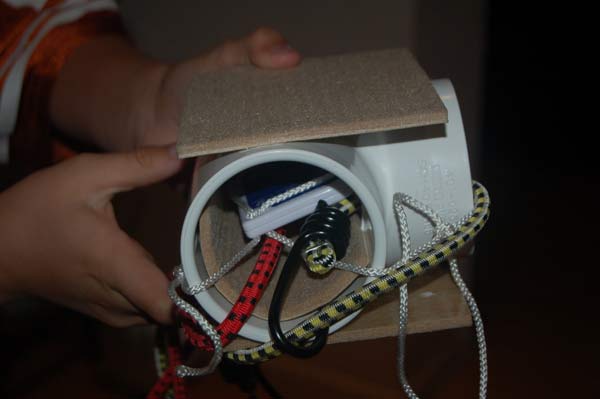
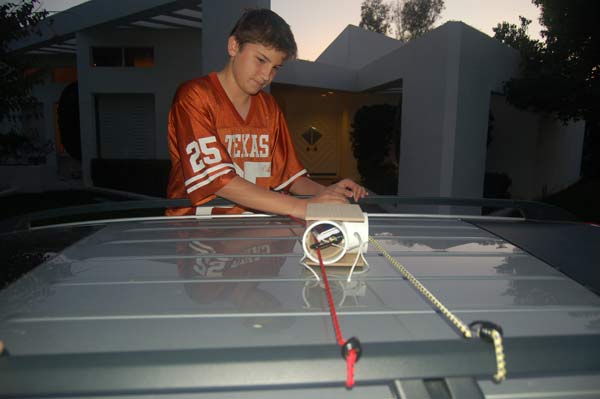
To protect the data logger from the 60mph wind  (we tried to drive at exactly 60 so my son could interpolate distances between intersections) we put the datalogger in a PVC Tee:
Temp2

We added some insulation to reduce the effect of heat from the car’s roof, and then strapped the assembly to the roof with the closed part of the Tee facing forward (the nose of the car is to the left in this picture).
Temp1

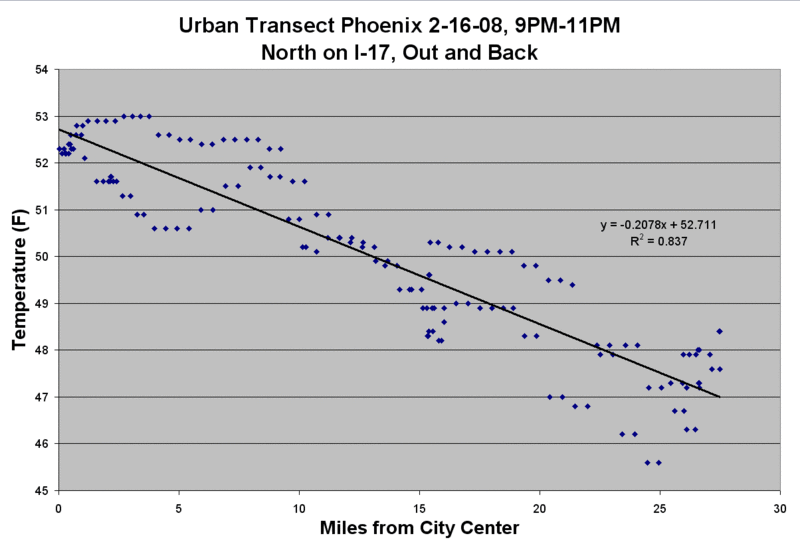
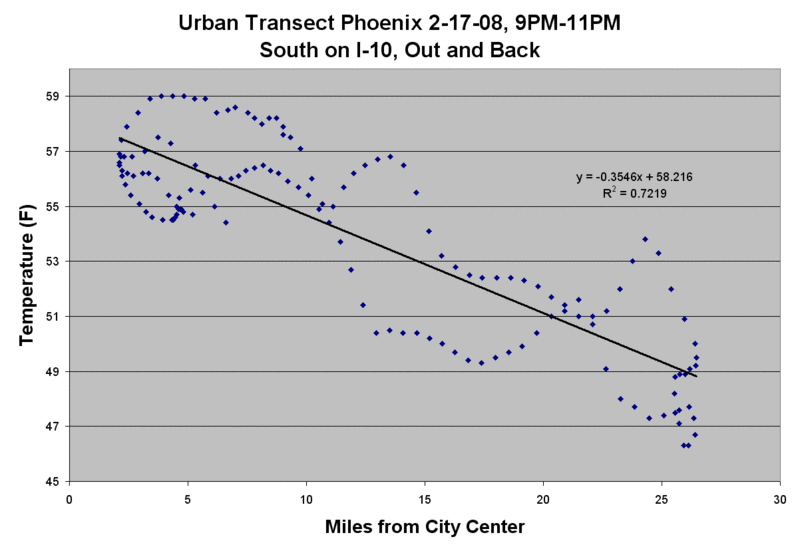
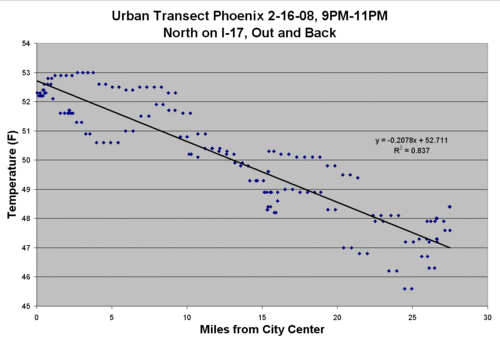
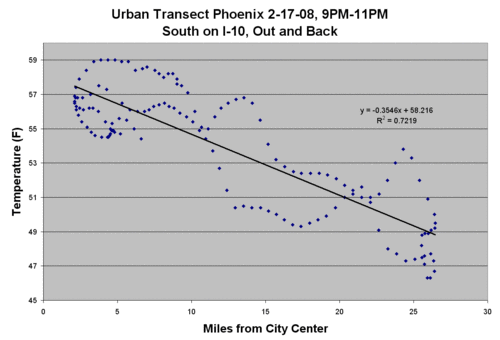
We drove transects two nights in a row.  Both nights were cloudless with winds below 5 mph.  Ideally, we would have driven between midnight and 6 AM, but this was my kid’s science project and he needs to get to bed so we did it from about 9PM to 11PM.  We were concerned that the air might still be cooling during the test, such that as we drove out from town, it might be easy to mix up cooling with time and cooling with location.  Our idea for correcting this was to drive and gather data on an entire loop, starting in the center of town, going about 30 miles out, and then returning to the starting point.  That way, with data taken in both directions, the results could be averaged and the cooling rate would cancel out.  As it turned out, we didn’t even bother to do the averaging.  The two trips can be seen in the plots, but the urban heat island shows through pretty clearly in the data and the slope of the line between temperature and distance was about the same on the inbound and outbound legs.

I used the GPS lat/long points to calculate the distance (as the crow flies) from the center of town (My son did it the hard way, using a tool on Google maps).

The first night we went north (click to enlarge):
Phoenixrun1

The second night we went south.  The urban profile going south is a little squirrellier, as the highway we were traveling tends to dip in and out of the urbanization.
Phoenixrun2

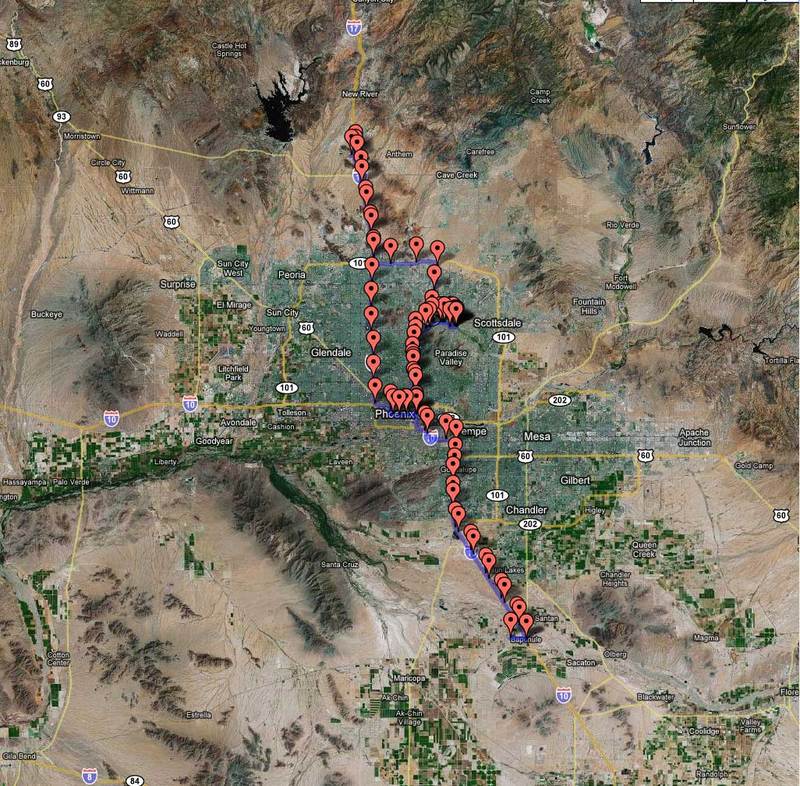
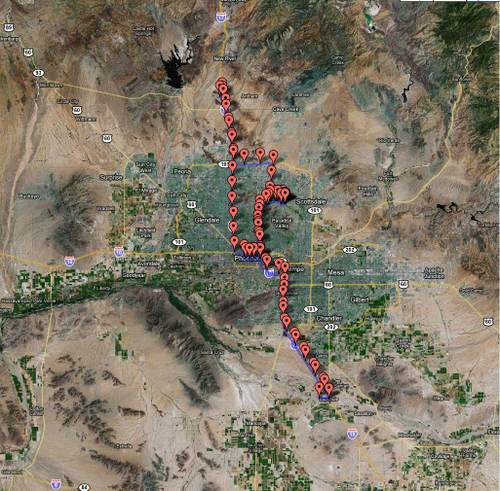
Here is the total route over the two nights.  I’m still trying to figure out the best way to plot the temperatures on the map (again, click to enlarge)
Gpsmap1

You can see the results.  Even at the too-early time of 9-11PM, the temperature fell pretty linearly by about 0.2-0.3 degrees F per mile from the city center (as the crow flies).

I would really love to do is to go down to Tucson and run this same test starting at the USHCN weather station there and driving outwards.  That may have to wait a few weeks until my job calms down a bit.

Update:  Per some emails I have received, it is theoretically possible for the urban heat island effect to be real and to have integrity in the surface temperature record.  The first way this could happen is if the official measurement stations are well sited and outside of growing urban heat islands.  I know for a fact by direct observation that this is not the case.  A second way this might be the case is if one argues that urban heat islands exist but their effect is static over time, so that they may bias temperatures but not the warming signal.  I also don’t think this is very credible, give growth of urban areas over the last 50 years.

A better argument might be that because most US temperature stations are arriving at daily temperature averages from just measuring daily min and max temperatures.  It might be arguable that while urban temperatures cool more slowly at night, they still reach the same Tmin in the early morning as the surrounding countryside.  Unfortunately, I do not think this is the case — studies like this one taken at 5AM have seen the same results.  But this is something I may pursue later, redoing the results at whatever time of day Phoenix usually hits its minimum temperature.

A good argument for the integrity of the surface temperature measurement system is NOT that scientists blind to local station installation details can use statistical tools to correct for urban biases.  After looking at two stations in the Arizona area, one urban (Tucson) and one rural (Grand Canyon) it appears the GISS statistical method, whatever this double-secret process may be [insert rant about government-funded research by government employees being kept secret] it actually tends to average biased sites with non-biased sites, which does nothing to get the urban bias out of the measured surface warming signal – it just spreads it around a little.  It reminds me a lot of my kids spreading the food they don’t like in a thin layer all over the plate, hoping that it will be less noticeable than when it sits in one place in a big pile. 

Again, I have not inspected their procedure, but looking at the results there seems to be a built-in assumption in the GISS algorithms that they expect an equal chance of a site being biased upwards vs. downwards.  In fact, I seem to see more GISS corrections fixing imagined downwards biases than upwards biases.  I just don’t see how this is a valid assumption.  The reality is that biases in outdoor temperature measurement are much more likely to be upwards than downwards, particularly over the last 50 years of urbanization and even more particularly given the fact that the preferred measuremnt technology, the MMTS station, has a very very short cable length that nearly gaurantees an installation near buildings, pavement, etc.

Update #2:  To this last point, consider this situation:  Thermometer one in the city shows 2 degrees of warming.  Thermometer two a few hundred kilometers away shows no warming.  Someone aware of urban biases without a dog in the hunt would, without other data to guide them, likely put their money on the rural site being correct and the urban site exaggerated or biased.  The urban site should be thrown out, not averaged in.  However, the folks putting the GISS numbers together are strong global warming believers.  They EXPECT to find warming, so when looking at the same situation, absolutely sure in their hearts there should be warming, the site with the 2 degrees of warming looks correct to them and the no warming site looks anomalous.  It is for this reason that the GISS methodology should be as public as possible, subject to full criticism by everyone.

Update #3:  I know that many commenters see one line or even a title to a post and jump to the comment section to bang out their rebuttal without reading the post. I typcally do not respond to such folks, but there are just so many here I feel the need to say:  Yes, the IPCC knows urban heat islands exist.  What I said, and I think it is true, is that the IPCC does not believe urban heat islands substantially bias the surface temperature record, and, if they do, their effect can be statistically corrected by approaches like that used by the GISS and discussed above in Update #1.  I admit that this experiment alone, even if the quality was perfect, would not disprove that notion, but it has to make one suspicious (skeptical, even?)  By the way, if you want to yell "Peterson!" at this point, see here.  The volume of interest, pro and con, on this post I think is going to motivate me to go down to Tucson and run the same test with this USHCN station as the urban starting point, and then we’ll see.

By the way, my point is clearly not, as some skeptical supporters might make out, that urban heat biases in surface temperature measurement account for all historical warming.  Clearly that is not true, as satellites, which do not have this urban bias problem, have measured real global warming, though at a lower rate than the surface temperature record.

Update #4:  To some of you commenters:  give me a break.  This is a junior high school science project funded with a $65 temperature logger and a half tank of gas.  I am sure the error bars are enormous and the R-squared probably has little meaning  (to tell the truth, Excel just put it there when I asked it to draw a trend line through the data).  Some of the data on the second run in particular looks weird to me and I would want to do a lot more work with it before I presented it to my PhD review board.  That being said, I would be happy to put it in front of said board next to the typical junior high baking soda and vinegar volcano project.

Given our constraints, I think we did a moderately thoughtful job of structuring the project– better, in fact, than the published Singapore study we emulated.  In particular, the fact that we did the run both ways tends to help us weed out the evening cooling effect as well as any progressive heating effect from the car itself.  I honestly had zero idea what we would find when we downloaded the data to the computer.  I kind of thought it would be a mess — remember, we were not really doing this at the right time of day.   It was not until my son did the charts using his position log he took by hand that I thoughy, "wow, there is a big effect here."   That is when I decanted the data from my GPS logger to check his results using a little more accurate position vs. time data and produced the charts here.  As I said, I really should have averaged position data for the forward and reverse runs, but I think the charts were fairly compelling.

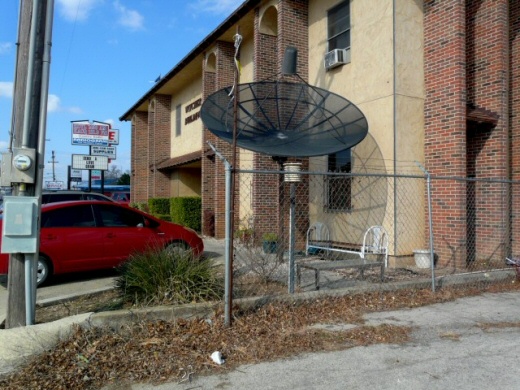
Update #5:  The other half of my son’s project was to participate in the SurfaceStations.org survey of USHCN temperature stations.  He did a photo survey of two sites.  Below is a picture from the USHCN station at Miami, AZ.  Left as an exercise to the commenters who are defending the virtue of the US surface temperature netork:  Explain how siting the temperature instrument within six feet of a reflective metal building that is perfectly positioned to reflect the afternoon sun from the SW onto the instrument does not introduce any measurement biases.  As extra credit, explain why the black gravel and asphalt road and the concrete building 6 feet away don’t store heat in the day to then to warm up the air around the instrument at night as the heat re-radiates.
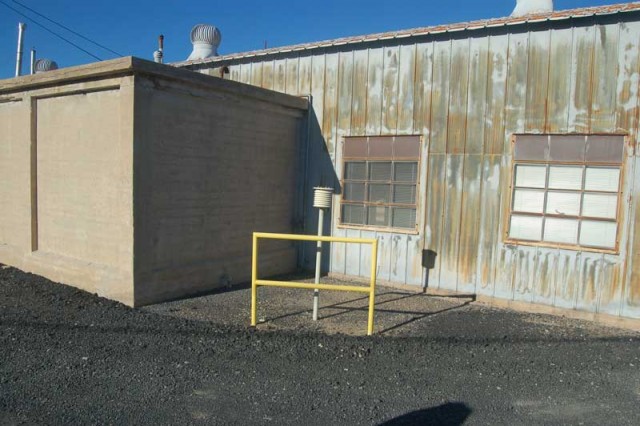

Miamifacingnorth1

More Surface Temperature Measurement Goofiness

I am still stunned that mainstream climate scientists continue to defend the suface temperature measurement record over much more sensible satellite measurement (mainly because the surface temperature readings give them the answer they want, rather than the answer that is correct).  However, since they do, we have to keep criticising until they change coarse.

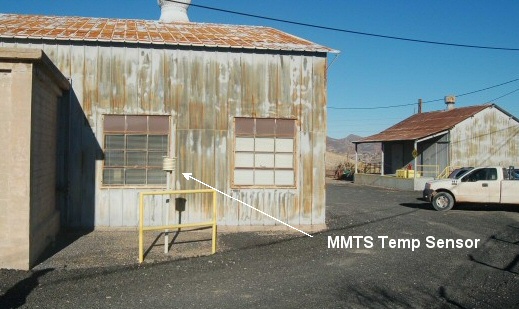
Via Anthony Watt is this temperature station in Lampassas, Texas, part of the USHCN and GISS data bases (meaning it is part of the official global warming record).

Lampasas_tx_ushcn

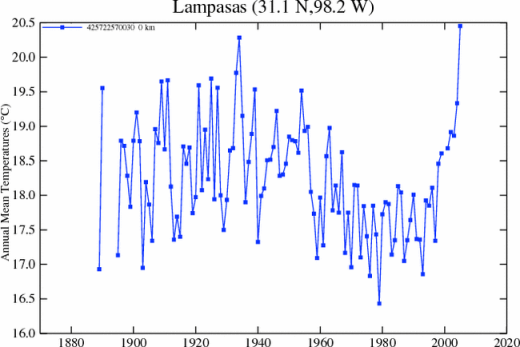
The temerpature instrument is in the white louvred cylindar in teh center.  This installation is wrong in so many ways:  in the middle of a urban heat island, near asphalt, next to a building, near car radiators, near airconditiong unit exhausts.  Could we possibly expect this unit to read correctly?  Well, here is the temperature plot:

Lampasas_tx_ushcn_plot

The USHCN data base says that this station moved here in the year 2000.  Hmmm, do you think that the temperature spike after 2000 is due to this site, or global warming.  By the way, the GISS calls it global warming.

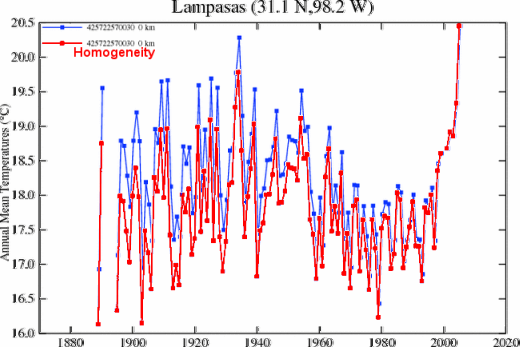
But James Hansen and others at the GISS defend this station and others to the death.  In fact, the GISS extrapolates temeprature trends not only for Lampassas but for hundreds of kilometers around this location from this one station.  Hansen has opposed Anthony Watt’s efforts to do a photo-survey of these stations, saying that his sophisticated statistical models can correct for such station biases without even seeing the station.  OK, let’s see how the adjust this station.  Their adjustment is in red:

Lampasas_giss_rawhomogen

According to the GISS, the temperatures since 2000 have been just fine and without any bias that needs correcting.  However, they seem to think that the temperature measurement in Lampassas in the 1920’s and1930’s (when Lampassas was a one horse town with no urbanization) was biased upwards somehow.  Why?  Well, we don’t know, but based on this adjustment, the GISS thinks this site has LESS urbanization today in this picture than in 1900.   The GISS adjustments have INCREASED the warming seen at this site.  Uh, right.

I think there is some bias that needs correcting, and the place to start may be in the GISS management.

A Junior High Science Project That Actually Contributes A Small Bit to Science

Tired of build-a-volcano junior high science fair projects, my son and I tried to identify something he could easily do himself (well, mostly, you know how kids science projects are) but that would actually contribute a small bit to science.  This year, he is doing a project on urban heat islands and urban biases on temperature measurement.   The project has two parts:  1) drive across Phoenix taking temperature measurements at night, to see if there is a variation and 2) participate in the surfacestations.org survey of US Historical Climate Network temperature measurement sites, analyzing a couple of sites for urban heat biases. 

The results of #1 are really cool (warm?) but I will save posting them until my son has his data in order.  Here is a teaser:  While the IPCC claims that urban heat islands have a negligible effect on surface temperature measurement, we found a nearly linear 5 degree F temperature gradient in the early evening between downtown Phoenix and the countryside 25 miles away.  I can’t wait to try this for myself near a USHCN site, say from the Tucson site out to the countryside.

For #2, he has posted two USHCN temperature measurement site surveys here and here.  The fun part for him is that his survey of the Miami, AZ site has already led to a post in response at Climate Audit.  It turns out his survey adds data to an ongoing discussion there about GISS temperature "corrections."

Miami_az_mmts

Out-of-the-mouth-of-babes moment:  My son says, "gee, dad, doesn’t that metal building reflect a lot of heat on the thermometer-thing."  You can bet it does.  This is so obvious even a 14-year-old can see it, but don’t tell the RealClimate folks who continue to argue that they can adjust the data for station quality without ever seeing the station.

This has been a very good science project, and I would encourage others to try it.  There are lots of US temperature stations left to survey, particularly in the middle of the country.  In a later post I will show you how we did the driving temperature transects of Phoenix.

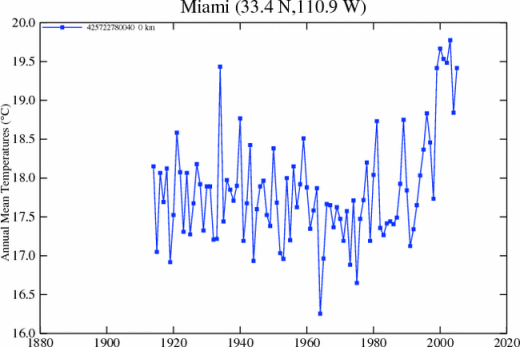
Update:  Here is the temperature history from this station, which moved from a more remote location away from buildings about 10 years ago.  I am sure the recent uptick in temperatures has nothing to do with the nearby building and asphalt/black rock ground cover.  It must be global warming.

Miami_az_giss_raw520

Off By a Factor of 300,000

From a summary of a speech by Al Gore:

The temperature of Venus is 455 degrees because CO2 floats in the air. This is where is we are heading because we are drawing it out of the Earth, trapping it and increasing temperature.

Using actual science, rather than an activist’s alarmist logic:

The arithmetic of absorption of infrared radiation also works to decrease the linearity. Absorption of light follows a logarithmic curve (Figure 1) as the amount of absorbing substance increases. It is generally accepted that the concentration of carbon dioxide in the atmosphere is already high enough to absorb almost all the infrared radiation in the main carbon dioxide absorption bands over a distance of only a few km. Thus, even if the atmosphere were heavily laden with carbon dioxide, it would still only cause an incremental increase in the amount of infrared absorption over current levels. This means that a situation like Venus could not happen here. The atmosphere of Venus is 90 times thicker than Earth’s and is 96% carbon dioxide, making the atmospheric carbon dioxide concentration on Venus 300,000 times higher than on Earth. Even so, the high temperatures on Venus are only partially caused by carbon dioxide; a major contributor is the thick bank of clouds containing sulfuric acid [7]. Although these clouds give Venus a high reflectivity in the visible region, the Galileo probe showed that the clouds appear black at infrared wavelengths of 2.3 microns due to strong infrared absorption [8]. Thus, Venus’s high temperature might be entirely explainable by direct absorption of incident light, rather than by any greenhouse effect. The infrared absorption lines by carbon dioxide are also broadened by the high pressure on Venus [9], making any comparison with Earth invalid.

Not to mention the fact that Venus is a lot closer to that big yellow thing that Al Gore denies has any real effect on changing temperatures on Earth.

What He Said

John Atkinson, via Tom Nelson, mirrors many of my thoughts on climate models:

The scientists who interest me in this field are those who can draw on the experience of a lot of people who have come before them. And uniformly in these areas I find scepticism. People who write mathematical models of complex systems for a living tend to find the climate models very unconvincing. Geologists find the arguments very unconvincing. Engineers find the arguments unconvincing. And astrophysicists find the arguments unconvincing….

The climate models seem to be largely driven by over-fitting to a small sample set and positive feedback. The small sample set – at most 30 years of accurate data – might be enough to try and predict one or two years, but 50 year predictions? Ignoring the biggest effect on global warming – water vapour – is surely going to cause problems.

Positive feedback in engineering invariably results in unstable systems – so we have to ask why do most if not all of the climate models rely on it to get doomsday predictions? For the Earth to have survived as long as it has with a stable climate, through major events like ice-ages or volcanic eruptions, there is little doubt that a degree of negative climate feedback is essential.

This Explains a Lot

The following is about a study on Marijuana use, but it could easily be about the media treatment of you-know-what:

The saddest part of Mirken’s article is this response from an American editor to his suggestion that reporters should have asked about the possible influence of confounding variables, such as dental hygiene and use of other drugs, on the link between marijuana and bad gums:

We are dealing with a peer-reviewed journal study, and I don’t feel at all comfortable going beyond what they are publishing. That is not our role.

Any journalist who doesn’t feel comfortable going beyond what appears in a medical journal to put a study’s findings in context and offer caveats where appropriate has no business writing about science. Reporters can’t be experts on everything, but they can ask smart questions and seek informed comments regarding a study’s potential weaknesses. If news organizations refuse to do so on the grounds that the study was peer reviewed and therefore must be faultless, they might as well just reprint researchers’ press releases. Which is pretty much what they do, all too often.

Trees Make Bad Thermometers

OK, I would have assumed that the title for this post was obvious to all:  There are a lot of reasons that trees don’t make very good thermometers.  Now, that is not a criticism of climate archaeologists who use tree rings to infer the historical temperature record.  Sometimes, we have to work with what we have.  Historians are the first to admit that coins are not the best way to deduce history, but sometimes coins are all we have.

But when historians rely on imperfect evidence, there generally is an understanding that the historical record created from this evidence is tentative and subject to error.  Unfortunately, some climate scientists have lost this perspective when it comes to tree-ring analyses, such as Mann’s hockey stick.  They tend to bury the fact that:

“There are reasons to believe that tree ring data may not capture long-term climate changes (100+ years) because tree size, root/shoot ratio, genetic adaptation to climate, and forest density can all shift in response to prolonged climate changes, among other reasons.” Furthermore, Loehle notes “Most seriously, typical reconstructions assume that tree ring width responds linearly to temperature, but trees can respond in an inverse parabolic manner to temperature, with ring width rising with temperature to some optimal level, and then decreasing with further temperature increases.” Other problems include tree responses to precipitation changes, variations in atmospheric pollution levels, diseases, pest outbreaks, and the obvious problem of enrichment that comes along with ever higher levels of atmospheric carbon dioxide. Trees are not simple thermometers!

When the tree-ring folks like Mann first did their analyses, they calibrated tree ring growth over recent decades with the recent historical temperature record, and then projected this calibration backwards on history.  But, as noted in the quote above, there is a lot of evidence that these calibration factors may not be linear over time.  And in fact, the few people that have gone back and resampled Mann’s trees have found that their growth diverges substantially from predicted values – in other words, the relationship between tree ring growth and temperature is not constant. 

Now, this does not make Mann and his peers bad scientists.  They were trying their best to reconstruct history, they tried one methodology, but then evidence mounted that this methodology is flawed.  What makes them potentially bad scientists is their reaction to the negative evidence.  Once evidence of the divergence problem was raised, scientists have simply ceased resampling trees.  Their focus hs become defending their original approach, rather than improving it based on new information.

Often, new approaches require new people, as in this case:

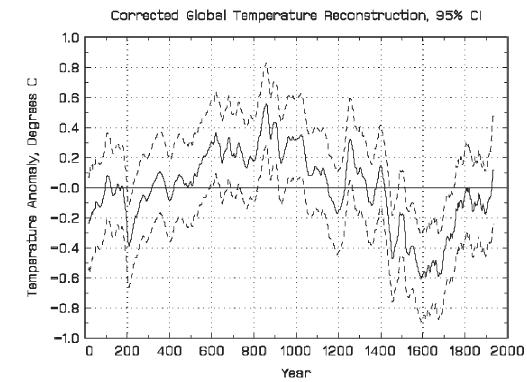
Loehle gathered as many non-tree ring reconstructions as possible for places throughout the world (Figure 1). There are dozens of very interesting ways to peer into the climatic past of a location, and Loehle included borehore temperature measurements, pollen remains, Mg/Ca ratios, oxygen isotope data from deep cores or from stalagmites, diatoms deposited on lake bottoms, reconstructed sea surface temperatures, and so on. Basically, he grabbed everything available, so long as it did not rely on trees.

And he got this plot for a temperature reconstruction:

Loehle_fig3

Only time will tell if this approach holds up better than tree rings, but it does better match the annecdotal history we have, including a Medieval warm period where Greenland was, you  know, green and a little ice age in the 17th century.  Like Mann, Loehle’s first version had some statistical and procedural errors.  Unlike Mann, Loehle reworked the whole analysis when these errors were pointed out.

Some General Thoughts

I have been getting a lot of new readers of late, including a number of commenters who disagree with me fairly strongly.  Welcome.  Here are some general thoughts:

  1. Excepting some ads for Viagra and cell phones, I have never and will never delete a comment on this site.  Folks are welcome to fill up the comment threads with contrary opinions. For those distrustful of the motives of skeptics, may I observe that sites like RealClimate cannot make this claim and routinely flush comments that don’t agree with the local prevailing doctrine, so make of that what you will.
  2. I almost never respond to comments in the comment thread itself.  I like to think about and digest the comments for a while, and then incorporate them or respond to them in later posts.  Trying to respond in real time in comment threads results in flame wars, not reasoned discussion. 
  3. Unlike many skeptics, I accept that atmospheric CO2 produced by man can warm the earth.  The IPCC and most climate scientists believe that the greenhouse gas effect alone may warm the earth about a degree over the rest of this century, an amount that would be a nuisance rather than catastrophic, and likely lost in the random noise of natural variations.
  4. However, I do not believe the earth’s climate is dominated by strong positive feedbacks and tipping points.  It is this feedback hypothesis in climate models that multiplies warming to 3-4-5 degrees or more over the next century.  In climate models, the catastrophe comes from feedback, not greenhouse effects, and I think this is a bad hypothesis.  Believers in catastrophic warming have an interesting problem reconciling Mann’s hockey stick, which points to incredible stability in temperatures, with a hypothesis of very high positive feedback, which should make temperatures skittish and volatile.  I also think that the hypothesis that aerosols are masking substantial amounts of warming is weak, and appears to be more wishful thinking to bail out model builders than solid science (while there is some cooling effect, the area of effect is local and shouldn’t have a substantial effect on global averages).
  5. I think the surface temperature record as embodied in the GISS analysis is a joke.  I cannot respect scientists who eschew obviously superior satellite measurements for the half-assed surface temperature record just because it doesn’t give them the answer they want to here.  The fact that the leader in fighting for surface temeprature measurement over satellites is James Hansen of NASA’s Goddard Institute for Space Studies is the ultimate dark irony.  It’s like Bill Gates campaiging for increased abacus use in schools.
  6. I have built models of complex systems for years.  I have been guilty many times of allowing seamingly reasonable assumptions to compound into meaningless results.  Unfortunately and embarassingly, I have also been guilty of tweaking, plugging, and tuning models to better match history in order to build confidence in their future predictions.  I see all too many of these same behaviors amoung climate modellers. 

More on Chartsmanship

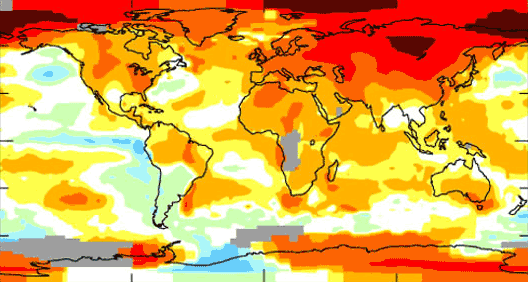
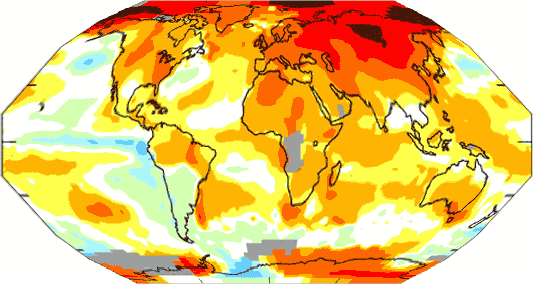
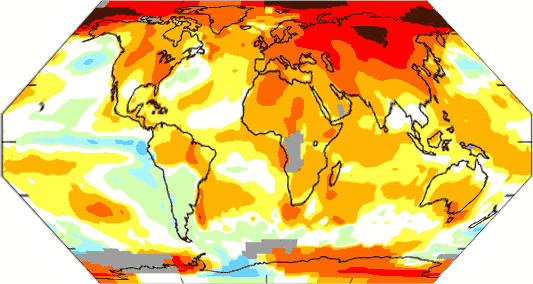
A week or so ago, I had an extended post on a number of issues I had with this chart from the GISS, showing "areas in 2007 that were warmer (reds) and colder (blues) than the mean annual temperature from 1951-1980:"

Giss1

I had many issues with this chart, not the least of which was the fact that it fills in data for large swaths of the earth for which we have no data.  However, another point I made was that the GISS is essentially fibbing here by using a straight cylindrical projection of the Earth.  We all know from junior high school that there are a lot of ways to project the globe onto a flat sheet of paper, all of which are imperfect. 

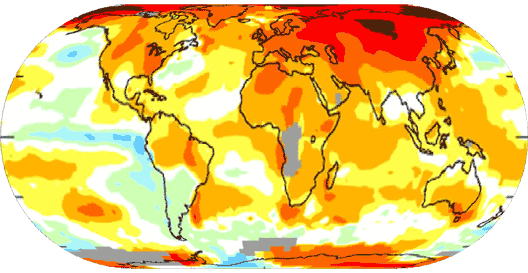
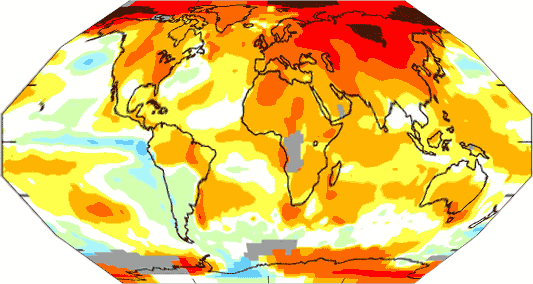
However, for a chart like this, one really needs an equal area projection.  In an equal area projection, a square inch at the equator represents the same surface area as a square inch at the poles.  The GISS is NOT using an equal area projection.  In fact, in the projection they are using, the area at the poles is wildly exaggerated.  Since the north pole is the area of the earth with the most anomolous measured warming, the chart visually overstates the amount of global warming.

In my post, I did not know how to reproject the map, so I took a wild stab at it using manual skews in Photoshop.  I thought maybe the GISS did not show the map correctly because it was hard to reproject the data.  It turns out, though, that there are some good free tools available to do just this kind of task.  With these tools I was able to convert the chart above to an equal-area projection (using the Eckert IV method):

Giss2

One can see that the visual message is certainly different when projected correctly.

This tool was so simple it took me less than 10 seconds to make this reprojection.  But here is the hilariously ironic part:  The source of this fabulous tool that the GISS should have used is … the GISS! Here is the tool on the GISS site.  Its free and a lot of fun.

Warmer and Richer

It is finally good to see someone making this point:  That even if one accepts the worst of the IPCC scenarios (which I do not) the cost of CO2 abatement, particularly in terms of lost economic growth, is far higher than the cost of rising temperatures — ESPECIALLY for the poor.

“The surprising conclusion using the Stern Review’s own estimates,” Dr. Goklany writes, “is that future generations will be better off in the richest but warmest” of the I.P.C.C.’s scenarios. He concludes that cutting emissions will do much less good than encouraging sustainable development in poor countries and policies of “focused adaptation” to deal with disease and environmental problems like coastal flooding. For a fifth the cost of the Kyoto Protocol, he calculates, these adaptation policies could yield more immediate and also long-term benefits than would a policy that entirely halted global warming (which would cost far, far more than Kyoto). He argues that this path isn’t merely an economic but also a moral imperative:

For the foreseeable future, people will be wealthier—and their well-being higher—than is the case for present generations both in the developed and developing worlds and with or without climate change. The well-being of future inhabitants in today’s developing world would exceed that of the inhabitants of today’s developed world under all but the poorest scenario. Future generations should, moreover, have greater access to human capital and technology to address whatever problems they might face, including climate change. Hence the argument that we should shift resources from dealing with the real and urgent problems confronting present generations to solving potential problems of tomorrow’s wealthier and better positioned generations is unpersuasive at best and verging on immoral at worst.

He also makes a point I have made for a long time — that the case for strong abatement is more of an aesthetic choice than a practical one.  There are a core of people who don’t like the fact, aesthetically, that man has somehow modified Gaia.

Here is a link to the report itself

Brrrrrrr

Via Anthony Watt:

Of course we already have had a heads up from all the wire reports around the world talking about the significant winter weather events that have occurred worldwide in the last month, but until now, there hasn’t been a measure of how the planet was doing for the winter of 2007/2008.

Remote Sensing Systems of Santa Rosa just posted the latest MSU (Microwave Sounder Unit) data.

January posted a -.08°C near global anomaly between -70S and 82.5N latitude (the viewshed of the satellite sounder). That makes it the coldest month since January 2000, and the 2nd coldest January for the planet in 15 years. Both northern and southern hemispheres posted negative anomalies of -012°C and -.038°C respectively, happening for the first time since January 2000.

The United States posted a -.557°C anomaly for January 2008 and a -0.196°C anomaly for December 2007.

One can reasonably argue that this is a La Nina event and therefore cyclical rather than a sign of cooling or not-warming  (January 2000 was also in a La Nina).  Which is all well and good except for a couple of things.  First, scientists used to think that El Nino’s and La Nina’s didn’t heat or cool the world so much as redistribute it across the surface.  Now, with satellites being able to watch the whole world at the same time, they are being forced to rething this proposition. 

Second, while climate scientists can reasonably argue that current cold temperatures are cyclical rather than part of a longer trend because they are an La Nina, they did NOT make this same argument when the 1998 El Nino produced cyclically hotter temperatures.  All I remember about 1998 is Mann, Gore, Hansen and company all saying 1998 was the hottest year on record and proof of global warming.

Chartmanship — A Picture that Sparked A Thousand Words (of Criticism)

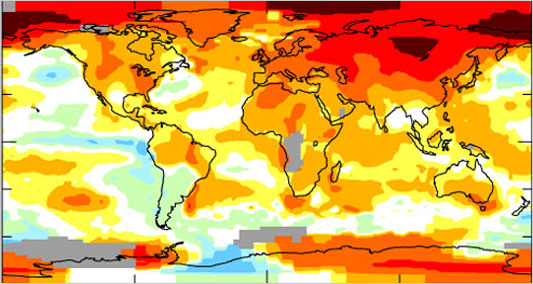
Note this chart used by Andrew Revkin:

Temperature_533b

The description of the chart is as follows:

Map shows areas in 2007 that were warmer (reds) and colder (blues) than the mean annual temperature from 1951-1980. (Credit: NASA/GISS)

It is said that a picture is worth a thousand words.  Let me see if I can come up with a thousand words as to what is wrong with this picture.

  • Every school kid knows that this sort of projection of the world greatly exaggerates the size of the poles and Greenland.  Since most of the red here is at the poles, then visually its impact is exaggerated.  For example, the top row of pixels at the top which constitute a fair percentage of the map actually represent a tiny plot of land at the pole.  That row of pixels represents an area at least 10x smaller than does the row of pixels at the equator.  I don’t have with me at work a good graphical tool to apply a spherical transform to the map, so I approximated it with a couple of linear skews.  This would be a more realistic map, except it still  exaggerates the area at the pole (see here to confirm it is a decent approximation)

Temperature_skewed3

Flip your eyes between the two of them — already we see a huge visual difference in impression.  (Update:  better version here, using a tool from the GISS no less!)

  • The coloring in and of itself makes a point.  The whole world has warmed a half degree or less in this period, but the dark red makes it look sizzling
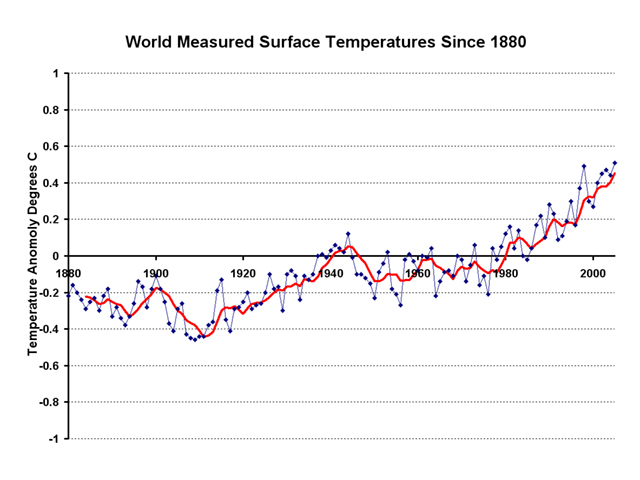
  • Here is the next trick — if you want to make a strong impression of growth, make sure to find the low point in the historical record and compare to that.  So, lets look at history:

Temperatureline

Hey, what do you know?  1950 to 1980 represents a low point in the trend.  Since they were trying to make a point about warming accelerating, then it might have made more sense to look at the warming since, say, 1998 — ie over the last decade.   Unfortunately, that chart would be all blue, since temperatures throughout this century have been lower than 1998.

  • There are four most frequently cited academic rollups of world-wide temperature anomaly.  They are:  GISS (surface), HadCrut3 (surface), RSS (satellite) and UAH (satellite).  Their current values are all shown here.  So, does the NY Times (and other catastrophists) take the average?  The median value?  No, silly.  They take the outlier which shows far more warming than the other three, which is the GISS.
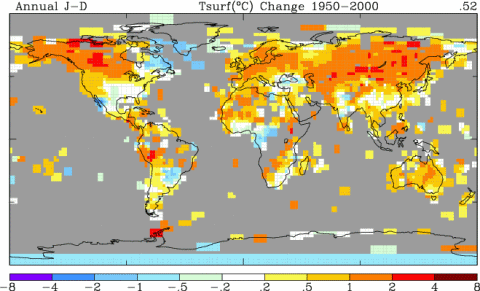
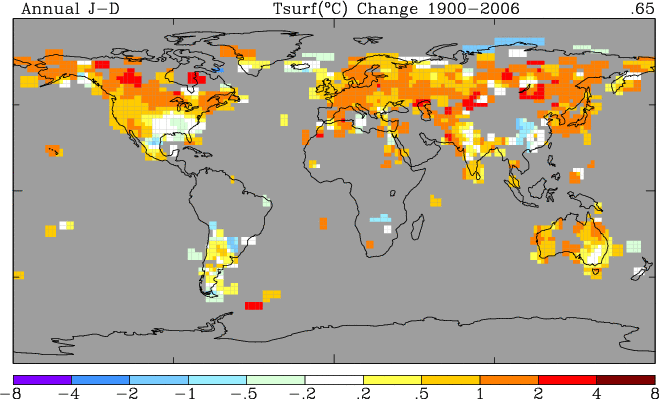
  • The GISS surface measurement system is rife with errors.  But the one I want to mention here is that, outside of the US, the temperature measurement points are very spotty.  Some points in the ocean are over 1000 miles from a thermometer, but still are colored on this chart  (yes, there is some grey I suppose for "no data" but that gray should be a lot more prevalent. )  If you only plotted data for 250km squares where the GISS actually has the data do make this comparison, without the mythical extrapolation into unmeasured areas, the chart should look like this:

Ghcn_giss_250km_trnd0112_1950_2000

How did they fill in all that grey area?  You tell me because Hansen certainly isn’t talking.

  • I am no longer going to accept any climate scientist as a serious scientist (and not just a biased mouthpiece) who insists on using the faulty and patchy surface temperature record over satellite measurement.  As I said previously:

Satellite temperature measurement makes immensely more sense – it has full coverage (except for the poles) and is not subject to local biases.  Can anyone name one single reason why the scientific community does not use the satellite temps as the standard EXCEPT that the "answer" (ie lower temperature increases) is not the one they want?  Consider the parallel example of measurement of arctic ice area.  My sense is that before satellites, we got some measurements of arctic ice extent from fixed observation stations and ship reports, but these were spotty and unreliable.  Now satellites make this measurement consistent and complete.  Would anyone argue to ignore the satellite data for spotty surface observations?  No, but this is exactly what the entire climate community seems to do for temperature.

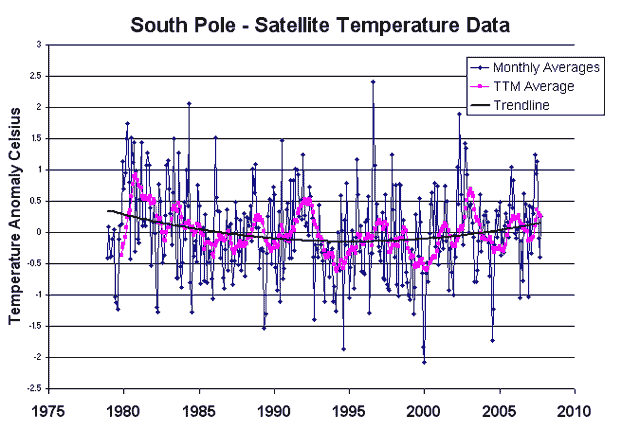
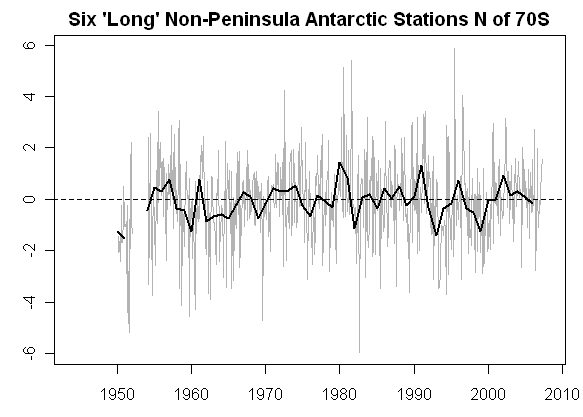
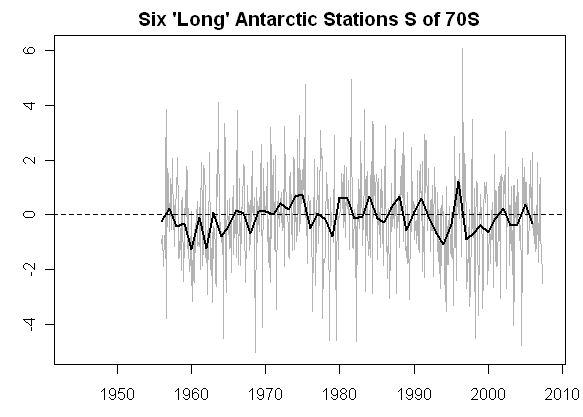
  • Some of the data is just plain bogus on the chart, part of the GISS/Hansen "higher must be right" approach to measuring temperature.  The Satellites show Antarctica cooling:

South_pole_temperatures

The surface temperature record shows the same thing

Antarc34Antarc33_2

There is one area warming – the relatively small Antarctic Peninsula.  It should be orange in the map above (and is) but the rest of the orange in Antarctica is a mystery.  Though this would not be the first time people tried to extrapolate Antarctic trends from the tip of this peninsula (Gore did it in his movie and 60 minutes did it the other day).  This is a bit like measuring US temperature trends from Key West.  More on Antarctica here.  By the way, the GISS chart without all the extrapolation that I show only has the hot area on the penninsula.  All the other hot zones comes from, where?  James Hansen’s imagination?

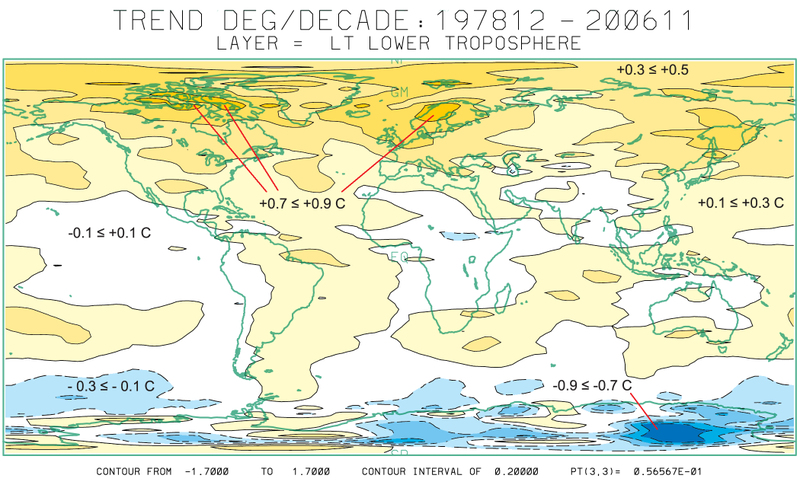
Update:  Here is a similar map by satellite, which avoids the coverage issues as well as urban and other surface measurement biases.  The story here is much more interesting, particularly the very different experience between north and south, something not predicted by greenhouse gas theory.  One can see that there has definitely been warming, but mostly concentrated at the north pole.

25yearbig

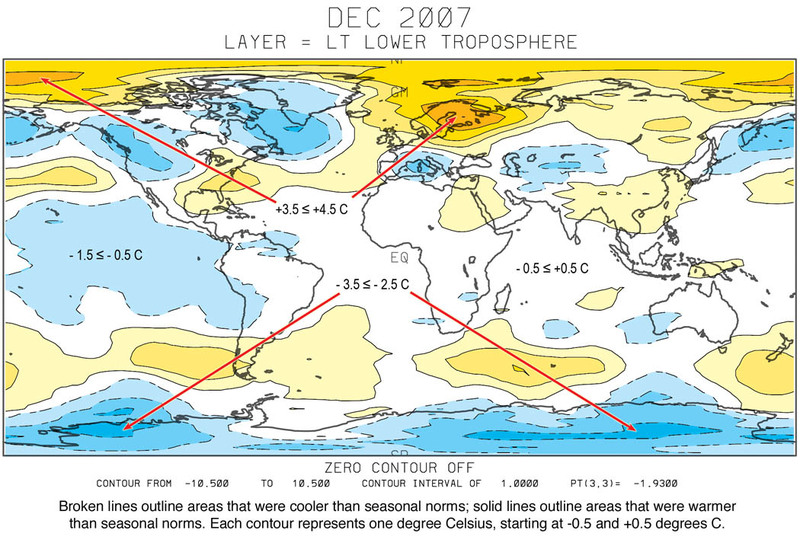
Here is the last monthly image, for December, 2007:

1207

Update:  I have been getting a lot of new readers of late, including a number of commenters who disagree with me fairly strongly.  Welcome.  Here are some general thoughts:

  1. Excepting some ads for Viagra and cell phones, I have never and will never delete a comment on this site.  Folks are welcome to fill up the comment threads with contrary opinions. For those distrustful of the motives of skeptics, may I observe that sites like RealClimate cannot make this claim and routinely flush comments that don’t agree with the local prevailing doctrine, so make of that what you will.
  2. I almost never respond to comments in the comment thread itself.  I like to think about and digest the comments for a while, and then incorporate them or respond to them in later posts.  Trying to respond in real time in comment threads results in flame wars, not reasoned discussion. 
  3. Unlike many skeptics, I accept that atmospheric CO2 produced by man can warm the earth.  The IPCC and most climate scientists believe that the greenhouse gas effect alone may warm the earth about a degree over the rest of this century, an amount that would be a nuisance rather than catastrophic, and likely lost in the random noise of natural variations.
  4. However, I do not believe the earth’s climate is dominated by strong positive feedbacks and tipping points.  It is this feedback hypothesis in climate models that multiplies warming to 3-4-5 degrees or more over the next century.  In climate models, the catastrophe comes from feedback, not greenhouse effects, and I think this is a bad hypothesis.  Believers in catastrophic warming have an interesting problem reconciling Mann’s hockey stick, which points to incredible stability in temperatures, with a hypothesis of very high positive feedback, which should make temperatures skittish and volatile.  I also think that the hypothesis that aerosols are masking substantial amounts of warming is weak, and appears to be more wishful thinking to bail out model builders than solid science  (while there is some cooling effect, the area of effect is local and shouldn’t have a substantial effect on global averages).
  5. I think the surface temperature record as embodied in the GISS analysis is a joke.  I cannot respect scientists who eschew obviously superior satellite measurements for the half-assed surface temperature record just because it doesn’t give them the answer they want to here.  The fact that the leader in fighting for surface temeprature measurement over satellites is James Hansen of NASA’s Goddard Institute for Space Studies is the ultimate dark irony.  It’s like Bill Gates campaiging for increased abacus use in schools.
  6. I have built models of complex systems for years.  I have been guilty many times of allowing seamingly reasonable assumptions to compound into meaningless results.  Unfortunately and embarassingly, I have also been guilty of tweaking, plugging, and tuning models to better match history in order to build confidence in their future predictions.  I see all too many of these same behaviors amoung climate modellers. 

I’m Glad Global Warming Catastrophists Have Science on their Side, Or Else I Might Suspect This Was Ridiculous

A Reuters story a couple of weeks ago said "Carbon Dioxide pollution kills hundreds a Year."  Wow.  To give one a sense of scale, cold weather kills about 700 people a year in the US alone.  So let me see, we want to hamstring the world’s economy and keep hundreds of millions of people in poverty to save fewer people than those who are killed in turn by cold weather? 

But the silliness does not end here.  This is what the story says:

The deaths were due to lung and heart ailments linked to ozone and polluting particles in the air, which are spurred by carbon dioxide that comes from human activities, according to the study’s author, Mark Jacobson of Stanford University.

As the planet warms due to carbon dioxide emissions, the annual death rate is forecast to climb, with premature deaths in the United States from human-generated carbon dioxide expected to hit 1,000 a year when the global temperature has risen by 1.8 degrees F (1 degree C).

By the way, don’t expect a better explanation of the mechanism of death further in the story, because it is not there, nor should you expect any counter-vailing opinions in this patented Adcocay-press-release-masquerading-as-a-Reuters-story.  Here is a big hint for everyone, though:  Ozone and some particulate pollution can cause health problems.  However, they have nothing to do with CO2 and global warming except that they are coincidently both created by burning fossil fuels.  Warmer weather can increase ground ozone levels, but it is absurd to say that this is any kind of substantial mechanism, and nowhere do we see any evidence of how ozone related health problems may scale with temperature.  But we can be suspicious because the author is saying deaths go from 700 at 0.8 degrees C increase (which he says is the current level) to 1000 at 1.0 degrees C.  So there are 300 more annual deaths just from 0.2C rise?  If so, why, when temperatures rise 20C or more in the Phoenix summer, then, aren’t people dropping like flies?

This is just another great example of how incentives work.  Funding for academic studies is always hard.  A professor who wants to study ozone effect on heath may not get funding.  But there is much more available if he pitches it as global warming effect on health, focusing on ozone. 

Update to My Best Skeptic’s Argument

Based on a lot of comment activity to this post, I wanted to add a bit of an update.  It is sometimes hard to summarize without losing important detail, and I think I had that happen here.

Commenters are correct that positive feedback dominated systems can be stable as long as the feedback percentage is less than 100%.  By trying to get too compact in my arguments, I combined a couple of things.  First, there are many catastrophists that argue that climate IS in fact dominated by feedback over 100% — anyone who talks of "tipping points" is effectively saying this.  The argument about instability making stable processes impossible certainly applies to these folks’ logic.  Further, even positive feedback <100% makes a system highly subject to dramatic variations.  But Mann et. al. are already on the record saying that without man, global temperatures are unbelievably stable and move in extremely narrow ranges.   It is hard to imagine this to be true in a climate system dominated by positive feedback, particularly when it is beset all the time with dramatic perturbations, from volcanoes to the Maunder Minimum.

To some extent, climate catastrophists are in a bind.  If historic temperatures show a lot of variance, then a strong argument can be made that a large portion of 20th century warming is natural occilation.  If historic temperatures move only in narrow ranges, they have a very difficult time justifying that the climate is dominated by positive feedbacks of 60-80%.

The point to remember, though, is that irregardless of likelihood, the historical temperature record simply does not support assumptions of feedback much larger than zero.  Yes, time delays and lags make a small difference, but all one has to do is compare current temperatures to CO2 levels 12-15 years ago to account for this lag and one still gets absolutely no empirical support for large positive feedbacks.

Remember this when someone says that greenhouse gas theory is "Settled."  It may or may not be, but the catastrophe does not come directly from greenhouse gasses.  Alone, they cause at most nuisance warming.  The catastrophe comes from substantial positive feedback (it takes 60-80% levels to get climate sensitivities of 3-5C) which is far from settled science.

Even Shorter Version of Climate Video

After finding out about this contest, I wanted to enter.  However, having very little time, I had to work with something I already had on the shelf.  So I chose to edit this 9+ minute video critiquing catastrophic global warming forecasts to create a three minute version (per the contest rules).

I am pretty sure this is not what the folks running the contest really are looking for, but I had fun trying.   So here is my most edited effort yet, Don’t Panic — The Case Against Catastrophic Global Warming Forecasts

I had to just assert some things given the time constraints without presenting the evidence (particularly in the aerosol discussion).  The more complete 9 minute version critiquing global warming forecasts is here.   And the big boy, the 50-minute video covering a wide range of climate change topics, is here.