On a number of occasions, I have emphasized that the key scientific hypothesis that drives catastrophic warming forecasts is not greenhouse gas theory, but is the theory that the climate is dominated by strong positive feedbacks:
The catastrophe comes, not from a mere 1 degree of warming, but from the multiplication for this warming 3,4,5 times or more by hypothesized positive feedback effects in the climate. Greenhouse gas theory gives us warming numbers we might not even be able to find amidst the natural variations of our climate; it is the theory of strong positive climate feedback that gives us the apocalypse.
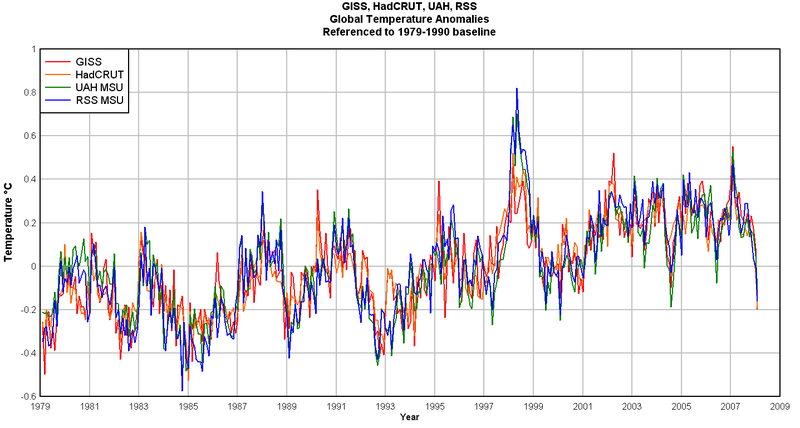
So when I read the interview with Jennifer Marohasy, I was focused less on the discussion of how world temperatures seemed sort of flat over the last 10 years (I have little patience with climate alarmists focusing on short periods of time to "prove" a long term climate trend, so I try not to fall in the same trap). What was really interesting to me was this:
The [NASA Aqua] satellite was only launched in 2002 and it enabled the collection of data, not just on temperature but also on cloud formation and water vapour. What all the climate models suggest is that, when you’ve got warming from additional carbon dioxide, this will result in increased water vapour, so you’re going to get a positive feedback. That’s what the models have been indicating. What this great data from the NASA Aqua satellite … (is) actually showing is just the opposite, that with a little bit of warming, weather processes are compensating, so they’re actually limiting the greenhouse effect and you’re getting a negative rather than a positive feedback."
Up to this point, climate scientists who argued for strong positive feedback have relied mainly on numbers from hundreds of thousands of years ago, of which our understanding is quite imperfect. I have long argued that more recent, higher quality data over the last 50-100 years seems to point to feedback that is at best zero and probably negative [also see video here and here]. Now we have better data from the satellite NASA launched in part to test the strong positive feedback hypothesis that in fact feedback may be negative. This means that instead of multiplying a climate sensitivity of 1 (from CO2 alone) to numbers of 3 or more with feedback, as the IPCC argued, a climate sensitivity of 1 from CO2 may actually be reduced to a net sensitivity well less than 1. This would imply warming from CO2 over the next century of less than 1C, an amount likely lost in the noise of natural variations and hardly catastrophic.
Marohasy: "That’s right … These findings actually aren’t being disputed by the meteorological community. They’re having trouble digesting the findings, they’re acknowledging the findings, they’re acknowledging that the data from NASA’s Aqua satellite is not how the models predict, and I think they’re about to recognise that the models really do need to be overhauled and that when they are overhauled they will probably show greatly reduced future warming projected as a consequence of carbon dioxide."