
I am late on this but I only finally read the entire article on climate science issues in Der Spiegel. The article is a good but not great update on various issues and controversies in climate science, but considering its source it represents a pretty amazing watershed. While the questions are a bit soft, they are coming from a quarter where questioning of any sort on the topic of climate science was verboten.
Category Archives: Skeptic Summaries
Reminder: Colorado Climate Presentation next Monday Night
I will be making a presentation on the science of the climate skeptic’s position on April 12 from 5-7PM at the University of Colorado – Colorado Springs (UCCS) in the UC 302 theater (campus map). I hope folks who are interested in the Denver / Colorado Springs area will attend.
Climate Presentation in Colorado
I will be making a presentation on the science of the climate skeptic’s position on April 12 from 5-7PM at the University of Colorado – Colorado Springs (UCCS) in the UC 302 theater (campus map). I hope folks who are interested in the Denver / Colorado Springs area will attend.
Valley Forward Remarks
Below the fold are my remarks to the Valley Forward lunch today — I only had five minutes, so I was fairly limited.
An Idea I Had Too Late
I was reading this post from Climate Quotes, wherein they demonstrate how the IPCC made a claim without proof, and when called on it, cast about for a source that turned out not to say any such thing. A lot of focus has been put on gray literature cited by the IPCC, but there appear to be at least as many occasions when the IPCC statement is not actually backed by the source cited.
The idea I had too late is that three years ago, when I had the time, I should have put the whole IPCC report on the web in some sort of Wiki or 2-column format (almost like a Medieval gloss) we could have linked and collected challenges to each individual statement and attribution. I think a couple of people are working towards this right now, but I kick myself for not thinking of it earlier. What a resource we would have now!
PS – No Consensus is looking for volunteers to identify and count the gray literature citations in the IPCC reports.
Lindzen Presentation
This is a very enjoyable presentation by Richard Lindzen on climate and global warming. Folks who have watched my video won’t find much new, but Lindzen is the horse’s mouth, as it were. Via Maggies Farm
Requires RealPlayer, which scared me because for years RealPlayer was among the most annoying of spyware carriers, but the installation seemed OK. I like the format of video plus synchronized slides – I struggle with this in putting my presentations on the web.
Monkton in Utah
The always entertaining Viscount Monckton of Brenchley will be in Utah next month giving a free public lecture. I am going to try to get up there.
Skeptic Wack-a-Mole
I welcome critical reactions to my recent video, which I put together as a layman’s summary of the science of the skeptic’s position (if you have sent me criticisms, I have read them even if I have not gotten back to you — my real life has been crazy lately).
If you have not seen the video, and are a frequent reader of this site, I encourage you to do so. But to understand what follows, I need to share a bit of a summary of the video.
The video begins by accepting that CO2 acts as a greenhouse gas and that increased atmospheric concentrations can cause some incremental warming, on the order of magnitude of 1C per doubling of concentrations. But while I accept that CO2 causes incremental warming, I challenge the notion that there is a high climate sensitivity to CO2, driven by positive feedbacks, that multiply this warming to 3,5, even 10 degrees (thus the title of the video “Catastrophe Denied.”)
So, much of the video looks at alarmist arguments that sensitivity to CO2 is high, or in other words, that CO2 is acting as the main driver of world temperatures, that it is the dominant factor in recent temperature increases and its effect dwarfs all other effects.
In challenging this proposition, I took on 3 arguments:
- That ice core analysis (as shown by Al Gore in his movie) shows that for hundreds of thousands of years, CO2 and temperatures have moved together, demonstrating that CO2 is the main thermostat of the Earth
- That Michael Mann’s hockey stick (as given prominence by both the IPCC AR3 and AR4 as well as Al Gore in his movie, though incorrectly labeled as Dr Thompson’s Thermometer) shows that absent man, Earth’s temperatures were incredibly flat and stable and that only the introduction of manmade CO2 recently upset this stability
- That climate models are unable to replicate recent warming (ie in the last 50 years) using only natural forcings and only the introduction of CO2 into the models allows them to replicate history correctly
I am not going to deal with these arguments here (go watch the movie!) but several comments I have received are all of a single theme. Basically, the comments state that neither numbers 1 or 2 above are arguments any climate scientists are using and, further, just to demonstrate what a silly straw-man-erector I am, they were never used as proof of high climate sensitivity to CO2. This former may or may not be true, but the latter is just BS, and it represents a typical alarmist tactic. Make an argument, defend it like a mother bear (arguing skeptics are bad people for even questioning such obvious and settled science), and then when the argument finally gets shot down in flames, claim that it doesn’t matter and that it was never a serious argument anyway. The virtue of this tactic is not only that it can help paint skeptics as raising straw men, but it can also hide the fact that the science is so week that supporters must lurch from justification to justification, from thin limb to thin limb, trying to find a new branch of the tree to support them before the old branch breaks.
One commenter insisted to me, for example, that the ice core analysis from Al Gore’s movie was never meant to show a direct cause and effect relationship between CO2 and warming but to show proof of CO2 positive feedback (ie higher temps cause more CO2 to be driven out of the oceans which increases its concentration in the atmosphere which causes more warming). I have no doubt that is how it is used today, but it is just Stalinist revisionism to claim that this was Gore’s argument in the movie.
Steve McIntyre had an interesting example of this approach in a recent post (actually, Steve could write a book on the defend-defend-defend-defend-It doesn’t matter style of debate). For years, in response to questions about siting issues and uncorrected biases in the surface temperature record, James Hansen has claimed that the GISS has solved all that by using computer algorithms that compared sites to other nearby sites and used sophisticated statistical approaches (way beyond the ability of mere skeptics to understand) that corrected out all these biases. Some of us Luddites continued to argue that they weren’t correcting the biases in this homogenization approach, but were merely spreading the error around multiple stations like peanut butter (Anthony Watt has a lot more in his new book).
But then we find this from the FOI’e emails from the GISS:
The next morning (Aug 7), Ruedy sent Hansen and Gavin a draft reply to my email. He reported a US error of 0.15 deg C (a bit lower than my estimate the previous night.) The draft reply satirized the idea (then being promulgated by Rabett and Tamino) that GISS software could “fix” defects in surface data:
I had no idea what code you are referring to until I learned from your article “Hansen’s Y2K Error (which should really be Reto’s Y2K error) that GISS is in possession of some magical software that is able to “fix” the defects in surface data. No wonder you would like to get your hands on that – so would I. Unfortunately your source totally misled you in that respect. I’m a little amazed that you uncritically present it as a fact given that a large part of your web site is devoted to convincingly prove that such software cannot possibly exist.
And there is the technique in a nutshell, don’t just abandon the analysis when challenged, but deny it ever existed, and paint the challenger as somehow defective in his approach by “uncritically” suggesting such a straw man
Catastrophe Denied: The Science of the Skeptic’s Position
I have repaired the overscan issues in the DVD files and am re-posting the links, which are all good now.
Once upon a time, Al Gore had a PowerPoint deck. Several years ago, I came to the conclusion that Gore’s presentation was deeply flawed, so I made my own PowerPoint deck in response, and have been updating it ever since. Here is the most recent version
Then, Al Gore made a movie from his PowerPoint deck. He won an Oscar and a Nobel prize for his movie. Those are a bit out of my reach, so I will have to settle for actually being right. My previous movie showed my PowerPoint deck presented to a live audience, and can still be found online here. I felt the sound quality could be improved and the narration could be tighter, so I went into the “studio” to create a tighter version. The product of this is what I believe to be my best effort yet at explaining, in a comprehensive but simple manner, the science of the skeptic’s position to laymen.
I have become a big fan of Vimeo because I don’t have to break videos up into 10-minute chunks as on YouTube. The Vimeo version is here and is embedded below:
Other Viewing Options
When I get the time to break this into 9(!) parts, I will post a link here to YouTube.
You can download the 212MB .wmv file here (link on the lower right). Alternatively, it can also be found here. The .wmv is also available via BitTorrent: You can find its page at Pirate Bay or the torrent directly here.
Download the .iso file (DVD disk image) to make you own playable DVD here (beware: 1.6GB). A free tool to burn the DVD from the image is ImgBurn
The .iso file is also available via BitTorrent: you can find its page at Pirate Bay with the torrent here.
Finally, you can buy the DVD at cost, here, for $7.50 plus shipping.
Climate Interview
Last week I did a very enjoyable interview Stefan Molyneux of FreeDomain Radio. My presence was almost superfluous, as Stefan was incredibly well-informed as well as passionate on climate topics. Our discussion hits on many critical topics related to the science of the skeptics position, from positive feedbacks to urban heat biases to hockey sticks. The interview is embedded below, but I encourage you to check out his site, he seems to get a lot of interesting interviews of which I appear to be the most pedestrian.
LOL, Missed My Chance at History
Something I discovered only days after the Climategate (I guess that unfortunate name is going to stick) story broke, I finally noticed a comment on my blog on the night of the release notifying me and my readers of the availability of the email file. It was pretty far down in a pretty random, really a throwaway post, and I didn’t notice until days later when the story had moved on. I never mentioned it because I was kind of embarrassed that I don’t seem to exercise the same real-time scrutiny on my comments as other bloggers seem to be able to manage.
Well, the embarrassment is worse than I thought, because by Steve McIntyre’s timeline, this site may have been first. I got a weird email that night that I frankly could not figure out that in retrospect may have been related. Anyway, I missed my chance. Which is fine because much more dedicated bloggers soon jumped on the case.
If you are wondering where I am, I am steadily working through a new 90-minute studio lecture (ie much better sound quality than here) on the science of the skeptic’s position. I have seen many good presentations of late but I really think I have hit on a good, balanced presentation and I am excited to share it soon.
Climate Presentation
I have cleaned up my Powerpoint presentation and added my narration on the notes pages. I have this available both as a .ppt file as well as a pdf. The pdf, I think, works particularly well — it looks and reads more like a book. This is my best current cut at presenting the science of the skeptic’s position and mostly supersedes my earlier book. Right click either to download. You are welcome to use the presentation with your own local groups.
Powerpoint presentation with notes pages (.ppt)
Some example pages:
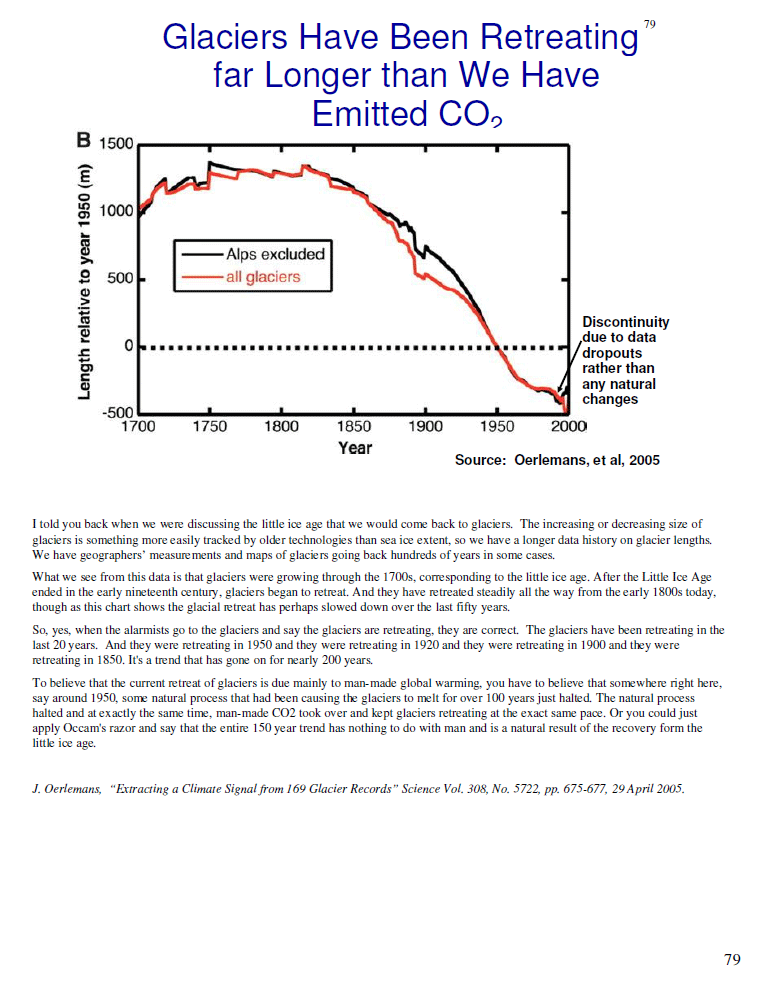
Why the Historical Warming Numbers Matter
This is cross-posted from my non-climate blog. I wrote it for folks who spend less time on the science-based skeptic sites, but I had several folks tell me that it would still be useful to post here.
First, let’s settle something. The world has warmed since 1850. While there always is an error bar on nearly every statement about nature, I think there is little point in questioning this past warming. There is ice core data that suggests that the little ice age, which ended some time in the very early 19th century, was perhaps the coldest period, or one of the two or three coldest periods, in the last 5000 years (ie in nearly the entire span of human civilization). Temperatures are inevitably warming from this low point.(*1)
So, if the point is not to deny warming altogether, what is the point in discussions of Climategate of picking over and trying to audit historical temperature records like the Hadley CRUT3 or NASA’s GISStemp? Skeptics often argue that much of the warming is due to bogus manual adjustments in the temperature records and biases such as urban warming. Alarmists argue that the metrics may understate warming because of masking by manmade anthropogenic cooling agents (e.g. sulfate aerosols). Why bother? Why does it matter if past warming is 0.6C or 0.8C or 0.3C? There are at least two reasons.
1. The slope of recent temperature increases is used as evidence for the anthropogenic theory.
We know greenhouse gasses like CO2 have a warming effect in the lab. And we know that overall they warm planets because otherwise ours would be colder. But how much does an incremental amount of CO2 (a relatively weak greenhouse gas) warm the Earth? A lot or a little? Is the sensitivity of the climate to CO2 high or low?
Every time I try to express this, it sounds so ridiculous that people think I must have it wrong. But the main argument supporting a high climate sensitivity to CO2 is that scientists claim to have looked at past warming, particularly from 1950-2000, and they can’t think of any natural cause that could behind it, which leaves CO2 by process of elimination. Yeah, I know this seems crazy – one wants to ask if this is really a test for CO2 sensitivity or of scientists’ understanding and imagination, but there you have it.
Now, they don’t always say it this directly. What they actually say is that they ran their climate models and their climate models could not produce the warming from 1950-2000 with natural forcings alone, but could reproduce this warming with forcings from CO2. But since the climate models are not handed down from the gods, but programmed by the scientists themselves to represent their own understanding of the climate system, in effect this is just a different way of saying what I said in the previous paragraph. The climate models perform the function of scientific money laundering, taking an imperfect knowledge on the front end and somehow converting that into settled science at the output.
Now, there are a lot of ways to criticize this approach. The models tend to leave out multi-decadal ocean cycles and don’t really understand cloud formation well. Further, the period from 1957-2008, which supposedly can only be explained by non-natural forcings, has almost the exact same temperature profile and increase as the time from 1895-1946, which of necessity must be mostly “natural.” I go into this more here, among other places.
But you can see that the amount of warming matters to this argument. The more the warming falls into a documented natural range of temperature variation, the harder it is to portray it as requiring man-made forcings to explain. This is also the exact same reason alarmist scientists work so hard to eliminate the Medieval Warm Period and little ice age from the temperature record. Again, the goal is to show that natural variation is in a very narrow range, and deviations from this narrow range must therefore be man-made. (*2)
This is the sort of unified field theory of everything we are seeing in the CRU emails. We see scientists using every trick they can find to lower or smooth out temperatures numbers before 1950, and adjust numbers after 1950 upwards. Every single trick and programming adjustment all tended to have this effect, whether it be in proxy studies or in the instrumental record. And all the efforts to prevent scrutiny, ignore FOIA’s, and throw out raw data have been to avoid third party replication of the statistical methods and adjustments they used to achieve these ends.
As an aside, I think it is incorrect to picture this as a SPECTRE-like cabal scheming to do evil. These guys really, really believed they had the right answer, and these adjustments were made to tease out what they just knew the right answer to be. This is why we are only going to see confused looks from any of these guys – they really, really believed they were doing God’s work. They are never going to understand what they did wrong. Which doesn’t make it any less bad science, but just emphasizes that we are never going to get data without spin until total sunlight is brought to this process
2. It is already really hard to justify the huge sensitivities in alarmist forecasts based on past warming — if past warming is lower, forecasts look even more absurd.
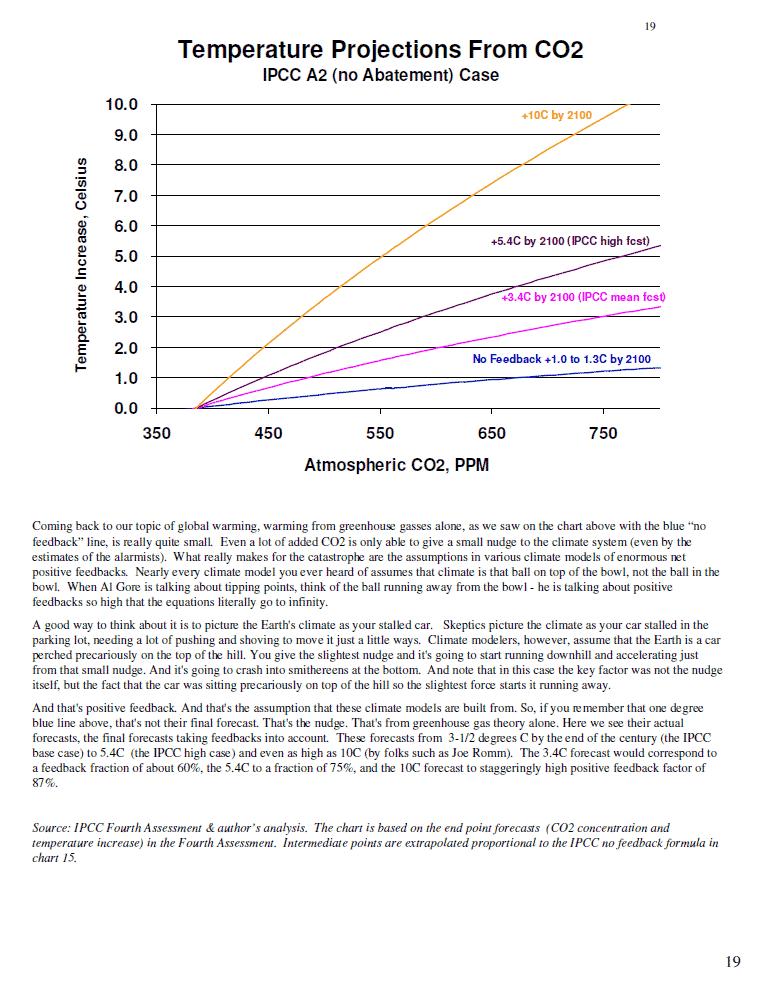
The best way to illustrate this is with a few charts from my most recent climate presentation and video. We usually see warming forecasts by year. But the real relationship is between warming and CO2 concentration (this relationship is called climate sensitivity). One can graph forecasts at various levels:

The blue line corresponds to the IPCC no-feedback formula that I think originally goes back to Michael Mann, and yields about 1-1.2C of warming for greenhouse gas warming from CO2 before feedback effects. The middle two lines correspond to the IPCC mid and high forecasts, and the top line corresponds to more alarmist forecasts from folks like Joe Romm who predict as much as 8-10C of warming by 2100 (when we will be at 650-800ppm CO2 per the IPCC). By the way, the IPCC does not publish the lines above the blue line, so I have taken the formula they give for the blue line and scaled it to meet their end points. I think this is reasonable.
A couple of things – all climate models assume net positive feedback, what skeptics consider the key flaw in catastrophic global warming theory. In fact, most of the catastrophe comes not from global warming theory, but by this second theory that the Earth’s temperature system is dominated by very high positive feedback. I illustrate this here. The blue line is from CO2 greenhouse gas warming. Everything above it is from the multiplier effects of assumed feedbacks.

I won’t go into the feedback issue much now – search my site for positive feedback or else watch my video for much more. Suffice it to say that skeptics consider the feedback issue the key failure point in catastrophic forecasts.
Anyway, beyond arguing about feedbacks, there is another way to test these forecasts. Relationships that hold for CO2 and warming in the future must hold in the past (same Earth). So lets just project these lines backwards to the CO2 level in the late 19th century.

Can you see the issue? When projected back to pre-industrial CO2 levels, these future forecasts imply that we should have seen 2,3,4 or more degrees of warming over the last century, and even the flawed surface temperature records we are discussing with a number of upwards biases and questionable adjustments only shows about 0.6C.
Sure, there are some time delay issues, probably 10-15 years, as well as some potential anthropogenic cooling from aerosols, but none of this closes these tremendous gaps. Even with an exaggerated temperature history, only the no feedback 1C per century case is really validated by history. And, if one assumes the actual warming is less than 0.6C, and only a part of that is from anthropogenic CO2, then the actual warming forecast justified is one of negative feedback, showing less than 1C per century warming from manmade CO2 — which is EXACTLY the case that most skeptics make.
Those who control the past control the future. Those who control the present control the past.– George Orwell
Footnotes:
(1) More than once I have contemplated how much the fact that the invention of the thermometer occurred at perhaps the coldest point in human memory (early 17th century) has contributed to the perceptions of current warm weather being unusual.
(2) For those who are on the ball, perhaps you can spot an amazing disconnect here. Scientists claim that the natural variation of temperatures is in a very narrow band, that they never move even 0.2C per decade by natural means. But they also say that the Earth’s temperature system is dominated by positive feedback, meaning that very very small changes in forcings are magnified many fold in to large temperature changes. I won’t go in to it in depth from a systems perspective, but trust me that “high stability in a narrow range” and “dominated by high positive feedback” are not very compatible descriptions of a system.
Missing the Main Arguments
Are skeptic’s really bad at making their case. Or are warming alarmists purposely avoiding the skeptic’s best arguments? That’s the question I am left with after reading this Scientific American article supposedly shooting down the skeptic’s best 7 arguments. Let’s walk very briefly through all seven. If you don’t want to go through these individually, I will preview the ending or you can skip to it: None of these seven include any of the most powerful or central arguments of skeptics. At the end of this article I offer seven competing skeptics claims that never seem to get addressed.
Claim 1: Anthropogenic CO2 can’t be changing climate, because CO2 is only a trace gas in the atmosphere and the amount produced by humans is dwarfed by the amount from volcanoes and other natural sources. Water vapor is by far the most important greenhouse gas, so changes in CO2 are irrelevant.
I have never really relied on this argument, so I am not going to bother with this one.
Claim 2: The alleged “hockey stick” graph of temperatures over the past 1,600 years has been disproved. It doesn’t even acknowledge the existence of a “medieval warm period” around 1000 A.D. that was hotter than today is. Therefore, global warming is a myth.
Without digging into the detail of proxies and statistical methods, it is nearly impossible to discuss the hockey stick in 3 paragraphs. But in the end it doesn’t matter because the author and I agree that it doesn’t matter. The author writes:
But hypothetically, even if the hockey stick was busted… what of it? The case for anthropogenic global warming originally came from studies of climate mechanics, not from reconstructions of past temperatures seeking a cause. Warnings about current warming trends came out years before Mann’s hockey stick graph. Even if the world were incontrovertibly warmer 1,000 years ago, it would not change the fact that the recent rapid rise in CO2 explains the current episode of warming more credibly than any natural factor does—and that no natural factor seems poised to offset further warming in the years ahead.
Leaving off the very end, where he goes sailing into the aether by saying incontrovertibly that the rise in CO2 explains our current episode of warming, he says that the hockey stick isn’t really evidence at all, no matter what it says. I agree. But skeptics weren’t the ones who brought it up as relevant evidence, the alarmists did. If they are walking away from it, fine. [By the way, this is an absolutely core technique of climate science – defend a flawed analysis like a mother bear, claim it is the smoking gun that proves everything, and then when forced to finally accept that it is flawed say that it doesn’t matter.]
Claim 3: Global warming stopped a decade ago; the earth has been cooling since then.
His answer here is really an amazing bit of cognitive dissonance. He writes:
Anyone with even a glancing familiarity with statistics should be able to spot the weaknesses of that argument. Given the extended duration of the warming trend, the expected (and observed) variations in the rate of increase and the range of uncertainties in the temperature measurements and forecasts, a decade’s worth of mild interruption is too small a deviation to prove a break in the pattern, climatologists say….
If a lull in global warming continues for another decade, would that vindicate the contrarians’ case? Not necessarily, because climate is complex.
So even a 20 year lack of warming does not disprove that CO2 is causing 0.2C – 0.25C per decade of warming or more, because natural variations could mask this or offset it somehow (offsetting therefore as much as 0.5C by natural variation in the cooling direction over two decades).
Some might ask, can’t the warming be hiding or taking some time off? First, if the theory is right, it can’t be taking time off. It has to warm, year in and year out. It can hide in the deep oceans, but new technologies like the ARGO floats since 2002 have shown no increase in ocean heat content in the 6-7 years. This is why scientists are stuck positing there is some natural phenomenon offsetting the heating with cooling.
But here is the problem, not that any warming scientists are honest enough to raise it. Their entire argument that recent warming has been driven by CO2 (as the author confidently asserted above) is that scientists are unable to explain the warming since 1950 any other way (ie it can’t be explained by natural factors). Leave aside that this assertion is based solely on runs of their flawed models – we will get to that later. Look at the temperature curve for the past decades:
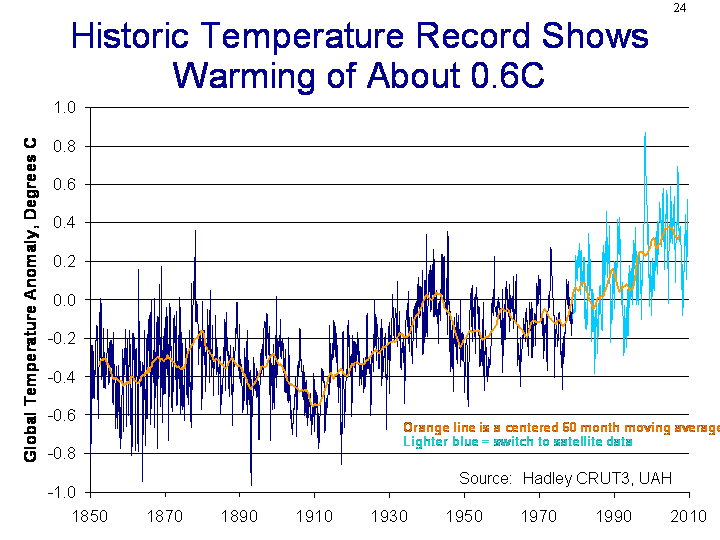
From this we see two things. First, warming since 1950 really means warming since about 1975-1980, since there was a flat period before that. And, this warming over the two decades of the 80’s and 90’s was between 0.4 and 0.5C.
So, do you see the problem? The entire foundation of global warming alarmism is based on the fact that their computer models can’t imagine anything natural that would warm things by as much as 0.4-0.5C over two decades. But now, to save the theory, they are positing that there are natural cooling effects that will offset 0.4-0.5C over two decades. Either natural effects can move temperatures a half degree over two decades or they can’t (by the way, if you want a hint, look at 1910-1940, where temperatures moved 0.6C over three decades long before man put much CO2 in the air.)
Claim 4: The sun or cosmic rays are much more likely to be the real causes of global warming. After all, Mars is warming up, too.
A couple of issues here. First, here is a great example of assuming your conclusion.
The IPCC notes that between 1750 and 2005, the radiative forcing from the sun increased by 0.12 watts/square-meter—less than a tenth of the net forcings from human activities [pdf] (1.6 W/m2).
Skeptic’s think that the net forcing numbers from human activities are over-stated, mainly due to over-assumptions of positive feedback effects. Rather than address this issue, he just assumes the forcing number is right and then says this “proves” skeptics are wrong.
He goes on to say that Svensmark’s cosmic ray theory of cloud formation is not well proven. I would agree with him that it is a formative theory and needs a lot more evidence and authentication before I am ready to say it represents how the world works. Which is one reason you will see me sometimes reporting on updates on his theory but you won’t find it in my core arguments on the topic.
But the interesting thing to me is that all the arguments the author makes against Svensmark could equally well apply to anthropogenic greenhouse gas warming theories. Both have been demonstrated in the laboratory, but it is unclear how either works in the complex climate system. Both have a few correlations going for it historically, but no smoking gun of causation. It is interesting the asymmetry of skepticism applied to Svensmark’s evidence vs. that of CO2 warming.
Claim 5: Climatologists conspire to hide the truth about global warming by locking away their data. Their so-called “consensus” on global warming is scientifically irrelevant because science isn’t settled by popularity.
*Shrug* Ad hominem argument, don’t really care. I have tried to be careful in all the CRU email flap to be clear that the substantial failures of scientific process don’t prove or disprove anything – they just mean that the science is not as settled as has been portrayed and that we need more transparency to let the evidence get battle-tested. I personally think a lot of it will collapse, but we actually have to still disprove it — just because it came from unethical folks does not make it wrong, any more than guys who took money from Exxon 20 years ago are automatically wrong either.
Claim 6: Climatologists have a vested interest in raising the alarm because it brings them money and prestige.
I actually think the author is naive or disingenuous to try to argue against this. Twenty years ago, climate science was a backwater with no money and no prestige. Now governments of the world spend billions, and Presidents know their names. Just the fact that average people know the names James Hansen and Phil Jones and Michael Mann disproves the authors point.
However, I am more than happy to totally leave this point behind and just forget about it, if I am allowed just one playground rejoinder – you guys started it. I am wondering why this argument was OK for years when it was skeptics and a few thousands of Exxon’s money but is now totally irrelevant when the alarmists are getting most of the funding, and the money runs up into the billions. But, as I said, if we want to declare a truce on ad hominem funding arguments, fine by me.
Claim 7: Technological fixes, such as inventing energy sources that don’t produce CO2 or geoengineering the climate, would be more affordable, prudent ways to address climate change than reducing our carbon footprint.
I am not a big fan of geoengineering climate, any more than I am of micromanaging economics. The same problems apply — where systems are complex and chaotic, the potential for unintended consequences are high.
Here is what he left out
So now its my turn. I will propose my own seven skeptic’s claims that are much more at the heart of our argument but which you never, ever see addressed in these type articles. By the way, if you think I am somehow moving the bar, see my climate speech, published before the Scientic American article, which highlights the claims below. Or see Richard Lindzen’s excellent summary article in the WSJ.
Claim A: Nearly every scientist, skeptic and alarmist alike, agree that the first order warming from CO2 is small. Catastrophic forecasts that demand immediate government action are based on a second theory that the climate temperature system is dominated by positive feedback. There is little understanding of these feedbacks, at least in their net effect, and no basis for assuming feedbacks in a long-term stable system are strongly net positive. As a note, the claim is that the net feedbacks are not positive, so demonstration of single one-off positive feedbacks, like ice albedo, are not sufficient to disprove this claim. In particular, the role of the water cycle and cloud formation are very much in dispute.
Claim B: At no point have climate scientists ever reconciled the claims of the dendroclimatologists like Michael Mann that world temperatures were incredibly stable for thousands of years before man burned fossil fuels with the claim that the climate system is driven by very high net positive feedbacks. There is nothing in the feedback assumptions that applies uniquely to CO2 forcing, so these feedbacks, if they exist today, should have existed in the past and almost certainly have made temperatures highly variable, if not unstable.
Claim C: On its face, the climate model assumptions (including high positive feedbacks) of substantial warming from small changes in CO2 are inconsistent with relatively modest past warming. Scientists use what is essentially an arbitrary plug variable to handle this, assuming anthropogenic aerosols have historically masked what would be higher past warming levels. The arbitrariness of the plug is obvious given that most models include a cooling effect of aerosols in direct proportion to their warming effect from CO2, two phenomenon that should not be linked in nature, but are linked if modelers are trying to force their climate models to balance. Further, since aerosols are short lived and only cover about 10% of the globe’s surface in any volume, nearly heroic levels of cooling effects must be assumed, since it takes 10C of cooling from the 10% area of effect to get 1C cooling in the global averages.
Claim D: The key issue is the effect of CO2 vs. other effects in the complex climate system. We know CO2 causes some warming in a lab, but how much on the real earth? The main evidence climate scientists have is that their climate models are unable to replicate the warming from 1975-1998 without the use of man-made CO2 — in other words, they claim their models are unable to replicate the warming with natural factors alone. But these models are not anywhere near good enough to be relied on for this conclusion, particularly since they admittedly leave out any number of natural factors, such as ocean cycles and longer term cycles like the one that drove the little ice age, and admit to not understanding many others, such as cloud formation.
Claim E: There are multiple alternate explanations for the 1975-1998 warming other than manmade CO2. All likely contributed (along with CO2) but it there is no evidence to give most of the blame to Co2. Other factors include ocean cycles (this corresponded to a PDO warm phase), the sun (this corresponded to the most intense period of the sun in the last 100 years), mankind’s land use changes (driving both urban heating effects as well as rural changes with alterations in land use), and a continuing recovery from the Little Ice Age, perhaps the coldest period in the last 5000 years.
Claim F: Climate scientists claim that the .4-.5C warming from 1975-1998 cannot have been caused natural variations. This has never been reconciled with the fact that the 0.6C warming from 1910 to 1940 was almost certainly due mostly to natural forces. Also, the claim that natural forcings could not have caused a 0.2C per decade warming in the 80’s and 90’s cannot be reconciled with the the current claimed natural “masking” of anthropogenic warming that must be on the order of 0.2C per decade.
Claim G: Climate scientists are embarrassing themselves in the use of the word “climate change.” First, the only mechanism ever expressed for CO2 to change climate is via warming. If there is no warming, then CO2 can’t be causing climate change by any mechanism anyone has ever suggested. So saying that “climate change is accelerating” (just Google it) when warming has stopped is disingenuous, and a false marketing effort to try to keep the alarm ringing. Second, the attempts by scientists who should know better to identify weather events at the tails of the normal distribution and claim that these are evidence of a shift in the mean of the distribution is ridiculous. There are no long term US trends in droughts or wet weather, nor in global cyclonic activity, nor in US tornadoes. But every drought, hurricane, flood, or tornado is cited as evidence of accelerating climate change (see my ppt slide deck for the data). This is absurd.
Catastrophe Denied — Video From My Climate Lecture
Note- If you are reaching here from Google, there is an updated version of this video with better sound, and it can be found here.
The video from my climate lecture on November 10, 2009 is now available online. This lecture is a fairly comprehensive overview of the science of the skeptic’s position. I have overlaid the slides on the video so you can see them better. I am currently re-recording the presentation in the studio to get better quality and when that is done I will offer the video as a DVD purchase or free bittorrent download.
The HD video is available full length via Vimeo embedded below. This is a lower resolution version — to see it in its full high-resolution glory click here. This higher resolution version is greatly recommended – the Vimeo engine works well and I find it streams even better than low-resolution YouTube videos on most computers.
Catastrophe Denied: A Critique of Catastrophic Man-Made Global Warming Theory from Warren Meyer on Vimeo.
Full Resolution Version Here
You can also view it on YouTube, though by YouTube’s rules the resolution gets crushed and it has to be broken up into nine (9!) parts. The YouTube playlist is embedded below or is here.
The slides from this presentation can be downloaded here.
Climate Presentation Slides
These are the Powerpoint slides for my Nov. 10 presentation in Phoenix.
The slides are available for download at this link (9.9MB): Download ppt
A pdf file of the presentation is here (2.7MB): Download pdf
You can also view a Google docs version of the presentation below, though a bit of the formatting gets screwed up in the translation: Climate Presentation, online viewer
Sign up here to be notified when I post the video
Thanks
We had a really good crowd out last night for my lecture. I am currently working on publishing the video and the slides. I am going to destroy the email list for this lecture, but before I do so I am going to send everyone a link to the slides and video when I get them posted. If you would like to be notified when these are up, you may join the email list here.
Posting Drought Over Soon
There is a lot going on that I should be posting about, but I am preparing for a new round of public presentations, of which I give the first tomorrow night in Phoenix. Once that is done, and I can get the video posted, I will be back to normal operations.
By the way, if you like the video, I am available for talks to groups for no speaking fee, if I can get to where you are. My business (totally unrelated to climate) takes me all over the country so I may be near you some time soon. Just drop me an email at the link above.
On the Radio Tonight
For those in Arizona, I will be on the Terry Gilberg show on 550 KFYI talking climate starting at 6:30 or 7:00 to about 8:00.
Reminder: Tuesday, Nov 10 Presentation in Phoenix
If you are in the Phoenix area and interested in a scientific discussion of climate issues, and in particular the science behind the skeptic’s position, you will likely enjoy my lecture this coming Tuesday (Nov 10) in Phoenix. The presentation is free to the public, and will be from 7-9PM in Dorrance Auditorium at the Phoenix Country Day School, on 40th Street just north of Camelback Road. Hope to see you there.
The information web site is here.
The brochure for the presentation is here.
The press release is here.