Silly Climate Study Hoax

Earlier today I was forwarded an email about a climate study.  This was supposedly an excerpt:

Anyone who has read, say, one or more scientific papers know that this is not the usual language of academic papers.  The first line sounds more like a letter to Penthouse than a scientific paper (you know, the classic "I never thought something like this would happen to me, but last Saturday night…)  What caused me to delete the email (fortunately it was still in the trash so I could go back and find these quotes) was the line "findings in this paper could nt be more damaging to manmade global warming theory or the the thousands of climate scientists…"  No academic in his right mind would state his/her conclusions in this manner, and even if they did, not editor or advisor would let it slip by. 

The premise of the paper was apparently that something other than man (ie bacteria) was creating the CO2 that was causing global warming.  But that in fact does not really refute the core of man-made global warming theory.  The shakiest part of man-made global warming theory is that CO2 will really cause the dire temeprature rises that are often published (rather than much smaller increases on the order of 1C rather than 5C or more).  But the authors were accepting this part, and merely positing that something other than man was causing the CO2 rise.  But this makes no sense.   The 100 ppm rise of CO2 over the last 150 years may not be all due to man, but its pretty clear a lot of it is.  After all, if CO2 has risen from 280 to 380 ppm in the last 150 years, that is a trend that could only go back so far, unless there were such a thing as negative concentrations.

The rest gets even sillier:

We believe that academic intimidation of this kind contradicts the spirit of open enquiry in which scientific investigations should be conducted. We deplore the aggressive responses we encountered before our findings were published, and fear the reaction this paper might provoke. But dangerous as these findings are, we feel we have no choice but to publish.

That’s the kind of thing you post in your blog, not in the paper itself.   Climate does unfortunately see a lot of ad hominem attacks back and forth, but seldom in the academic papers themselves.

So I assumed that it was some ill-concieved hoax by a skeptic, though I could not really understand what point they were trying to make.  Positing such a thing, only to have it quickly shot down, could only hurt the skeptic position.  If a skeptic made the hoax, it was a stupid strategy.  The point is trying to bring clarity and real science back to a politicized scientific debate, and this just does the opposite.

I have therefore come to the conclusion that this hoax is likely the work of global warming catastrophists.  My guess is that they wanted to make a point that skeptics were no such thing — that skeptics would bite like a hungry bass at such a lure as long as it supported their position.  And certain folks in political circles did so, at least for a few hours.   My presumption is that if we had all trumpeted this fake study, then our judgement on other issues would get called into question.  My sense is that catastrophists have convinced themselves with their own propaganda that skeptics are all motivated by political and financial agendas.  But most skeptics are really interested in the science, and are motivated by the real fear that we are at the cusp of embarking on some really poor, near tragic, policy decisions.

Now, if you really want to have fun, create a similar hoax the other way, supporting catastrophic man-made global warming.  You will probably make the NBC Nightly News.  It would be fun to try something really nutty and see if people buy it, like saying the oceans will rise 20 feet in the next century… oops, its already been done.  Al Gore made that claim, among other truly absurd statements, in his movie An Inconvinient Trust, for which he not only made the NBC Nightly News but he also won an Oscar and a Nobel Prize. 
Retreating Glaciers

No global warming catastrophe movie is complete without scenes of melting glaciers.  And it is true that many (but by no means all) of the world’s large glaciers have retreated over the last century.  The implication is that this retreat is due to man.

The reason I titled my climate video "What is Normal?" is because I am facinated with the hubris we have of observing climate for just a few decades, but suddenly declaring we know what is a "normal" or "abnormal" climate.  Such may be the case with retreating glaciers.

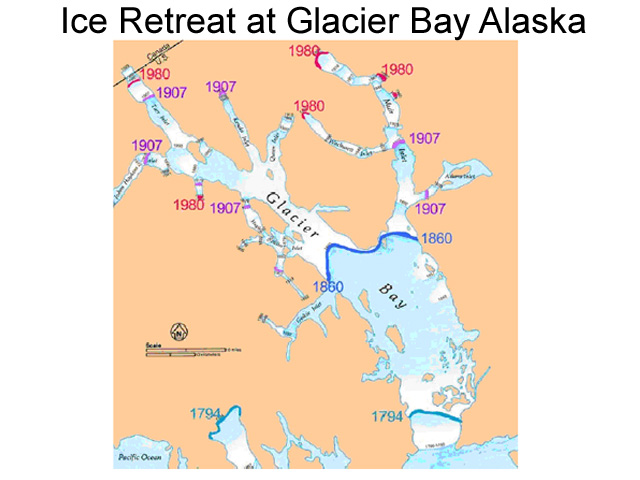
This is a picture published in Alaska Geographic Magazine, plotting the retreat of the famous glacier at Glacier Bay, Alaska.

Glacier1

As you can see, the vast majority of the retreat occured between 1794 and 1907, before man is generally blamed with substantially affecting the climate with CO2.  Yes, we have seen some retreats in the last 50 years, but in this context they look much more like a continuation of a natural trend than any new man-made phenomenon.  In fact, to claim that recent retreats are man-made, one would have to argue that the natural forces driving glacier retreats since 1794 would have had to halt around 1950, coincidently exactly when man’s impact began.  This kind of coincident occurance isn’t impossible, but certainly fails any Occam’s Razor smell test.

Let’s All Be Like India!

Never have I seen a global warming catastrophist help make it clear what potential costs were are facing in trying to roll back CO2 emissions (emphasis added):

Mr Stern, the former chief economist of the World Bank, sends out a very clear message: “We need to cut down the total amount of carbon emissions by half by 2050.” At current levels, the per capita global emissions stand at 7 tonnes, or a total of 40-45 gigatonnes. At this rate, global temperatures could rise by 2.5-3 degrees by then. But to reduce the per capita emissions by half in 2050, most countries would have to be carbon neutral. For instance, the US currently has, at 20-25 tonnes, per capita emissions levels that are three times the global average.

The European Union’s emission levels stand at 10-15 tonnes per capita. China is at about 3-4 tonnes per capita and India, at 1 tonne per capita, is the only large-sized economy that is below the desired carbon emission levels of 2050. “India should keep it that way and insist that the rich countries pay their share of the burden in reducing emissions,” says Mr Stern.

It is fabulous to see a global warming action supporter making my case for me.  In short, he is saying that India should stay the way it is (poor) and everyone else in the world needs to devolve until they are just like India (poor).  I have often said that aspiring to a slightly cooler but substantially poorer world makes no sense, and here we see the choice starkly.

By the way, it is always worth a moment to reality check any warming forecast you see in print, in this case a forecast of 2.5-3 degrees C by 2050.

Historically, we have seen a rise of 0.6 degrees at the same time CO2 concentrations have risen by 100ppm, though not all of this 0.6 degrees is due to CO2.  Recently, CO2 has been rising at 1.5-2 ppm per year.  Let’s assume that from now until 2050, it accelerates and rises on average 3 ppm per year, which is probably high.  This gives us a high-side estimate of 3 x 42 years = 126 ppm more.  So historically, 100 ppm caused something less than 0.6 degrees but going forward, 126 ppm more will cause 2.5-3 degrees?  Do you see how crazy and unsubantiable this is?  Particularly since the relationshio of CO2 to radiation absorbtion, and thus to temperature, is a diminishing one, such that the next 100 ppm should cause less warming than the last 100 ppm. 

Yeah, I know, it’s more complicated (dimming and feedback, etc).  But the ultimate answer considering this greater complexity is still the same.  The more complex answer is discussed in slightly longer form here, and in much longer form in my film and my book (both free online).

Signal to Noise Ratio in Measuring Temperature

Well, posting has a been a bit light for what I hope is now a fairly obvious reason:  I have been working overtime just to get my climate video published.  Now that the video is out, I can get back to my backlog of climate material I want to post.

For a while, I have been fascinated with the topic of signal to noise ratio in climate measurement.  For most purposes, the relevent "signal" we are trying to tease out is the amount of warming we have seen over the last decades or century.  The "noise" consists of measurement inacuracies and biases.

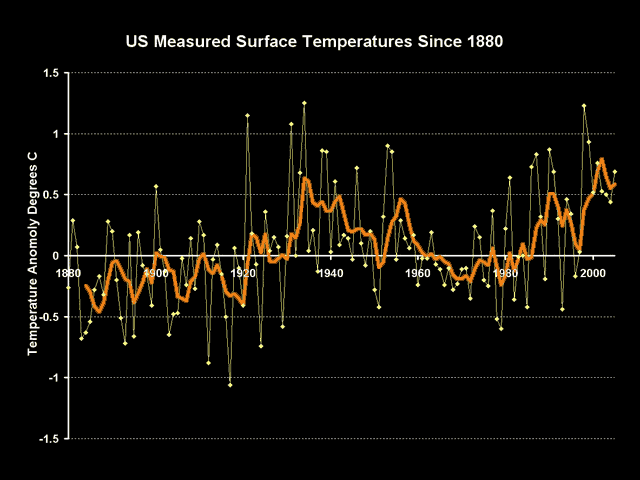
Here are the NASA GISS numbers for US temperature over the last century or so:

Adjust1

The warming trend is hard to read, with current temperatures relatively elevated vs. the last 120 years but still lower than the peaks of the 1930’s.  But we can learn something by going below the surface of these numbers.

These numbers, and in fact all numbers you will ever see in the press, are not the raw instrument measurements – they include a number of manual adjustments made by climate scientists to correct for both time of observation as well as changing quality of the measurement site itself.  These numbers include adjustments both from the NOAA, which maintains the US Historical Climate Network on which the nubmers are based, and from NASA’s GISS.  All of these numbers are guesstimates at best.

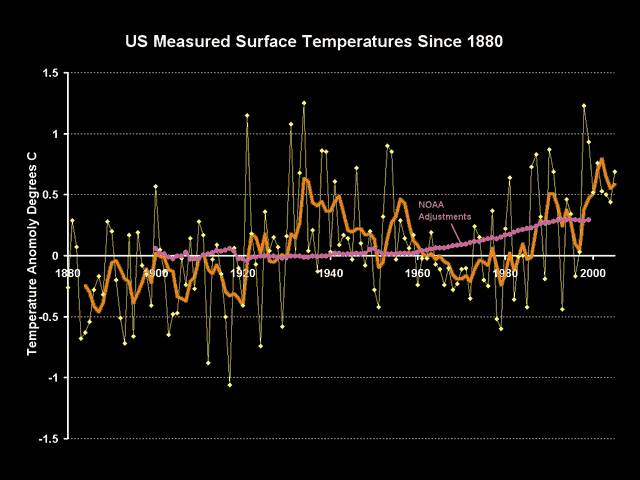
Though the GISS is notoriously secretive about revealing much about its temperature correction and aggregation methodologies, but the NOAA reveals theirs here.  The sum total of these adjustments are shown on the following chart in purple:

Adjust2

There are a couple observations we can make about these adjustments.  First, we can be relatively astonished that the sign on these adjustments is positive.  The positive sign implies that modern temerpature measurement points are experiencing some sort of cooling bias vs. history which must be corrected with a positive add-on.  It is quite hard to believe that creeping urbanization and poor site locations, as documented for example here, really net to a cooling bias rather than a warming bias (also see Steve McIntyre’s recut of the Peterson urban data here).

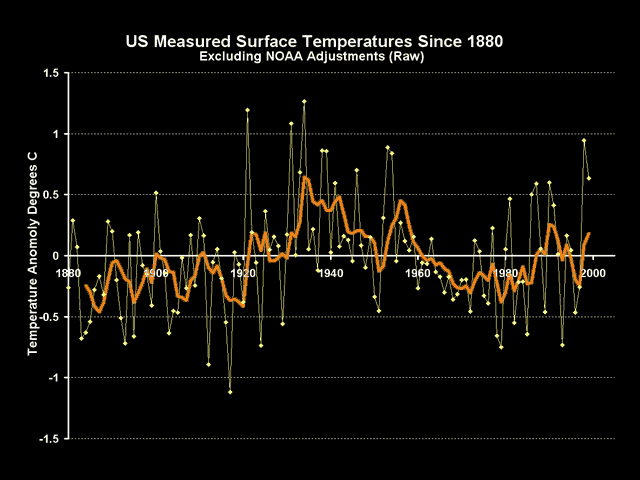
The other observation we can make is that the magnitude of these adjustments are about the same size as the warming signal we are trying to measure.  Backing into the raw temperature measurements by subtracting out these adjustments, we get this raw signal:

Adjust3

When we back out these adjustments, we see there is basically no warming signal at all.  Another way of putting this is that the entirety of the warming signal in the US is coming not from actual temeprature measurements, but from adjustments of sometimes dubious quality being made by scientists back in their offices.  Even if these adjustments are justifiable, and some like the time of observation adjustment are important, the fact is that the noise in the measurement is at least as large as the signal we are trying to measure, which should substantially reduce our confidence that we really know what is going on.

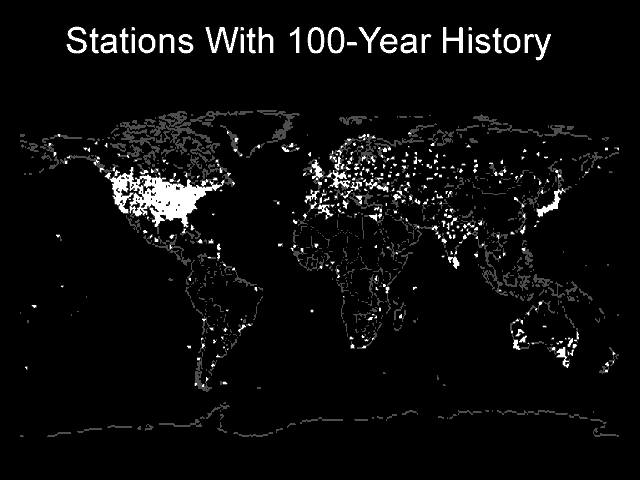
Postscript:  Yes, I know the US is just one part of the world.  But the US is the one part of the world with the best, highest quality temperature measurement system.  If signal to noise ratios are low here, then how bad are they in the rest of the world?  After all, we in the US do have some rural sites with 100 year temperature measurement histories.  No one in 1900 was measuring temperatures in rural Africa or China or Brazil.

World_100_yr_history_2

More Ways to View My Climate Video

There has been a lot of interest in my new climate video.  Already we have nearly 450 1400 views at Google video and over 200 800 downloads of the video.  I am now releasing the video on DVD and through YouTube.

I have had several requests for a DVD version rather than an online version or file.  For a limited time, through December 31, 2007, I will send a DVD of my video What is Normal?  A Critique of Catastrophic Man-Made Global Warming Theory to anyone who sends me a stamped self-addressed envelope.  The DVD plus a standard CD mailer weigh about 3.3 OZ, so you will need $1.31 postage in the US.  Send your request to "Climate Video, c/o Warren Meyer, 11811 N. Tatum Blvd #4095, Phoenix, AZ, 85253"

Also, in response to popular demand, I have release the video on YouTube.  YouTube requires that all videos be under 10 minutes, so I have broken the film into six parts.  If you want to just preview a portion, the second half of the fourth film and the first half of the fifth are probably the most critical.

A Youtube Playlist for the film is here.  This is a cool feature I have not used before, but will effectively let you run the parts end to end, making the 50-minute video more or less seamless. 

The individual parts are:

Climate Video Part 1:  Introduction; how greenhouse gases work; historical climate reconstructions
Climate Video Part 2:  Historical reconstructions; problems with proxies
Climate Video part 3:  How much warming is due to man; measurement biases; natural cycles in climate
Climate Video Part 4:  Role of the sun; aerosols and cooling; climate sensitivity; checking forecasts against history
Climate Video Part 5:  Positive and negative feedback;  hurricanes.
Climate Video Part 6:  Melting ice and rising oceans; costs of CO2 abatement; conclusions.

You may still stream the entire climate film from Google Video here. (the video will stutter between the 12 and 17 second marks, and then should run fine)

You may download a 258MB full resolution Windows Media version of the film by right-clicking here.

You may download a 144MB full resolution Quicktime version of the film by right-clicking here.

Climate Video Release!

My first climate movie, What is Normal?  A Critique of Catastrophic Man-Made Global Warming Theory is now available for free download.  If you have the bandwidth, I encourage you to download the full 640×480 version as Windows Media Video, but be forewarned that the file is 258MB.  This is actually a pretty small file for a 50+ minute movie, and the full resolution version looks much nicer than the streaming version.

Right-Click Here to Download Climate Movie in Full Resolution

Update:  Right-Click here for full resolution 144MB .mov quicktime version of Climate Movie

Make sure you turn up your volume — I think I recorded this with a pretty low audio level.

If you are bandwidth-challenged, or you can’t view a .WMV file, you may stream the video from Google video or download a reduced resolution version here.  Unfortunately, to make the video stream effectively, the resolution is cut to 320×240, but having watched it, it actually still looks surprisingly good streamed. 

Note, on the streaming version, the video stutters between the 12 and 17 second marks in the movie, but runs fine after that.  By the way, thanks to all the commenters who gave me some good alternatives to using my own fairly week narration voice.  I decided for this first release I wanted to see what I could achieve with a pure solo effort.  Many thanks to Adobe Premier Elements, which made this effort possible.

Finally, you can stream the reduced resolution Google video version below:

New Global Warming Video Release

Please check back Monday morning, as I will be releasing my new video, "What is Normal:  A Critique of Catastrophic Man-Made Global Warming Theory."  As with my global warming book, which began as a ten page summary and ended up as an 85-page manuscript, the video started at a goal of 15 minutes and eventually ended up at 50 minutes.  However, unlike other global warming-related videos I will not name, it is all climate science, with no self-congratulatory segments on my childhood.

CO2 and Drought

One of the sloppier predictions about global warming is that is will cause massive droughts, and certainly we have seen this line of reasoning over the last week as the media attempts to hang the blame for Southern California fire damage on CO2, when in fact most of the blame lies on rapid home construction in areas known to have a high fire danger.

I suppose the layman’s logic is as follows:  Well, it is usually hot when we have droughts, and it is hot in deserts, so therefore if the world gets hotter, we will have droughts and deserts.  Of course, this logic is silly, but is none-the-less prevenlent (does no one remember that rain forests are hot too?)

In fact, one almost certain effect of global warming will be an increase in the evaporation rate of the oceans.  Megatons more water is put into the sky as temperatures of the air and oceans rise.  Presumably, much of this water will fall as rain somewhere, so it would probably be more logical to guess that warming would cause more rain rather than less.

As Steven Malloy points out, as temperatures have risen about 0.6C over the last century, rainfall in the US and Southern California have actually increased:

During the period 1900-2005, precipitation seems to have actually increased in areas above 30 degrees north latitude — including California and the rest of the U.S. — according to the most recent assessment from the United Nations’ Intergovernmental Panel on Climate Change.

This does not mean, of course, that droughts haven’t occurred in North America over the last 100 years, but it doesn’t support a link between rising global temperature and increased drought.

Examining the occurrence of drought in southern California since 1900 is also illuminating.

According to data maintained by the federal National Climatic Data Center, drought conditions are no stranger to southern California.

During the period 1900 to 2005, moderate-to-severe drought conditions occurred in Southern California during 34 of those 106 years — that is, about one-third of the time.

Comparing the southern California drought record against the global temperature record reveals the following:

— During the period 1900-1940, when most of the 20th century’s one-degree Fahrenheit temperature increase occurred, there were 7 years of moderate-to-severe drought.

— During the period 1941-1975, when global temperatures cooled, giving rise to concerns of a looming ice age, there were 11 years of moderate-to-severe drought.

— During the period 1976 to 1990, when global temperatures rose back to the 1940 level, there were 8 years of moderate-to-severe drought.

— Since 1991, when global temperatures rose slightly past the 1940 levels, there have been 7 years of drought.

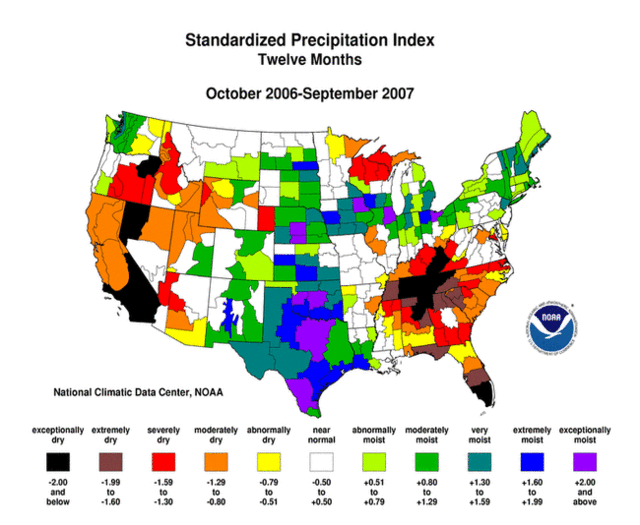
In fact, just last week I posted drought maps that showed that while Southern California has had drought conditions over the last year…

Spi12_200709_pg

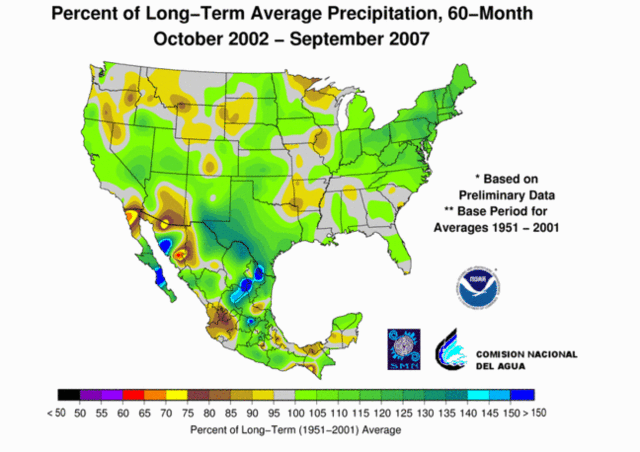
…they have had absolutely average rainfall over the last five years and Northa America has been downright soggy:

Usnmx20070960monpctpcppg

On Monday, I will be releasing my climate video tentatively titled "What is Normal?"  A recurring theme in that video is our current inability to accept extremes in the weather as "normal,"  which in fact they are.

Climate Exaggeration

There is nothing unique about the following, but I include it as an example of the unbelieveable exaggerations that are being bandied about concerning climate.  I was doing some research on the Salton Sea for a post at Coyote Blog and ran accross this letter from the California Audobon Society.  It says, in part:

Although there is uncertainty about what the precise impacts will be, there is no longer legitimate scientific disagreement about the fact that the climate is changing and that those changes will accelerate over the next century.

One of the classic rhetorical tricks is to say "it cannot be denied that" followed by two statements.  The first statement will in fact be undeniable, setting up the reader to blindly accept the second, which is much more contentious.  In this case, there is indeed no doubt that Climate is changing.  Climate is always changing, else we would still have glaciers in Minnesota.  However, it is far, far from given that the changes will "accelerate" in the next century.  In fact, the relationship between CO2 and warming is in fact a diminishing return, making "acceleration" difficult in all but a looney universe dominated by positive feedbacks.

But the real whopper comes in the next paragraph:

According to recent analyses, California is projected to experience temperature increases of at least 4-8 degrees Fahrenheit (if global emissions are significantly curtailed) and more likely temperature increases of 9-18 degrees Fahrenheit (current emissions path) over the next centur

Really?  First absolutely impossible to reconcile 9-18 degree F with the approximately 1F (0.6C) warming we have seen in the last century.  CO2 rose 100ppm in the last century and produced 1F, but adding another 200ppm in the next century will produce 9-18F??  This implies an upward sloping curve that is exactly opposite of the relationship everyone agrees CO2 and warming have.  18F implies almost two degrees a decade, a huge number considering the warming over the last decade has been close to zero and no decade has had warming of more than about 0.3F.  Further, I am sure the Sierra Club found someone who actually produced such a study, but the IPCC "consensus", which I think is exaggerated, calls for only about 4-6F increases in the next century.  Five degrees F is probably bad enough, do they really have to outright exaggerate?

Next Solar Cycle Looks Very Weak

Via Anthony Watts:

“All Quiet Alert” – That sounds like an oxymoron, and maybe it is, but the sun is extremely quiet right now, so much in fact that the Solar Influences Data Center in Belgium has issued an “All quiet alert” on October 5th. Since then, the sunspot number has remained at zero.

The sun is blank–no sunspots.

There is talk about of an extended solar minimum occurring, or perhaps a recurrence of a Dalton or Maunder type minimum. There are signs that the sun’s activity is slowing. The solar wind has been decreasing in speed, and this is yet another indicator of a slowing in the suns magnetic dynamo. Below are near real-time (updated hourly)dials of Solar Wind speed, Solar Wind Density, and Interplanetary Magnetic Field. …

One thing is certain, based on past climate history and solar history, if in fact the suns magnetic activity slows, or collapses and we enter a prolonged period of little or no sunspot activity, we’ll see a global cooling trend.

It is still too early to tell, but pretty interesting none-the-less.

Global Warming Video

Anthony Watt has a pointer to a nice presentation in four parts on YouTube by Bob Carter made at a public forum in Australia.  He walks through some of the skeptics’ issues with catastrophic man-made global warming theory.

What caught my attention, though, were the pictures Mr. Carter shows in his presentation about about 1:30 into part 4.  Because I took the pictures he shows, down at the University of Arizona, as part of Mr. Watts project to document temperature measurement stations.  Kind of cool to see someone I don’t know in a country I have (sadly) never visited using a small bit of my work.  Part 4 is below, but you can find links to all four parts here.

Coming soon, my own home-brewed video effort on global warming and climate.  Right now it runs about 45 minutes, and I’m in the editing stages, mainly trying to make the narration match what is on the screen.

Cross-posted from Coyote Blog

Warmer but Richer

James Pethoukokis via Cafe Hayek

In one of its occasional assessments, the Intergovernmental Panel on Climate Change—the cowinner with Al Gore of the Nobel Peace Prize—posited a scenario in which the global economy would grow at about 2 percent a year for the next 100 years (it’s growing at more than twice that pace currently) with "fragmented" and "slow" per capita economic growth and technological change.

Indeed, it is just this scenario that was used by the influential Stern Report on the economic impact of climate change. By the year 2100, the size of the global economy would be $243 trillion. However, there is another IPCC scenario. It imagines "a future world of very rapid economic growth, low global population growth that peaks in mid-century and declines thereafter, and the rapid introduction of new and more efficient technologies." According to this story line, the global economy would grow at 3.5 percent per year, giving us a $550 trillion global economy in the year 2100, more than twice the size of the economy assumed in the first scenario.

I don’t know about you, but give me a century of accelerating technological change and $300 trillion to pay for it, and there are few problems that would keep me up at night. So the question is: Which policies will get us there?

A couple of years ago, people were all asking themselves what the world could do to avoid catastrophes like the Indonesian Tsunami.  I argued the best thing to do was to help poorer countries to develop as fast as possible. 

Ironically, the primary way to avoid such disasters is not by reversing human technology (as global warming activists want to do), but by increasing it, in the form of warning systems and evacuation routes.  Global warming advocates actually want to keep everyone poor – they blame wealth and progress for global warming, but note that wealthy countries like the US (the global warming great Satan) has had the technology and the wealth to afford to put systems in place that would have prevented such a huge death toll.  Wealth, prosperity and technology are what would have averted this disaster, and it is just these things that global warming advocates oppose for Southeast Asia.

Scientific Analisis of the Day

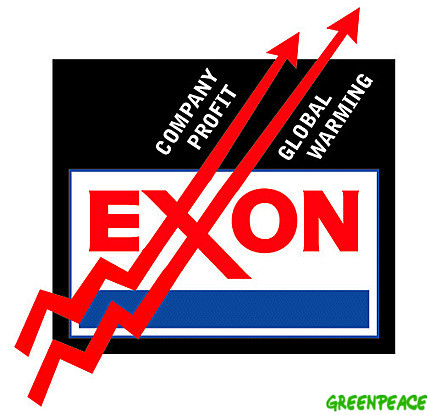
From Greenpeace:

Exxonprofitsandclimatechan

Gosh, its an amazing coincidence that the steps proposed to curb CO2 (reduce oil use, demonize oil companies, limit growth, increase government interventions in free economies, limit global trade) exactly match the political goals held by many leading climate catastrophists long before greenhouse gas theory was even born.  But I am sure its all about the science.  When I hear a climate catastrophist promoting nuclear energy to replace coal in electricity generation (the one no-brainer technology substitution we have available to us to reduce CO2 production), that is a person I can respect for their intellectual integrity.  Of course, I almost never hear it.

By the way, Greenpeace should have a picture of John D. Rockefeller,the founder of Standard Oil of New Jersey (and predecesor of Exxon) on the wall of every one of its offices.  Mr. Rockefeller and Standard Oil, by making Kerosene cheap and universally available as a luminant, did more than Greenpeace will ever do to save the whales.

Update:  The chart itself is kind of funny when you think about it.  It implies that increased prices for gas and oil, which increase profits, would also increase global warming.  But in fact, exactly the opposite is true.  As prices have risen, Exxon has made higher profits but demand has been reduced.  In fact, Exxon really "promoted" global warming the most in the 1980’s and 1990’s when they were making miserable profits and oil prices were low.

Example of A Temperature Proxy

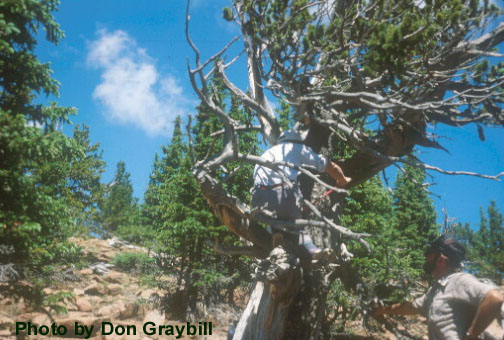
Many of you have probably read about the disputes over temeprature histories like Mann’s hockey stick chart.  I thought you might be interested in how some of these 1000-year long proxies are generated.  There are several different approaches, but one that Mann relied a great deal on is measuring tree rings in bristle cone pine trees.  Here is a picture of a researcher taking a core from a very old tree that is then sent to a lab to have it’s ring widths measured. 

Alm4

In theory, these ring widths are directly proportional to annual temepratures, but there are a lot of questions about whether this is really true.  Other factors, like changing precipitation patterns, might also affect ring widths, and there may be reasons why the scale could change over time.  Remember, we only have a few decades, at most, of good temperature data to scale growth in a tree that goes back over a thousand years.  In fact, scientists are finding that, more recently, tree ring proxy data for current growth is diverging from surface temperature data, meaning either that surface temperature data is flawed or that they don’t really understand how to scale tree ring data yet.  Interestingly, and as a sign of the health of climate science, researchers have reacted to this problem by … not updating tree ring proxy databases for recent years.  That’s one way to handle data that threatens your hypothesis — just refuse to collect it.  Much more on proxy histories here.

Why They Renamed it “Climate Change”

Global Warming was renamed "climate change" so that any "unusual" weather could be grouped under the banner and blamed on man as part of the general panic.  And, more specifically in this case, be used as an excuse to fund a little mountain climbing every year:

The Alps’ tallest peak was measured at 4,810.90 metres on September 15 and 16 – a 2.15 metre increase in two years, surveyors from France’s Haute-Savoie region announced.

"The height as well as the volume of Mont Blanc has increased considerably, because the snow has massed on the summit over the last two years," expert Philippe Borel said at a meeting in the Alpine town Chamonix.

When skeptics refute that many shrinking glaciers, such as the ice pack on Kilamanjaro, are due to changing winds and precipitation patterns rather than warming, they get ignored.  However, when ice is increasing, then of course the press blames it on winds and precipitation rather than cooling:

"We’re registering a greater frequency of winds from the west which bring rain and higher temperatures."

In the summer the precipitation translates into snow sticking in regions over 4,000 metres in altitude that increases Mont Blanc’s volume and height, Mr Giezendanner said.

Interestingly, that sounds a lot like this explanation for shrinking Arctic Ice, which most of the press did not see the need to report.

By the way, this story is an awesome illustration of the point I frequently make — that is, the hubris we have of declaring some weather pattern to be "abnormal" when in fact we only have been observing climate in any depth for a few decades.  Or in this case, for about 4 years:

The volume of ice on Mont Blanc’s slopes over 4,800 metres high was first calculated at 14,600 cubic metres in 2003.

It dropped to 14,300 cubic metres two years later, but then almost doubled to 24,100 cubic metres in 2007.

So for the whole history of time, we have three data points over 4 years for ice depth on Mt. Blanc.  How is there a story here at all, one way or another?

Postscript:  When I was a consultant at McKinsey, I used to joke that it is better to have just one data point rather than many, because then you could draw whatever curve or trendline you wanted to through that one point.

Al Gore and the Peace Prize

This morning I was all fired up to write something petty, like "Al Gore now has made the same contributions to peace as have previous winners Yassir Arafat and Henry Kissinger."  Later, I considered a long and drawn out post on the inaccuracies of "An Inconvinient Truth", but I really have already done that in long form here and in short form here.  In truth, the Peace prize process has for years been about a group of leftish statists making a statement, and often it has been about tweaking the US, rather than a dispassionate analysis of true contributions to peace made with the benefit of some historic distance (as is done with the scientific prizes).  Further, most folks I argue with don’t really care about the specific inacuracies in Gore’s movie, their response typically being something in the "fake but accurate" line of reasoning.

So instead I will say what I told a reader by email a few hours ago.  I tend to be optimistic about the world, and believe that we are approaching a high water mark (so to speak) for the climate catastrophists, where we will look back and see their influence peak and start unwinding under the presure of science and the reality of the enormous cost to abate CO2.  Gore’s Peace prize, in the same year as his Oscar and that global warming music festival no one can even remember the name of 3 months later, feels to me like it may be that high water mark.   The Peace Prize certainly was the high water mark for Jimmy Carter’s credibility, not to mention that of Henry Kissinger and a myriad of others.  Think of it this way — if the guys who made the peace prize decisions were investors, and you knew what they were investing in, you would sell short.  Seriously, just look at the group.  Well, they just invested in Al Gore.

Update:  One thing many commenters have not pointed out is that Al Gore is really manuevering the US and China and India (and the rest of the developping world) into a position that, if he has his way, conflict is going to occur over who gets to grow and develop, and who does not.  CO2 catastrophism has the ablility to be the single most destabalizing issue of the 21st century. This is peace?

The Studies Do No Such Thing

Today the USA Today announced in a headline:

Studies Link Man-Made Causes to Rise in Humidity

From the article:

One study, published in today’s edition of the journal Nature, found that the overall increase in worldwide surface humidity from 1973-99 was 2.2%, which is due "primarily to human-caused global warming," according to study co-author Nathan Gillett of the University of East Anglia, in Norwich, U.K.

Here is what makes me immediately suspicious, even at this point in the article:  No one can acurately come up with an empirical proof of how much of the warming from 1973-99 was due to man’s activities and how much was due to natural effects (the best you can find are studies that say "most" or "a lot of" or "some".  Therefore, it is impossible that anyone was able to attribute a humidity rise just to the man-made portion of the warming, since we don’t know how much that was.

Second, there are been a number of good studies that have shown that man can have a substantial effect on air humidity, but that these effects tend to be due to land use (e.g. agriculture, irrigation, urbanization, and even swimming pools) rather than CO2 caused warming.  To throw all of the humidity rise only on CO2, and not these other anthropogenic effects, seems facile.

So how did the study author’s get to their conclusions?

It turns out the only empirical work anyone did was measure humidity.  And yes, humidity did seem to go up over the these decades.  But this is the end of the empirical work in the studies. 

Both studies relied primarily on computer models of the Earth’s climate system to reach their conclusions.

Great.  For years I have called these computer models scientific money-laundering.  They take unproven assumptions, plug them into something they call a model, and then get results they claim to be proven.  They are washing garbage unproven assumptions through these black boxes and then calling them clean results on the back end.  Garbage In – Scientific Proof Out. It is crazy.  The models are built on the assumption that anthropogenic effects drive the climate, and so they therefore spit out the results that… anthropogenic effects drive the climate.

Roy Spencer, principal research scientist at the University of Alabama-Huntsville, says, "The main thing they’re trying to show is that the recent warming and moistening in the last 30 years is outside the range of natural variability, and that man is causing the warming. The use of climate models to do this is not convincing. … The idea that you can use climate models as a surrogate for reality is circular reasoning."

I often tell my friends that when you really flay away all the bullshit, the main argument by climate catastrophists for anthropogenic origens of climate change is that scientists "can’t think of anything else it can be."  In other words, having exhausted all the natural causes the current state of the science knows about, they assume the cause must be man.  My friends never believe me when I say this, but here is a climate scientist in his own words:

"Natural variability in climate just can’t explain this moisture change. The most plausible explanation is that it’s due to the human-caused increase in greenhouse gases," Santer says. His study also discounted influences from solar activity and the 1991 eruption of Mount Pinatubo.

This is the heart of the "link" trumpeted in the article’s headline — that scientists can’t imagine that the cause is natural varaiblity and that it is plausible man is the cause.  Wow, that’s good science.  And by the way, can you imagine if, say, astrophysics took the same approach?  "We don’t know of any natural phenomenon that would cause pulsars so they must be man-made."  This is science Percival Lowell would have loved.

The Cost of CO2 Abatement

I had an argument about global warming the other night with a couple of friends.  I achnowleged that the world was warming somewhat and some of that was due to man, but said that any rational estimate of future warming due to man’s efforts yielded forecasts far below the catastrophic levels espoused by Al Gore (and for which he will apparently win the Nobel Peace Prize on Friday).  Their response, which I have found to be typical, was 1) it doesn’t matter how much the warming is, it is bad to change the earth at all and 2) we need to aggresively fight CO2 "just in case" there is some catastrophic tipping point lurking out there.

The problem is that the costs of abating CO2 to any levels that might make a difference are both enormous and certain  (vs. global warming costs which may or may not be large and are uncertain).   Since fossil fuel production is intrinsic to economic growth, at least at current technology levels, large cuts in fossil fuel productions mean large cuts in world economic growth.  A reduction, for example, in economic growth by must 1 percentage point a year would reduce the size of the global economy by 2.5 times in a century.  And a one percentage point reduction is surely less than the true effect of the levels of CO2 cuts that catastrophists are petitioning for.

In particular, what is seldom mentioned, is that CO2 cuts of the kind suggested in Kyoto-type protocols are likely to lock over a billion people into poverty, just at the time when they are beginning to get their first experiences with prosperity.

In 2007, human beings will consume roughly 15 terawatts of energy worldwide. That level of energy use will rise rapidly over the next 100 years due to population growth and increasing living standards, especially among the global poor. By the year 2100, humankind will need to produce and consume roughly 60 terawatts of energy if every human on earth is to reach the level of prosperity enjoyed today by the world’s wealthiest one billion people. Even if economies were to become much more efficient, the total terawatts needed to bring all of humankind out of poverty would still need to roughly double by 2050 and triple by century’s end.