Archive for the ‘Climate Propaganda’ Category.

Willful Blindness

Paul Krugman writes in the NY Times:

And as I watched the deniers make their arguments, I couldn’t help thinking that I was watching a form of treason — treason against the planet.

To fully appreciate the irresponsibility and immorality of climate-change denial, you need to know about the grim turn taken by the latest climate research….

Well, sometimes even the most authoritative analyses get things wrong. And if dissenting opinion-makers and politicians based their dissent on hard work and hard thinking — if they had carefully studied the issue, consulted with experts and concluded that the overwhelming scientific consensus was misguided — they could at least claim to be acting responsibly.

But if you watched the debate on Friday, you didn’t see people who’ve thought hard about a crucial issue, and are trying to do the right thing. What you saw, instead, were people who show no sign of being interested in the truth. They don’t like the political and policy implications of climate change, so they’ve decided not to believe in it — and they’ll grab any argument, no matter how disreputable, that feeds their denial….

Still, is it fair to call climate denial a form of treason? Isn’t it politics as usual?

Yes, it is — and that’s why it’s unforgivable.

Do you remember the days when Bush administration officials claimed that terrorism posed an “existential threat” to America, a threat in whose face normal rules no longer applied? That was hyperbole — but the existential threat from climate change is all too real.

Yet the deniers are choosing, willfully, to ignore that threat, placing future generations of Americans in grave danger, simply because it’s in their political interest to pretend that there’s nothing to worry about. If that’s not betrayal, I don’t know what is.

So is it fair to call it willful blindness when Krugman ignores principled arguments against catastrophic anthropogenic global warming theory in favor of painting all skeptics as unthinking robots driven by political goals? Yes it is.

I am not entirely sure how Krugman manages to get into the head of all 212 “no” voters, as well as all the rest of us skeptics he tars with the same brush, to know so much about our motivations.  He gives one example of excessive rhetoric on the floor of Congress by a skeptic — and certainly we would never catch a global warming alarmist using excessive rhetoric, would we?

Mr. Krugman, that paragon of thinking all of us stupid brutes should look up to, buys in to a warming forecast as high as 9 degrees (Celsius I think, but the scientist Mr. Krugman cannot be bothered to actually specify units).  In other words, he believes there will be about 1 degree per decade warming, where we saw exactly zero over the last decade.  Even in the panicky warming times of the eighties and nineties we never saw more than about 0.2C per decade.  Mr. Krugman by implication believes the the Earth’s climate is driven by strong positive feedback (a must to accept such a high forecast) — quite an odd assumption to make about a long-term stable stystem without any good study showing such feedback and many showing the opposite.

But, more interestingly, Mr. Krugman also used to be a very good, Nobel-prize winning economist before he entered his current career as political hack.  (By the way, this makes for extreme irony – Mr. Krugman is accusing others of ignoring science in favor of political motivations.  But he is enormously guilty of doing the same in his own scientific field).   It is odd that Mr. Krugman would write

But in addition to rejecting climate science, the opponents of the climate bill made a point of misrepresenting the results of studies of the bill’s economic impact, which all suggest that the cost will be relatively low.

Taking this statement at face value, a good economist would know that if the costs of a cap-and-trade system are low, then the benefits will be low as well.  Cap-and-trade systems or more direct carbon taxes only work if they are economically painful for energy consumers.  It is this pain that changes behaviors and reduces emissions.  A pain-free emissions reduction plan is also a useless one.  And in fact, the same studies that show the bill would have little economic impact also show it will have little emissions impact.  And thus it is particularly amazing Krugman can play the “traitor” card on 212 people who voted against a bill nearly everyone on the planet (including the ones who voted for the bill) know will not be effective.

I remember the good old days when Democrats thought it was bad when Republicans called folks who did not agree with them on Iraq “traitors.”  After agreeing with Democrats at the time, I am disapointed that they have adopted the same tactic now that they are in power.

GCCI #8: A Sense of Scale

In this post I want to address a minor point on chartsmanship.  Everyone plays this game with scaling and other factors to try to make his or her point more effective, so I don’t want to make too big of a deal about it.   But at some point the effort becomes so absurd it simply begs to be highlighted.

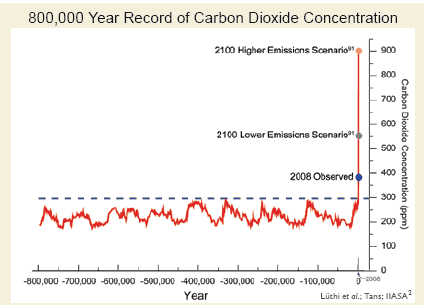
Page 13 of the GCCI report has this chart I have already seen circulating around the alarmist side of the web:

co2

There are two problems here.

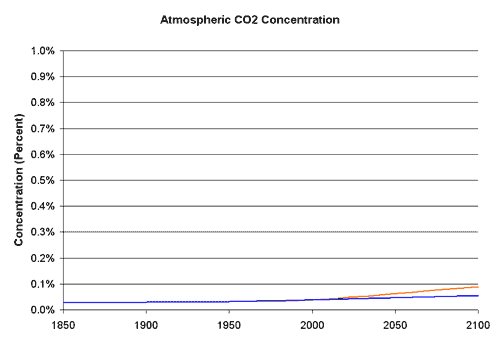
One, the compression of the X axis puts the lower and upper scenario lines right on top of each other.  This really causes the higher scenario  (which, at 900ppm, really represents a number higher than we are likely to see even in a do-nothing case) to visually dominate.

The other issue is that the Y-axis covers a very, very small range, such that small changes are magnified visually.  The scale runs from 0% of the atmosphere up to 0.09% of the atmosphere.  If one were to run the scale to cover a more reasonable range, he would get this  (with orange being the high emissions case and blue being the lower case):

co2a

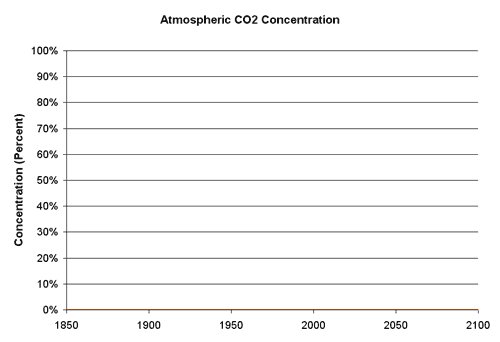
Even this caps out at just 1% of the atmosphere.  If we were to look at the total composition of the atmosphere, we would get this:

co2b

So Much For That Whole Commitment To Science We Were Promised

From the Guardian:

Today’s release of the study, titled Global Climate Change Impacts in the United States, was overseen by a San Francisco-based media consulting company…

The nearly 200-page study was scrubbed of the usual scientific jargon, and was given a high-profile release by Obama’s science advisor, John Holdren, and the head of the National Oceanic and Atmospheric Administration (NOAA), Jane Lubchenco.

Wow, that’s sure how I learned to handle a scientific report back when I was studying physics – scrub it of the science and give it to an activist PR firm!   Do you need any more evidence that climate science has become substantially dominated by post-modernist scientists, where ideological purity and staying on message is more important than actually having the science right?

I saw a draft of this report last year, but I am still trying to download this new version.  I expect to be sickened.  Here is a taste of where they are coming down:

If today’s generation fails to act to reduce the carbon emissions that cause global warming, climate models suggest temperatures could rise as much as 11F by the end of the century.

11F is about 6.1C.  I don’t know if they get this by increasing the CO2 forecast or by increasing the sensitivity or both, but it is vastly higher than the forecasts even of the over-apocalyptic IPCC.  I think one can fairly expect two things, though — 1) More than 2/3 of this warming will be due to positive feedback effects rather than Co2 acting alone and 2) There will be little or no discussion of the evidence that such positive feedback effects actually dominate the climate.

Apparently the report will make up for having all the science stripped out by spending a lot of time on gaudy worst case scenarios:

That translates into catastrophic consequences for human health and the economy such as more ferocious hurricanes in coastal regions – in the Pacific as well as the Atlantic, punishing droughts to the south-west, and increasingly severe winter storms in the north-east and around the Great Lakes.

The majority of North Carolina’s beaches would be swallowed up by the sea. New England’s long and snowy winters might be cut short to as little as two weeks. Summers in Chicago could be a time of repeated deadly heat waves. Los Angelenos and residents of other big cities will be choking because of deteriorating air quality.

Future generations could face potential food shortages because of declining wheat and corn yields in the breadbasket of the mid-west, increased outbreaks of food poisoning and the spread of epidemic diseases.

This strikes me as roughly equivilent to turning in a copy of Lucifer’s Hammer in response to a request for a scientific study of the physics of comets.

Global Warming “Accelerating”

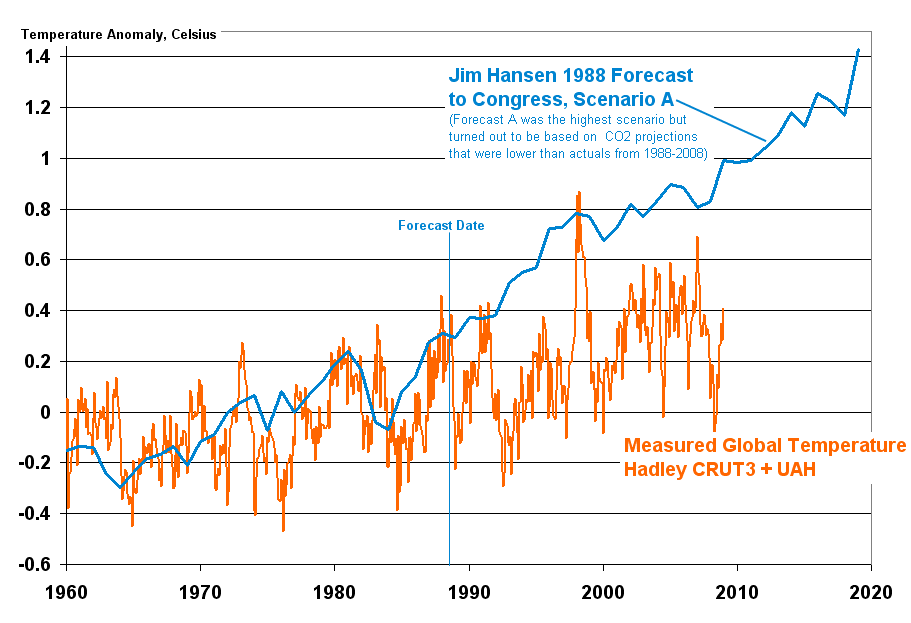
I have written a number of times about the “global warming accelerating” meme.  The evidence is nearly irrefutable that over the last 10 years, for whatever reason, the pace of global warming has decelerated (click below to enlarge)
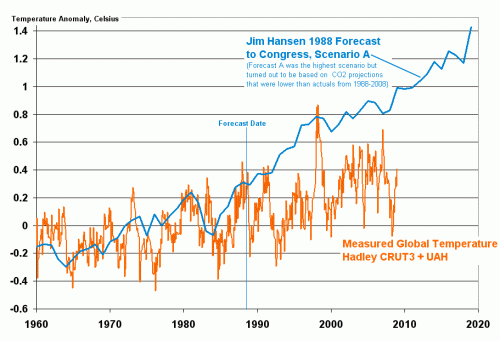
hansenjan20091

This is simply a fact, though of course it does not necessarily “prove” that the theory of catastrophic anthropogenic global warming is incorrect.  Current results continue to be fairly consistent with my personal theory, that man-made CO2 may add 0.5-1C to global temperatures over the next century (below alarmist estimates), but that this warming may be swamped at times by natural climactic fluctuations that alarmists tend to under-estimate.

Anyway, in this context, I keep seeing stuff like this headline in the WaPo

Scientists:  Pace of Climate change Exceeds Estimates

This headline seems to clearly imply that the measured pace of actual climate change is exceeding previous predictions and forecasts.   This seems odd since we know that temperatures have flattened recently.  Well, here is the actual text:

The pace of global warming is likely to be much faster than recent predictions, because industrial greenhouse gas emissions have increased more quickly than expected and higher temperatures are triggering self-reinforcing feedback mechanisms in global ecosystems, scientists said Saturday.

“We are basically looking now at a future climate that’s beyond anything we’ve considered seriously in climate model simulations,” Christopher Field, founding director of the Carnegie Institution’s Department of Global Ecology at Stanford University, said at the annual meeting of the American Association for the Advancement of Science.

So in fact, based on the first two paragraphs, in true major media tradition, the headline is a total lie.  In fact, the correct headline is:

“Scientists Have Raised Their Forecasts for Future Warming”

Right?  I mean, this is all the story is saying, is that based on increased CO2 production, climate scientists think their forecasts of warming should be raised.  This is not surprising, because their models assume a direct positive relationship between CO2 and temperature.

The other half of the statement, that “higher temperatures are triggering self-reinforcing feedback mechanisms in global ecosystems” is a gross exaggeration of the state of scientific knowledge.  In fact, there is very little good understanding of climate feedback as a whole.  While we may understand individual pieces – ie this particular piece is a positive feedback – we have no clue as to how the whole thing adds up.  (see my video here for more discussion of feedback)

In fact, I have always argued that the climate models’ assumptions of strong positive feedback (they assume really, really high levels) is totally unrealistic for a long-term stable system.  In fact, if we are really seeing runaway feedbacks triggered after the less than one degree of warming we have had over the last century, it boggles the mind how the Earth has staggered through the last 5 billion years without a climate runaway.

All this article is saying is “we are raising our feedback assumptions higher than even the ridiculously high assumptions we were already using.”  There is absolutely no new confirmatory evidence here.

But this creates a problem for alarmists

For you see, their forecasts have consistently demonstrated themselves to be too high.  You can see above how Hansen’s forecast to Congress 20 years ago has played out (and the Hansen A case was actually based on a CO2 growth forecast that has turned out to be too low).  Lucia, who tends to be scrupulously fair about such things, shows the more recent IPCC models just dancing on the edge of being more than 2 standard deviations higher than actual measured results.

But here is the problem:  The creators of these models are now saying that actual CO2 production, which is the key input to their model, is far exceeding their predictions.  So, presumably, if they re-ran their predictions using actual CO2 data, they would get even higher temperature forecasts. Further, they are saying that the feedback multiplier in their models should be higher as well.  But the forecasts of their models are already high vs. observations — this will even cause them to diverge further from actual measurements.

So here is the real disconnect of the model:  If you tell me that modelers underestimated the key input (CO2) in their models,  and have so far overestimated the key output (Temperature), I would have said the conclusion to this article is that climate sensitivity must be lower than what was embedded in the models.  But they are saying exactly the opposite.  How is this possible?

Postscript: I hope readers understand this, but it is worth saying because clearly reporters do not understand this:  There is no way that climate change from CO2 can be accelerating if global warming is not accelerating.  There is no mechanism I have ever heard by which CO2 can change the climate without the intermediate step of raising temperatures.  Co2–>temperature increase–>changes in the climate.

Update: Chart originally said 1998 forecast.  Has been corrected to 1988.

Update#2: I am really tired of having to re-explain the choice of using Hansen’s “A” forecast, but I will do it again.  Hansen had forecasts A, B, C, with A being based on more CO2 than B, and B with more CO2 than C.  At the time, Hansen said he thought the A case was extreme.  This is then used by his apologists to say that I am somehow corrupting Hansen’s intent or taking him out of context by using the A case, because Hansen himself at the time said the A case was probably high.

But the only difference between A, B, and C were not the model assumptions of climate sensitivity or any other variable — they only differed in the amount of Co2 growth and the number of volcano eruptions (which have a cooling effect via aerosols).  We can go back and decide for ourselves which case turned out to be the most or least conservative.   As it turns out, all three cases UNDERESTIMATED the amount of CO2 man produced in the last 20 years.  So, we should not really use any of these lines as representative, but Scenario A is by far the closest.  The other two are way, way below our actual CO2 history.

The people arguing to use, say, the C scenario for comparison are being disingenuous.  The C scenario, while closer to reality in its temperature forecast, was based on an assumption of a freeze in Co2 production levels, something that obviously did not occur.

Skipping A Step

Here is a little glimpse of how climate alarmism works.  Check out this article in the NewScientist (I don’t know anything about this particular publication, but my general assumption is that most periodicals use “New” in the context of such a title as a synonym for “socialist.”):

Rather than spreading out evenly across all the oceans, water from melted Antarctic ice sheets will gather around North America and the Indian Ocean. That’s bad news for the US East Coast, which could bear the brunt of one of these oceanic bulges.

It goes on and on with more detail, which sounds really scary:

First, Jerry Mitrovica and colleagues from the University of Toronto in Canada considered the gravitational attraction of the Antarctic ice sheets on the surrounding water, which pulls it towards the South Pole. As the ice sheet melts, this bulge of water dissipates into surrounding oceans along with the meltwater. So while the sea level near Antarctica will fall, sea levels away from the South Pole will rise.

Once the ice melts, the release of pressure could also cause the Antarctic continent to rise by 100 metres. And as the weight of the ice pressing down on the continental shelf is released, the rock will spring back, displacing seawater that will also spread across the oceans.

Redistributing this mass of water could even change the axis of the Earth’s spin. The team estimates that the South Pole will shift by 500 metres towards the west of Antarctica, and the North Pole will shift in the opposite direction. Since the spin of the Earth creates bulges of oceanic water in the regions between the equator and the poles, these bulges will also shift slightly with the changing axis….

The upshot is that the North American continent and the Indian Ocean will experience the greatest changes in sea level – adding 1 or 2 metres to the current estimates. Washington DC sits squarely in this area, meaning it could face a 6.3-metre sea level rise in total. California will also be in the target zone.

Spotting the skipped logic step does not require one to be a climate skeptic.  Anyone familiar with the most recent IPCC report should see it too.  Specifically, the authors simply posit — without even bothering to mention it as an assumption! — that tons of land-based ice (remember, sea ice melting has no effect on sea levels) is going to melt in Antarctica.  But just about everyone, even the alarmists at the IPCC, predict just the opposite, even in 3C per century global warming scenarios.

Why?  Well, for a couple of reasons.  The first is that Antarctica is so cold that several degrees of warming will not bring most of the continent above freezing, even in the summer.  The exception is probably the Antarctic Peninsula, which sticks out north of the rest of the continent and accounts for 2% of the land mass and a much smaller percentage of the total ice pack.

The other reason is that if the world warms, the seas around Antarctica will warm and the models show the warming surrounding seas increasing precipitation on the continent and actually increasing snow pack.  In fact, increases in Antarctic ice pack actually exceed decreases forecast in ice packs around the rest of the world.  The entirety of the IPCC ocean rise scenario is driven by the thermal expansion of water, not net ice melting.

By the way, I presume these guys have their math right, but it seems astonishing to me that the ice mass (or lack of it) could really exert enough gravitational pull to change sea levels in the northern hemisphere by a meter or two.  Gravity is an astonishingly weak force — does this reality check?  I had always thought differences in ocean levels (say for example the fact that the Atlantic and Pacific are not the same height on either side of the Panama Canal)  had more to do with differentials in evaporation rates.

PS- Is telling me global warming will flood Washington DC supposed to make me be against global warming?  Because that sounds pretty good to me. ;=)

Your One-Stop Climate Panic Resource

Absolutely classic video — a must see:

From Marc Marano via Tom Nelson:

This 9 ½ minute video brilliantly and accurately (it is not a spoof!) shows the absurdity of today’s man-made global warming fear campaign. It appears to have been produced by a group called Conservative Cavalry. They really did their homework and put together quite a show. This video should be shown in classrooms across the country and in newsrooms!

The video is based on the website “A complete list of things caused by global warming.”

The website is run by Dr. John Brignell is a UK Emeritus Engineering Professor at the University of Southampton who held the Chair in Industrial Instrumentation at Southampton.

Be Cool and Prevent Cooling by Reducing Global Warming

I seldom highlight stories like this, because I am more interested in the science than the propoganda of climate issues, but I just couldn’t resist this story.  Via Tom Nelson, from Belleville News Democrat:

Speakers at the public forum also addressed how global warming may directly affect metro-east residents, citing this summer’s flooding and unusually cool weather, and future impact on agriculture.

"These are symptoms of global warming," said Kathy Andria, who represented the American Bottoms Conservancy at the forum.

Andria said she will help organize Belleville residents to work towards being a greener city and become designated by the Sierra Club as a Cool City.

So we want to fight global warming which is causing unusually cool weather.  If we are succesful, then we will be labelled a Cool City so that we won’t have all this cool weather because we will have stopped warming.

Seriously, has there even been a more transparent "heads I win, tails you lose" argument than saying that unusually cool weather is evidence of global warming?

100 Months to the Tipping Point

Wow — it turns out that after hundreds of millions or even billions of years of remaining stable, the world climate will, due to (at most) a few tenths of degrees of man-made warming and an increase of a trace gas composition in the atmosphere by about 0.01%, go past its tipping point or point of no return and run away to catastrophe.  I sure wish there was a prediction market where I could bet against this.  See this end of the world website here (HT to a reader). 

Given a bit more time, I will try to take on in depth the underlying article behind this site.  But for now, suffice it to say that underlying hypothesis is that the world’s climate is dominated by positive feedback, a hypothesis, if true, that would set climate apart from nearly every other natural process that we know of.  In fact, the only major natural process I can think of that is dominated by positive feedback and tipping points is nuclear fission.  Here are many articles on how catastrophic forecasts assume large positive feedbacks and why this assumption is unlikely.

Because, You Know, All We Skeptics Are Fighting Against Settled Science

I saw Al’s climate sci-fi movie, but I didn’t read the book.  Via Tom Nelson, Robert Johnston has a refutation of some of Al’s claims in his book.  This one caught my eye because it is a topic with which I am pretty familiar.  Gore writes:

"People who want to deny global warming because it’s easier than dealing with it try to argue that what scientists are really observing is just the ‘urban heat island’ effect… This is simply wrong. Temperature measurements are generally taken in parks, which are actually cool areas within the urban heat islands… Most scientific research shows that ‘urban heat islands’ have a negligible effect…" (p. 318)

I can’t believe we let Al Gore lecture us on science.  A few responses:

  • I don’t think most skeptics deny that some warming has occurred in the 20th century.  Satellite measurement, which is not subject to urban heat island biases, has shown several tenths of a degree C warming since the late 1970′s.  However, skeptics do tend to argue that surface temperature networks do tend to overestimate the 20th century warming signal due in part to urban biases  (not to mention over-zealous addition of fudge-factors by the alarmists running the data gathering). Of course, we also will dispute that "most" of this warming is due to anthropogenic CO2.
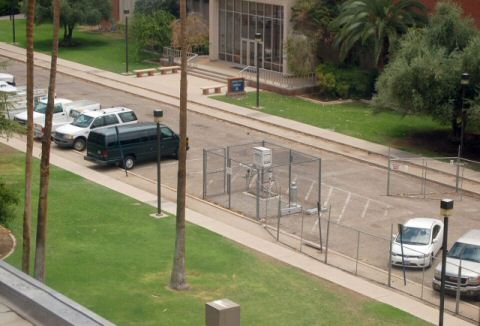
  • The statement that most temperature measurements are taken in parks is so wrong as to be absurd.  As Anthony Watts SurfaceStations.org climate station survey process has shown, the vast majority of stations are actually located near buildings  (a predictable result of siting and cable length limitations of the most commonly used sensors).  You don’t have to take my word for it, just scan the pictures yourself at random.  I have had a lot of fun participating in this project.  Here, by the way, is the Tucson station I surveyed.  As you can see, the station is definitely located in a park[ing lot].

Tucson1

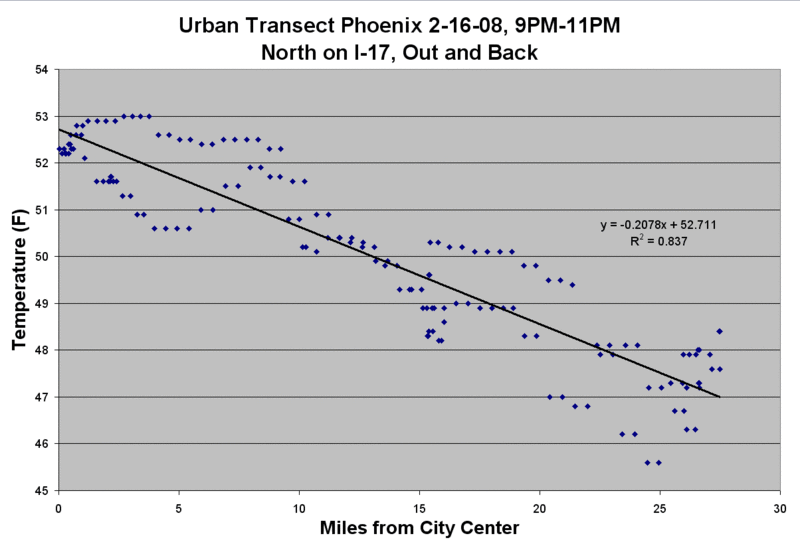
  • We skeptics are often called "deniers" for not accepting that the theory of catastrophic man-made global warming is settled science.  But if you want to see real denialism in the face of facts, one only has to look at the alarmist’s absurd position that, as Al Gore puts it, "urban heat islands have a negligible effect."  The fact is that urban heat islands are well-known to science, and can cause the center of cities to be as high as 5-8C hotter than the outlying rural areas.  It turns out that this is so horribly difficult to understand and prove that … my 14-year-old son did it for a science project.  Here is the results of one of our data runs across town  (details described in the article).

Phoenixrun1

  • Defenders of the surface temperature record will sometimes argue that they have successfully corrected for urban biases (leading to the cognitive dissonance of their saying that the biases have no effect and that they have fully corrected for them).  But here is the problem:  without detailed siting information, and surveys like that run by my son, it is impossible to make these corrections anything but guesses (ironically, many of the folks making this argument have opposed Anthony Watt’s survey process and continue to maintain that they can make better adjustments blind than having data of station siting).  At most, the total warming signal we are trying to identify over the last century is about a degree F.  But as you can see above, we found a 6 degree urban heat effect on the first night of our study, and we found a 9 degree urban effect our second night.  You can see that not only does the magnitude of this heat island effect swamp the signal we are trying to measure, even the variability or uncertainty in assessing the urban bias is several times larger than the warming signal. 

Update:  Here is a new study debunking Gore’s claim that man-made global warming was melting the Kilimanjaro ice cap.  This claim never made much sense, since even if temperatures were to warm by several degrees, they would still remain well below freezing all year long.

Climate Alarmists and Individual Rights

I am not sure this even needs comment:  (HT:  Maggies Farm)

I’m preparing a paper for an upcoming conference on this, so please comment if you can! Thanks. Many people have urged for there to be some legal or moral consequence for denying climate change. This urge generally comes from a number of places. Foremost is the belief that the science of anthropogenic climate change is proven beyond reasonable doubt and that climate change is an ethical issue. Those quotes from Mahorasy’s blog are interesting. I’ll include one here:

Perhaps there is a case for making climate change denial an offence. It is a crime against humanity, after all. –Margo Kingston, 21 November 2005

The urge also comes from frustration with a ‘denial’ lobby: the furthest and more extreme talkers on the subject who call global warming a ‘hoax’ (following James Inhofe’s now infamous quote). Of course there would be frustration with this position–a ‘hoax’ is purposeful and immoral. And those who either conduct the science or trust the science do not enjoy being told they are perpetrating a ‘hoax’, generating a myth, or committing a fraud….

I’m an advocate for something stronger. Call it regulation, law, or influence. Whatever name we give it, it should not be seen as regulation vs. freedom, but as a balancing of different freedoms. In the same way that to enjoy the freedom of a car you need insurance to protect the freedom of other drivers and pedestrians; in the same way that you enjoy the freedom to publish your views, you need a regulatory code to ensure the freedoms of those who can either disagree with or disprove your views. Either way. While I dislike Brendan O’Neill and know he’s wrong, I can’t stop him. But we need a body with teeth to be able to say, “actually Brendan, you can’t publish that unless you can prove it.” A body which can also say to me, and to James Hansen, and to the IPCC, the same….

What do you think? Perhaps a starting point is a draft point in the codes for governing how the media represent climate change, and a method for enforcing that code. And that code needs to extend out to cover new media, including blogs. And perhaps taking a lesson from the Obama campaign’s micro-response strategy: a team empowered with responding to complaints specifically dealing with online inaccuracy, to which all press and blogs have to respond. And so whatever Jennifer Mahorasy, or Wattsupwiththat, or Tom Nelson, or Climate Sceptic, or OnEarth, or La Marguerite, or the Sans Pretence, or DeSmog Blog, or Monckton or me, say, then we’re all bound by the same freedoms of publishing.

He asked for comments.  I really did not have much energy to refute something so wrong-headed, but I left a few thoughts:

Wow, as proprietor of Climate-Skeptic.com, I am sure flattered to be listed as one of the first up against the wall come the great green-fascist revolution.  I found it particularly ironic that you linked my post skewering a climate alarmist for claiming that heavier objects fall faster than lighter objects.  Gee, I thought the fact that objects of different masses fall at the same rate had been "settled science" since the late 1500s.

But I don’t think you need a lecture on science, you need a lecture on civics.  Everyone always wants free speech for themselves.  The tough part is to support free speech for others, even if they are horribly, terribly wrong-headed.  That is the miracle of the first amendment, that we have stuck by this principle for over 200 years.

You see, technocrats like yourself are always assuming the perfect government official with perfect knowledge and perfect incentives to administer your little censorship body.  But the fact is, such groups are populated with real people, and eventually, the odds are they will be populated by knaves.  And even if folks are well-intentioned, incentives kill such government efforts every time.  What if, for example, your speech regulation bureaucrats felt that their job security depended on a continued climate crisis, and evidence of no crisis might cause their job to go away?  Would they really be unbiased with such an incentive?

Here is a parallel example to consider.  It strikes me that the laws of economics are better understood than the activity of greenhouse gasses.  I wonder if the author would support limits on speech for supporters of such things like minimum wages and trade protectionism that economists routinely say make no sense in the science of economics.  Should Barrack Obama be enjoined from discussing his gasoline rebate plan because most all economists say that it won’t work the way he says?  There is an economist consensus, should that be enough to silence Obama?

Media Rorschach Test

This will come as no surprise to folks who attempt to follow climate science through the media, but a recent study really sheds some interesting light on how the media report science based on their pre-conceived notions, and not on the science itself.  Alex Tabarrok discusses media reporting on the relative math skills of men and women.  The politically correct view is that there are no differences, so it seems that was going to be the way the new science was reported, whether the data matched or not:

For the past week or so the newspapers have been trumpeting a new study
showing no difference in average math ability between males and
females.  Few people who have looked at the data thought that there
were big differences in average ability but many media reports also
said that the study showed no differences in high ability.

The LA Times, for example, wrote:

The study also undermined the assumption — infamously espoused by
former Harvard University President Lawrence H. Summers in 2005 — that
boys are more likely than girls to be math geniuses.

Scientific American said:

So the team checked out the most gifted children. Again, no difference.
From any angle, girls measured up to boys. Still, there’s a lack of
women in the highest levels of professional math, engineering and
physics. Some have said that’s because of an innate difference in math
ability. But the new research shows that that explanation just doesn’t
add up.

The Chronicle of Higher Education said:

The research team also studied if there were gender discrepancies at
the highest levels of mathematical ability and how well boys and girls
resolved complex problems. Again they found no significant differences.

All of these reports and many more like them are false.  In fact, consistent with many earlier studies
(JSTOR), what this study found was that the ratio of male to female
variance in ability was positive and significant, in other words we can
expect that there will be more math geniuses and more dullards, among
males than among females.  I quote from the study (VR is variance
ratio):

Greater male variance is indicated by VR > 1.0. All VRs, by state and grade, are >1.0 [range 1.11 to 1.21].

Notice
that the greater male variance is observable in the earliest data,
grade 2.  (In addition, higher male VRS have been noted for over a
century).  Now the study authors clearly wanted to downplay this
finding so they wrote things like "our analyses show greater male
variability, although the discrepancy in variances is not large."
Which is true in some sense but the point is that small differences in
variance can make for big differences in outcome at the top.  The
authors acknowledge this with the following:

If a
particular specialty required mathematical skills at the 99th
percentile, and the gender ratio is 2.0, we would expect 67% men in the
occupation and 33% women. Yet today, for example, Ph.D. programs in
engineering average only about 15% women.

Both the WSJ and economist Mark Perry get it right.

Climate Global Warming Is Caused by Everything Our Interest Group Opposed Before It Came Along As An Issue

Many leftish groups have for years had a curious opposition to advertising.  Ralph Nader and his PIRG groups always made it a particular issue.  This always struck me as inherently insulting, as the "logic" behind their opposition to advertising is that people are all dumb, unthinking, programmable robots who launch off and buy whatever they see advertised on TV.

The global warming hysteria kind of sucks all the oxygen out of every other goofy leftish issue out there, so now its necessary to link your leftish cause to global warming.  So it is no surprise to find out that advertising apparently causes global warming:

AUSTRALIAN television advertising is producing as much as 57 tonnes of carbon dioxide per hour, and thirty second ad breaks are among the worst offenders, according to audit figures from pitch consultants TrinityP3.

Carbon emissions are particularly strong during high-rating programs such as the final episodes of the Ten Network’s Biggest Loser, which produced 2135kgs per 30 second ad, So You Think You Can Dance at 2061kg for every 30 seconds, closely followed by the Seven News 6pm news at 1689kg and Border Security at 1802kg.

TrinityP3 managing director Darren Woolley said emissions are calculated by measuring a broadcasters’ power consumption and that of a consumer watching an ad on television in their home, B&T Magazine reports.

“We look at the number of households and the number of TVs, and then the proportion of TVs that are plasma, LCD or traditional, and calculate energy consumption based on those factors,” Woolley said.

TrinityP3 is formalising a standard carbon footprint measurement of advertising, which it claims will be the first of its kind.

“Most companies have been obliged to think through their strategies on reducing carbon emissions and they need to remember that their marketing strategies do have an environmental impact that needs to be included. This is not something that is easily able to be measured,” Mr Woolley said.

“Reality television is interesting as the more viewers and voters that tune in, the higher the carbon footprint. The more people vote, the more it adds to the CO2 in the atmosphere.

Note that, oddly, the 54 minutes an hour of regular programming is OK, it’s only the 6 minutes of advertising that has a carbon footprint.  That’s OK, though, because I am going to start turning off the TV during advertisements and go out and sit in my idling SUV and listen to my commercial-free satellite radio instead.

Climate Global Warming Is Caused by Everything Our Interest Group Opposed Before It Came Along As An Issue

Many leftish groups have for years had a curious opposition to advertising.  Ralph Nader and his PIRG groups always made it a particular issue.  This always struck me as inherently insulting, as the "logic" behind their opposition to advertising is that people are all dumb, unthinking, programmable robots who launch off and buy whatever they see advertised on TV.

The global warming hysteria kind of sucks all the oxygen out of every other goofy leftish issue out there, so now its necessary to link your leftish cause to global warming.  So it is no surprise to find out that advertising apparently causes global warming:

AUSTRALIAN television advertising is producing as much as 57 tonnes of carbon dioxide per hour, and thirty second ad breaks are among the worst offenders, according to audit figures from pitch consultants TrinityP3.

Carbon emissions are particularly strong during high-rating programs such as the final episodes of the Ten Network’s Biggest Loser, which produced 2135kgs per 30 second ad, So You Think You Can Dance at 2061kg for every 30 seconds, closely followed by the Seven News 6pm news at 1689kg and Border Security at 1802kg.

TrinityP3 managing director Darren Woolley said emissions are calculated by measuring a broadcasters’ power consumption and that of a consumer watching an ad on television in their home, B&T Magazine reports.

“We look at the number of households and the number of TVs, and then the proportion of TVs that are plasma, LCD or traditional, and calculate energy consumption based on those factors,” Woolley said.

TrinityP3 is formalising a standard carbon footprint measurement of advertising, which it claims will be the first of its kind.

“Most companies have been obliged to think through their strategies on reducing carbon emissions and they need to remember that their marketing strategies do have an environmental impact that needs to be included. This is not something that is easily able to be measured,” Mr Woolley said.

“Reality television is interesting as the more viewers and voters that tune in, the higher the carbon footprint. The more people vote, the more it adds to the CO2 in the atmosphere.

Note that, oddly, the 54 minutes an hour of regular programming is OK, it’s only the 6 minutes of advertising that has a carbon footprint.  That’s OK, though, because I am going to start turning off the TV during advertisements and go out and sit in my idling SUV and listen to my commercial-free satellite radio instead.

Climate Re-Education Program

  A reader sent me a heads-up to an article in the Bulletin of the American Meteorological Society ($, abstract here) titled "Climate Change Education and the Ecological Footprint".  The authors express concern that non-science students don’t sufficiently understand global warming and its causes, and want to initiate a re-education program in schools to get people thinking the "right" way.

So, do climate scientists want to focus on better educating kids in details of the carbon cycle?  In the complexities in sorting out causes of warming between natural and man-made effects?  In difficulties with climate modeling?  In the huge role that feedback plays in climate forecasts?

Actually, no.  Interestingly, the curriculum advocated in the Journal of American Meteorology has very little to do with meteorology or climate science.  What they are advocating is a social engineering course structured around the concept of "ecological footprint."  The course, as far as I can tell, has more in common with this online kids game where kids find out what age they should be allowed to live to based on their ecological footprint.

Like the Planet Slayer game above, the approach seems to be built around a quiz (kind of slow and tedious to get through).  Like Planet Slayer, most of the questions are lifestyle questions – do you eat meat, do you buy food from more than 200 miles away, how big is your house, do you fly a lot, etc.  If you answer that yes, you have a good diet and a nice house and travel a bit and own a car, then you are indeed destroying the planet.

I could go nuts on a rant about propoganda in government monopoly schools, but I want to make a different point [feel free to insert rant of choice here].  The amazing thing to me is that none of this has the first thing to do with meteoroogy or climate science.  If there were any science at all in this ecological footprint stuff, it would have to be economics.  What does meteorology have to say about the carrying capacity of the earth?  Zero.  What does climate science have to say about the balance between the benefits of air travel and the cost of the incremental warming that might result from that air travel?  Zero. 

Take one example – food miles.  I live in Phoenix.  The cost to grow crops around here (since most of the agricultural water has to be brought in from hundreds of miles away) is high.  The cost is also high because even irrigated, the soil is not as productive for many crops as it is in, say, Iowa, so crops require more labor, more fertilizer, and more land for the same amount of yield.  I could make a really good argument that an ear of corn trucked in from Iowa probably uses less resources than an ear of corn grown withing 200 miles of where I live.  Agree or disagree, this is a tricky economics question that requires fairly sophisiticated analysis to answer.  How is teaching kids that "food grown within 200 miles helps save the planet" advancing the cause of climate science?  What does meteorology have to say about this question?

I am sorry I don’t have more excerpts, but I am lazy and I have to retype them by hand.  But this is too priceless to miss:

Responding to the statement "Buying bottled water instead of drinking water from a faucet contributes to global warming" only 21% of all [San Jose State University] Meteorology 112 students answered correctly.  In the EF student group, this improved to a 53% correct response….  For the statement, "Eating a vegetarian diet can reduce global warming," the initial correct response by all Meteorology 112 students was 14%, while the EF group improved to 80%.

Oh my god, every time you drink bottled water you are adding 0.0000000000000000000000000001C to the world temperature.  How much global warming do I prevent if I paint flowers on my VW van?  We are teaching college meteorology students this kind of stuff?  The gulf between this and my freshman physics class is so wide, I can’t even get my head around it.  This is a college science class?

In fact, the authors admit that their curriculum is an explicit rejection of science education, bringing the odd plea in a scientific journal that science students should be taught less science:

Critics of conventional environmental education propose that curriculum focused solely on science without personal and social connections may not be the most effective educational model for moving toward social change.

I think it is a pretty good sign that a particular branch of science has a problem when it is focused more on "social change" than on getting the science right, and when its leading journal focuses on education studies rather than science.

If I were a global warming believer, this program would piss me off.  Think about it.  Teaching kids this kind of stuff and then sending them out to argue with knowlegeable skeptics is like teaching a bunch of soldiers only karate and judo and then sending them into a modern firefight.  They are going to get slaughtered. 

Another Dim Bulb Leading Global Warming Efforts

Rep. Edward Markey (D-Mass.) is chairman of the House (Select) Energy Independence and Global Warming Committee.  He sure seems to know his stuff, huh:

A top Democrat told high school students gathered at the U.S. Capitol Thursday that climate change caused Hurricane Katrina and the conflict in Darfur, which led to the “black hawk down” battle between U.S. troops and Somali rebels….

“In Somalia back in 1993, climate change, according to 11 three- and four-star generals, resulted in a drought which led to famine,” said Markey.

“That famine translated to international aid we sent in to Somalia, which then led to the U.S. having to send in forces to separate all the groups that were fighting over the aid, which led to Black Hawk Down. There was this scene where we have all of our American troops under fire because they have been put into the middle of this terrible situation,” he added.

Ugh.

Extrapolating From One Data Point

Years ago, when I was studying engineering in college, I had a professor who used to "joke"  (remember, these are engineers, so the bar for the word "joke" is really low) that when he wanted to prove something, it was a real benefit to have only one data point.  That way, he said, you could plot a trend in any direction with any slope you wanted through the point.  Once you had two or three or more data points, your flexibility was ruined.

I am reminded of this in many global warming articles in the press today.  Here is one that caught my eye today on Tom Nelson’s blog.  There is nothing unusual about it, it just is the last one I saw:

Byers said he has decided to run because he wants to be able to look at his children in 20 or 30 years and be able to say that he took action to try to address important challenges facing humanity. He cited climate change as a “huge” concern, noting that this was driven home during a trip he took to the Arctic three weeks ago.

“The thing that was most striking was how the speed of climate change is accelerating—how it’s much worse than anyone really wants to believe,” Byers said. “To give you a sense of this, we flew over Cumberland Sound, which is a very large bay on the east coast of Baffin Island. This was three weeks ago; there was no ice.”

Do you see the single data point:  Cumberland Sound three weeks ago had no ice.  Incredibly, from this single data point, he not only comes up with a first derivative (the world is warming) but he actually gets the second derivative from this single data point (change is accelerating).  Wow!

We see this in other forms all the time:

  • We had a lot of flooding in the Midwest this year
  • There were a lot of tornadoes this year
  • Hurricane Katrina was really bad
  • The Northwest Passage was navigable last year
  • An ice shelf collapsed in Antarctica
  • We set a record high today in such-and-such city

I often criticize such claims for their lack of any proof of causality  (for example, linking this year’s floods and tornadoes to global warming when it is a cooler year than most of the last 20 seems a real stretch). 

But all of these stories share another common problem – they typically are used by the writer to make a statement about the pace and direction of change (and even the acceleration of this change), something that is absolutely scientifically impossible to do from a single data point.  As it turns out, we often have flooding in the Midwest.  Neither tornadoes nor hurricanes have shown any increasing trend over the past decades.  The Northwest Passage has been navigable a number of years in the last century.  During the time of the ice shelf collapse panic, Antarctica was actually setting 30-year record highs for sea ice extent.  And, by simple math, every city on average should set a new 100-year high temperature record every 100 days, and this is even before considering the urban heat island effect’s upward bias on city temperature measurement.

Postscript:  Gee, I really hate to add a second data point to the discussion, but from Cyrosphere Today, here is a comparison of the Arctic sea ice extent today and exactly 20 years ago (click for a larger view)

Deetmp7873arrow

The arrow points to Cumberland Sound.  I will not dispute Mr. Byers personal observations, except to say that whatever condition it is in today, there seems to have been even less ice there 20 years ago.

To be fair, sea ice extent in the Arctic is down about a million square kilometers today vs. where it was decades ago (though I struggle to see it in these maps), while the Antarctic is up about a million, so the net world anomaly is about zero right now. 

The Date You Should Die

A while back I wrote about a disgusting little online game sponsored by the Australian government via the ABC.  It appears that this game is being promoted in the public schools as well:

Professor Schpinkee’s “date one should die” exercise is meant to be a “fun” experience for primary students of public schools associated with the Australian Sustainability Schools Initiative.” According to a 2007 Schools Environment newsletter, written by the government sustainability officer in New South Wales and sent to schools in this program, teachers are encouraged to lead children to the Australian Broadcasting Corporation’s Planet Slayer website and use Professor Schpinkee’s Greenhouse Calculator. The newsletter refers to the calculator as a “great game for kids.”

My original post has screenshots and more description.  Via Tom Nelson

Great Moments In Alarmism

Apparently a number of papers are "commemorating" today the 20th anniversary of James Hansen’s speech before Congress warning of catastrophic man-made global warming.  So let’s indeed commemorate it.  Here is the chart from the appendices of Hansen’s speech showing his predictions for man-made global warming:

Hansencheck

I have helpfully added in red the actual temperature history, as measured by satellite, over the last 20 years (and scale-shifted to match the base anomaly in Hansens graph).  Yes, 2008 has been far colder than 1988.  We have seen no warming trend in the last 10 years, and temperatures have undershot every one of Hansen’s forecasts.  He thought the world would be a degree C warmer in 20 years, and it is not.  Of course, today, he says the world will warm a degree in the next 20 years — the apocalypse never goes away, it just recesses into the future.

This may explain why Hansen’s GISS surface temperature measurements are so much higher than everyone else’s, and keep getting artificially adjusted upwards:  Hansen put himself way out on a limb, and now is using the resources of the GISS to try to create warming in the metrics where none exist to validate his forecasts of Apocalypse. 

By the way, if you want more insight into the "science" led by James Hansen, check out this post from Steve McIntyre on his trying to independently reproduce the GISS temperature aggregation methodology. 

Here are some more notes and scripts in which I’ve made considerable progress on GISS Step 2. As noted on many occasions, the code is a demented mess – you’d never know that NASA actually has software policies (e.g. here or here . I guess that Hansen and associates regard themselves as being above the law. At this point, I haven’t even begum to approach analysis of whether the code accomplishes its underlying objective. There are innumerable decoding issues – John Goetz, an experienced programmer, compared it to descending into the hell described in a Stephen King novel. I compared it to the meaningless toy in the PPM children’s song – it goes zip when it moves, bop when it stops and whirr when it’s standing still. The endless machinations with binary files may have been necessary with Commodore 64s, but are totally pointless in 2008.

Because of the hapless programming, it takes a long time and considerable patience to figure out what happens when you press any particular button. The frustrating thing is that none of the operations are particularly complicated.

Hansen, despite being paid by US Taxpayers and despite all regulations on government science, refused for years to even release this code for inspection by outsiders and to this day resists helping anyone trying to reproduce his mysterious methodologies.

Which in some ways is all irrelevent anyway, since surface temperature measurement is flawed for so many reasons (location biases, urban heat islands, historical discontinuities, incomplete coverage) that satellite temperature measurement makes far more sense, which is why I used it above.  Of course, there is one person who fights hard against use of this satellite methodology.  Ironically, this person fighting use of space technology is … James Hansen, of the Goddard Institute for Space Studies of NASA!  In our next episode, the head of the FCC will be actively fighting for using the telegraph over radio and TV.

The Power of Government Schools

What does a good government technocrat do when the public does not support his expensive vision?  Why, he uses the power of the government education monopoly to try to do a little indocrination.  This is the summary from the climate education bill as proposed by Barrack Obama:

Climate Change Education Act – Requires the Director of the National Science Foundation to establish a Climate Change Education Program to: (1) broaden the understanding of climate change, possible long and short-term consequences, and potential solutions; (2) apply the latest scientific and technological discoveries to provide learning opportunities to people; and (3) emphasize actionable information to help people understand and to promote implementation of new technologies, programs, and incentives related to energy conservation, renewable energy, and greenhouse gas reduction.
Requires such Program to include: (1) a national information campaign to disseminate information on and promote implementation of the new technologies, programs, and incentives; and (2) a competitive grant program to provide grants to states, municipalities, educational institutions, and other organizations to create materials relevant to climate change and climate science, develop climate science kindergarten through grade 12 curriculum and supplementary educational materials, or publish climate change and climate science information.
This helps to explain why Obama opposes school choice — because he sees the government schools not just as an education establishment, but as a re-education tool.

CBS Walks Away From Story Claiming Global Warming is Increasing Earthquakes

That fabled multiple-levels-of-editorial-review is at work again at CBS, this time with the story heaadlined "Seismic Activity 5 Times More Energetic Than 20 Years Ago Because Of Global Warming."  Now, only a journalism major who had assiduously avoided taking any science and math classes in his/her life could have possibly found this reasonable.  Half degee changes in atmospheric temperatures are hardly likely to affect seismic activity (the subject of the article, Dr. Tom Chalko, has also written that global warming might make the Earth explode).  Had CBS actually approached any other scientist in the world in any specialization for some kind of comment on the article, they would have likely been told that it made no sense.  But, of course, MSM editorial policy is not to ask for dissenting views in global warming alarmism articles.

Well, it appears CBS has walked away from the story without comment.  Anthony Watt has the whole story, including screen caps of the original article.