
Today will actually be fun, because it involves criticism of some of my writing around what I find to be the most interesting issue in climate, that of feedback effects. I have said for a while that greenhouse gas theory is nearly irrelevant to the climate debate, because most scientists believe that the climate sensitivity to CO2 acting along without feedbacks is low enough (1.2C per doubling) to not really be catastrophic. So the question whether man-made warming will be catastrophic depends on the assumption of strong net positive feedbacks in the climate system. B Kalafut believes I have the wrong mental model for thinking about feedback in climate, and I want to review his post in depth.
Naming positive feedbacks is easy. In paleoclimate, consider the effect of albedo changes at the beginning of an ice age or the “lagging CO2” at the end. In the modern climate, consider water vapor as a greenhouse gas, or albedo changes as ice melts. In everyday experience, consider convection’s role in sustaining a fire. Consider the nucleation of raindrops or snowflakes or bubbles in a pot of boiling water. At the cellular level, consider the voltage-gated behavior of the sodium channels in a nerve axon or the “negative damping” of hair cells in the cochlea.
I am assuming he is refuting my statement that “it is hard to find systems dominated by strong net positive feedbacks that are stable over long periods of time.” I certainly never said individual positive feedbacks don’t exist, and even mentioned some related to climate, such as ice albedo and increases in water vapor in air. I am not sure we are getting anywhere here, but his next paragraph is more interesting.
On to the meat of Meyer’s argument: he seizes on one word (“feedback”) and runs madly, from metaphor to mental model. Metaphor: “like in an ideal amplifier”. Model: The climate experiences linear feedback as in an amplifier–see the math in his linked post or in the Lindzen slides from which he gets the idea. And then he makes the even worse leap, to claiming that climate models (GCMs) “use” something called “feedback fractions”. They do not–they take no such parameters as inputs but rather attempt to simulate the effects of the various feedback phenomena directly. This error alone renders Meyer’s take worthless–it’s as though he enquires about what sort of oats and hay one feeds a Ford Mustang. Feedback in climate are also nonlinear and time-dependent–consider why the water vapor feedback doesn’t continue until the oceans evaporate–so the ideal amplifier model cannot even be “forced” to apply.
First, I don’t remember ever claiming that climate models used a straight feedback-amplification method. And I am absolutely positive I never said GCM’s use feedback fractions. I would not expect them to. This is a total straw man. I am using a simple feedback amplification model as an abstraction to represent the net results of the models in a way layman might understand, and backing into an implied fraction f from published warming forecasts and comparing them to the 1.2C non-feedback number. Much in the same way that scientists use the concept of climate sensitivity to shortcut a lot of messy detail and non-linearity. I am, however, open to the possibility that mine is a poor mental model, so lets think about it.
Let’s start with an analogy. There are very complicated electronic circuits in my stereo amplifier. Nowadays, when people design those circuits, they have sophisticated modeling programs that can do a time-based simulation of voltage and current at every point in the circuit. For a simulated input, the program will predict the output, and show it over time, even if it is messy and non-linear. These models are in some ways like climate models, except that we understand electronic components better so our parametrization is more precise and reliable. All that being said, it does not change the fact that a simple feedback-gain model for sections of the complex amplifier circuitry is still a useful mental model for the process at some level of abstraction, as long as one understands the shortcomings that come from any such simplification.
The author is essentially challenging the use of Gain = 1/ (1-f) to represent the operation of the feedbacks here. So let’s think about if this is appropriate. Let’s begin with thinking about a single feedback, ice albedo. The theory is that there is some amount of warming from CO2, call it dT. This dT will cause more ice to melt than otherwise would have (or less ice to form in the winter). The ice normally reflects more heat and sunlight back into space than open ocean or bare ground, so when it is reduced, the Earth gets a small incremental heat flux that will result in an increase in temperatures. We will call this extra increase in temperature f*dT where f is most likely a positive number less than one. So now our total increase, call it dT’ is dT+f*dT. But this increase of f*dT will in turn cause some more ice to melt. By the same logic as above, this increase will be f*f*dT. And so on in an infinite series. The solution to this series for a constant value of f is dT’ = dT/(1-f) … thus the formula above.
So the underlying operation of the feedback is the same: Input –> output –> output modifies input. There are not somehow different flavors or types of feedback that operate in radically different ways but have the same name (as in his Mustang joke).
The author claims the climate models are building up the affects of the processes like ice albedo from its pieces, ie rather than abstracting in to the gain formula, the models are adding up all the individual pieces, on a grid, over time. I am sure that is true. The question is not whether they use the simplified feedback formula, but whether it is a useful abstraction. I see nothing from my description of the ice albedo process to say it is not.
What happens if there are time delays? Well, as long as f is less than 1, the system will reach steady state at some point and this formula should apply. What happens if the feedback is non-liner? Well, in most natural systems, it is almost certainly non-linear. In our ice albedo example, f is almost certainly different at different temperatures levels (for example, a change from -30C to -31C has a lot less effect on ice albedo than a change from 0C to 1C. The factor f is probably also dependent on the amount of ice remaining, since in the limit when all the ice is melted there should be no further effect. But I would argue that when we pull back and look at the forest instead of the trees, a critical skill for modelers who too often get buried in their minutia while losing the ability to reality-check their results, that the 1/(1-f) is still an interesting if imperfect abstraction for the results, particularly since we are looking at tenths of a degree, and its hard for me to believe that it is wildly non-linear over that kind of range. (By the way, it is not at all unusual for mainstream alarmist scientists to use this same feedback formula as a useful though imperfect abstraction, for example in Gerard H. Roe and Marcia B. Baker, “Why Is Climate Sensitivity So Unpredictable?”, Science 318 (2007): 629–632 Not free but summarized here.)
To determine if it is a useful abstraction, I would ask the author what conclusions I draw that fall apart. I really only made two points with the use of feedback anyway.
- I used the discussion to educate people that feedback is the main source of catastrophic warming, so that it should be the main focus of the scientific replication. We can argue all day about time delays and non-linearity, but if the IPCC says the warming from CO2 alone is going to be 1.2C per doubling and the warming with all feedbacks considered is going to be, say, 4.8C per doubling (the author says himself that the models all converge at constant CO2), then we can say feedback is amplifying the initial man-made input by 4, or alternatively, 75% of the warming is from feedback effects, so these are probably where we need to focus. I struggle to see how one can argue with this.
- I used the simple gain formula to say if feedback were quadrupling temperatures, this implies a feedback factor of 0.75, and that this number is pretty dang high for a long-term stable system. Yes, the feedback is non-linear, but I don’t think this is an unreasonable reality check on the models to see what sorts of average feedbacks are being produced by the parameters.
The author’s points on non-linearity and time delays are actually more relevant to the discussion in other presentations when I talked about whether the climate models that show high future sensitivities to CO2 are consistent with past history, particularly if warming in the surface temperature record is exaggerated by urban biases. But even forgetting about these, it is really hard to reconcile sensitivities of, say, four degrees per doubling with history, where we have had about 0.6C (assuming irrationally that its all man-made) of warming in about 42% of a doubling (the effect, I will add, is non-linear, so one should see more warming in the first half than the second half of a doubling). Let’s leave out aerosols for today (those are the great modeler’s miracle cure that allows every model, even those of widely varying CO2 sensitivities and feedback effects, all exactly back-cast to history). These time delays and non-linearities could help reconcile the two, though my understanding is that the time delay is thought to be on the order of 12 years, which would not reconcile things at all. I suppose one could assume non-linearity such that the feedback effects accelerate with time past some tipping point, but I will say I have yet to see any convincing physical study that points to this effect.
Well, the weather is lovely outside so I suppose I should get on with it:
Meyer draws heavily from a set of slides from a talk by Richard Lindzen before a noncritical audience. These slides are full of invective and conspiracy talk, and their scientific content is lousy. Specifically, Lindzen supposedly estimates effective linear feedbacks for various GCMs and finds some greater than one. The mathematics presented by Lindzen in his slides does not allow that, and he doesn’t provide details of how such things even could be inferred. An effective linear feedback greater than one implies a runaway process, yet GCMs are always run for finite time, so there cannot be divergence to infinity. Moreover, as far as I know, all of the GCMs are known to converge once CO2 is stabilized.
I draw on Lindzen and Lindzen is wrong about a bunch of stuff and Lindzen uses invective and conspiracy talk so, what? Lindzen can answer all of this stuff. I used one chart from Lindzen, and it wasn’t even about feedback (I will reproduce it below).
I did mention that in theory, if the feedback factor is greater than one, in other words, if the first order feedback addition to input is greater than the original input, then the function rapidly runs away to infinity. Which it does. I don’t know what Lindzen has to say about this or what the author is referring to. My only point is that when folks like Al Gore talk about runaway warming and Earth becoming Venus, they are really implying runaway positive feedback effects with feedback factors greater than one. Since I really don’t go anywhere with this and in reality the author is debating Lindzen over an argument or analysis I am not even familiar with, I will leave this alone. The only thing I will say is that his last sentence seems on point, but his second to last is double talk. All he is saying is that by only solving a finite number of terms in a a divergent infinite series his calculations don’t go to infinity. Duh.
I am open to considering whether I have the correct mental model. But I reject the notion that it is wrong to try to simplify and abstract the operation of climate models. I have not modeled the climate, but I have modeled complex financial, economic, and mechanical systems. And here is what I can tell you from that experience — the more people tell me that they have modeled a system in the most minute parametrization, and that the models in turn are not therefore amenable to any abstraction, the less I trust their models. These parameters are guesses, because there just isn’t enough understanding of the complex and chaotic climate system to parse out their different values, or to even be clear about cause and effect in certain processes (like cloud formation).
I worry about the hubris of climate modelers, telling me that I am wrong and impossible to try to tease out one value for net feedback for the entire climate, and instead I should be thinking in terms of teasing out hundreds or thousands of parameters related to feedback. This is what I call knowledge laundering:
These models, whether forecasting tools or global temperature models like Hansen’s, take poorly understood descriptors of a complex system in the front end and wash them through a computer model to create apparent certainty and precision. In the financial world, people who fool themselves with their models are called bankrupt (or bailed out, I guess). In the climate world, they are Oscar and Nobel Prize winners.
This has incorrectly been interpreted as my saying these folks are wrong for trying to model the systems. Far from it — I have spend a lot of my life trying to model less complex systems. I just want to see some humility.
Postscript: Here is the only chart that I know of in my presentation from Lindzen, and its not even in the video he links to, it is in this longer and more comprehensive video
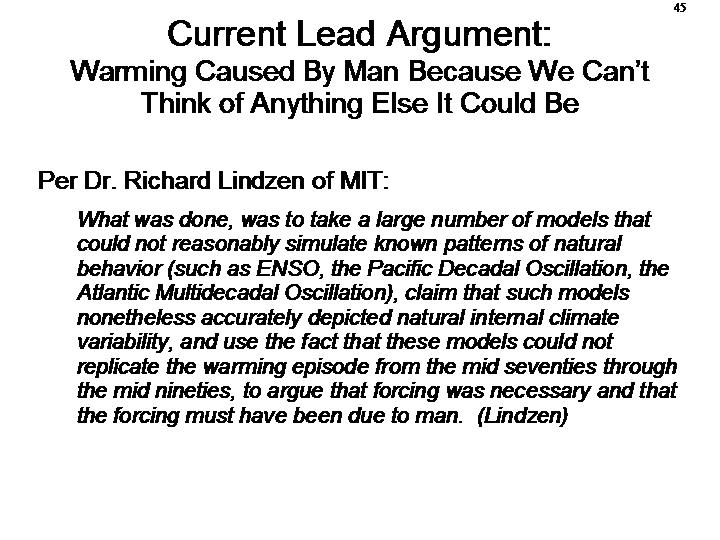
That seems a reasonable enough challenge to me, particularly given the data in this post and this quote from Judith Currey, certainly not a skeptic:
They don’t disprove anthropogenic global warming, but we can’t airbrush them away. We need to incorporate them into the overall story. We had two bumps—in the ’90s and also in the ’30s and ’40s—that may have had the same cause. So we may have exaggerated the trend in the later half of the 20th century by not adequately interpreting these bumps from the ocean oscillations. I don’t have all the answers. I’m just saying that’s what it looks like.
Again, as I have said before, man’s CO2 is almost certainly contributing to a warming trend. But when we really look at history objectively and tease out measurement problems and cyclical phenomena, we are going to find that this trend is entirely consistent with a zero to negative feedback assumption for the climate as a whole, meaning that man’s CO2 is driving 1.2C or less of warming per doubling of CO2 concentrations.
Purely guessing, but he probably just thought that’s what it was asking for.
Wow, Waldo’s mask is slipping, and I bet he thinks we are surprised.
Hmmm…perhaps, Wally. I have grown a little leery of posters who pretend to be scientists on this blog. Several (not you) have tried to pass themselves off as expert researchers or the like, and usually it is a waste of time to try and interact with them. netdr, I wonder, might be one such…
Actually I am an engineer and teacher and I have designed many devices with positive and negative feedback, and I know the characteristics of each. The earth’s climate is overall negative feedback. The problem is that climatologists mean something different than engineers do by this term.
I have also written computer simulations professionally but not climate models.
I noticed that no one commented on the arguments I made about the feedback fractions vs simulations of the process. I was interested in what you had to say.
I disagree that Dr Hansen’s model didn’t predict temperatures for coming years.
It did exactly that. I don’t see any quibble about that.
http://pubs.giss.nasa.gov/docs/1988/1988_Hansen_etal.pdf
Dr Hansen’s graph on page 7 of his testimony clearly shows that the observed Delta T in 1988 was .3 o C.
The graph shows the predicted delta temperature to be .9 in 2009 [and 1 in 2010] Scenario “B” !
To me that implies an increase of .6 degrees C by 2009 and .7 by 2010.
Am I wrong ?
Even with the “adjusted” temperature data data we have experienced:
http://data.giss.nasa.gov/gistemp/graphs/Fig.A2.txt
1988 = .31
2009 = .57
Delta temp = .26
This is a long way from what was predicted and what s more important a long way from scary.
You can use 5 year averages to try to do better but it won’t help much.
The volcano was Pinatubo in 1991 but it was a relatively small one historically. 10 K^3 if I recall correctly.
As far as where my name links to I am as surprised as you and have no explanation.
You can find me posting on USA today [under NetDr] and occasionally on Realclimate when they let me.
“The problem is that climatologists mean something different than engineers do by this term.”
Your problem, not theirs.
“I disagree that Dr Hansen’s model didn’t predict temperatures for coming years.”
You have completely misunderstood the point of the model. It was not designed to predict the temperature in a given year. That is weather. It was designed to predict the change in the long term average weather conditions in response to external stimuli. That is climate.
“Am I wrong ?”
Yes.
“This is a long way from what was predicted and what s more important a long way from scary.”
Comparing anomalies for single years is stupid. Are you being deliberately stupid or is it quite accidental? What was predicted was in fact a roughly 0.2°C/decade rise in temperatures. The average anomalies for the 1980s, 1990s and 2000s were 0.176, 0.313 and 0.513 °C.
“You can use 5 year averages to try to do better but it won’t help much.”
5 years is too short to separate climate signal from weather “noise”. 10 years is getting towards OK. 30 years is standard. Again you don’t know the difference between weather and climate.
“The volcano was Pinatubo in 1991 but it was a relatively small one historically. 10 K^3 if I recall correctly.”
It was one of the largest volcanic eruptions in recorded human history.
Seems to me you are tremendously ignorant and keen to distort the facts in any way that seems to make them fit your preconceptions.
Comparing anomalies for single years is stupid. Are you being deliberately stupid or is it quite accidental? What was predicted was in fact a roughly 0.2°C/decade rise in temperatures.
*********************
Using words like “stupid” is childish. We grown ups don’t do it.
Using satellite data from 1988 to present which is free from parking lot measurements. The temperature trend is .15 o C in 10 years.
http://woodfortrees.org/plot/uah/from:1988/to:2010/trend/plot/uah/from:1988/to:2010
That amount is far from a problem. Only the most alarmist of us believe 1.5 o C in 100 years would be a catastrophe. Alternate energy can be developed without painful an unnecessary taxes.
Still no comment on feedback fractions vs simulations?
This is about science, little lady. There’s a requirement for a certain level of intelligence before you can take part in the discussion. Looks to me like you don’t have it, and I’m not looking to avoid hurting anyone’s feelings. If you’re being stupid, I’ll call you stupid.
So obviously you don’t understand the relevance of today’s temperature trends to projected future trends. Lengthy response times in various parts of the climate system delay the full response. 0.15°C/decade cannot be extrapolated to 1.5°C/century. Even if it could, that does not mean no disaster. The Paleocene-Eocene Thermal Maximum saw global temperatures rise by 6°C in 20,000 years. Work out what that is per decade or century, and compare to the present. The PETM coincided with a mass extinction of sea life.
Your comment about taxes betrays just what a narrow minded world view you have. Is that really your greatest worry regarding climate change? What a laughable failure of perspective.
Your question about feedback fractions seems to betray yet more misunderstandings. There is a difference between what our “climate skeptic” thought, which was that models simply multiply all temperature changes by some factor, from which he can deduce a single parameter that characterises the entire climate system, and reality, in which models incorporate as much physics as possible, and which reproduce to a large extent the behaviour of the observed climate system. Temperature changes occur which exceed the values you’d get if every parameter except one was held constant. This behaviour is not usefully characterised by any single number. Unfortunately our wannabe “climate skeptic” doesn’t have the intellect to understand either the complexity of the models, or criticisms of his deeply flawed thinking. He’s going to spew out the same shit again and again, he’ll be wrong again and again, and he won’t care. Sad to see weak-minded fellow travellers like yourself leaping off the same cliff.
It seems my little shadow is in full form, blithering about her delusional tipping points and sharing more of her endless supply of boorishness.
At least Waldo, her soul mate, has some cleverness and civility to help hide his sheepish faith.
But my dear little shadow can’t engage, is too stupid and lazy to pick a handle and stick to it, and couldn’t convey valid information if she ever were to stumble on some.
The simple fact that no changes indicating an apocalypse is occurring, much less is going to occur in our climate due to CO2 has driven the never wuzzer palpably crazy. But then I am certain it was a very short drive.
I’m such a cunt.
Hunter,
“So obviously you don’t understand the relevance of today’s temperature trends to projected future trends. Lengthy response times in various parts of the climate system delay the full response. 0.15°C/decade cannot be extrapolated to 1.5°C/century. Even if it could, that does not mean no disaster. The Paleocene-Eocene Thermal Maximum saw global temperatures rise by 6°C in 20,000 years. Work out what that is per decade or century, and compare to the present. The PETM coincided with a mass extinction of sea life.”
Why is it that “extinction” has become synonymous with “disaster?” One species’ extinction means another species’ opportunity. These mass extinctions are disastrous for some, but without them we’d likely not be here. And we’d still see some form of reptile/avian/dinosaur species dominating the planet.
Life is a beautiful thing. You kill of 30% of species on the planet and it responds with rapid speciation, allowing for life to peruse new avenues, not possible in the previous system. Extinction is part of life and is not bad in anyway.
Hunter
It has been my experience that when I demolish someone logically they respond by getting insulting. That is when I know I have won and they have run out of logic.
If I understood your [ranting] response about the fractional feedback minus the insults it was that there are interactions between feedback elements which do not go through the temperature link. IE: Warming in one place causes winds which accelerate cooling in another etc!
You have a magical belief in models which is misplaced. We cannot model the cloud rain system or interactions such as you hint at. Possibly in 100 years.
Again thanks for the insults that is how I know I have won.
My pet troll is obviously off the leash pretty badly, so sorry to all about that.
But it is rather entertaining as it cavorts and stumbles around, no?
Its oooga-booga spittle flecked attempts at insulting are fun, even if predictable, but then again, it is a rather limited troll.
That’s OK, hunter(the sane one).
I’ve just arrived at this site from one of a similar name, where I’ve read a few disparaging remarks about it, so thought I should have a look.
But I’ve immediately found people at least debating some of the specific questions I have on the topic, which seem not to be well addressed elsewhere.
Yes, the language sometimes seems to be a bit more colorful than is necessary.
But the most interesting observation for me is that (on this thread at least) it is not always obvious whether a poster is from one “side” or the other of “the debate”.
Which is how it should be. I am heartily sick of looking through websites only to find the same old same old…
I believe that everyone is my superior in some way in that I can learn from him. [He might know how to be a cabdriver in NY and I don’t.] I keep hoping to learn from those better informed than I am why the true believers believe what to me seems unbelievable.
Most don’t understand the science well enough to know what they believe except “consensus consensus consensus”!
Hunter is too wrapped up in abuse and invective to be useful to me.
He believes that if a person of average or above average intelligence sees our two arguments side by side he would lose so he must shut me up with abuse.
Poor troll.
Again, hmmmmm…To get back to the persona of netdr…Dr. Net, I am willing to believe you when you write that you are an “engineer and teacher and I have designed many devices with positive and negative feedback.” It is pretty clear that you have a scientific background. Personally I would be happy to find a balanced commentator on these blogs who actually understands the science involved (although I am a little dubious that “feedback” is the same for a “device” and the planet’s atmosphere – but perhaps that is only my own layperson’s understanding of the concept).
Frequently, as a layperson, I have science questions(mind you, I would still take the word of a climate physicist first, but here it would be interesting to get a response). In a couple of instances I have posted them here – they have either gone unanswered or they were answered by people I do not trust (and which, on closer examination, turned out to be more of the political pseudo-science so prevalent on blogsites critical of AGW).
I did actually have some questions about Hansen’s paper and your analysis of it.
Still, I do wonder about the loop back to Climate Skeptic from your moniker. The 3 fields (name, e-mail, website) are generally auto-completed after the first post. Why does your moniker link back to CS?
Waldo
It seems illogical to think that planets somehow have their own physical laws.
The picture that is emerging of the earth’s climate is an overall negative feedback systems with feedback elements which may be positive or negative along with forcings which are independent of temperature. There may even be feedbacks with linkages between them. This is beyond our simulation capabilities in 2010. As an engineer I can testify that the more complex something is the more likely it is that it won’t work.
If the planet had no feedback a certain amount of warming would produce a given amount of radiation, this is called the “black body” case.
CO2 obstructs the radiation so the body has to warm more to radiate the same amount of heat.
A good analogy is putting a pan of water on the stove and warming it but not to the boiling point. This analogy skips the interactions between feedbacks by using an overall resulting feedback.
If we put a lid on it the pan will warm more without turning the stove higher. [The lid like CO2 hinders radiation]
We cannot heat and cool the earth but it heats and cools itself and we can observe the effects.
If the earth has no feedback the increase in radiation as temperature naturally rises and falls will equal the black body case.
If the overall feedback is negative there will be more radiation per degree warming. This is equivalent to the pan lid getting thinner with temperature.
If the overall feedback is positive there will be less radiation per degree than the black body case. The pan will have to heat more to get the same radiation out.
This experiment was done in 2009 by Lindzen and Choy using satellite measurements of the earth’s radiation vs. the known temperature of the earth.
The overall feedback turned out to be negative. The experiment was replicated by 2 other groups.
Realclimate tried to prove it was an invalid test but the best they could do was claim the feedback wasn’t as negative as claimed because the data had been “adjusted ” .[There is that word gain.]
Wow. That’s great, netdr. Not sure I followed all that, but it is very interesting. I’ll try and look up the Lindzen / Choy experiment and the Real Science response if I can.
Why does your moniker link back to CS? Just curious.
Well that didn’t take long to find. A good deal of press coverage of the Lindzen / Choi (not Choy) experiment. I could not really follow the Real Climate response (there is a graphic which did not paste). You seem to have the requisite knowledge. Could you explain it to me and perhaps how RC authors are wrong?
Lindzen and Choi Unraveled
— group @ 8 January 2010
Guest Commentary by John Fasullo, Kevin Trenberth and Chris O’Dell
A recent paper by Lindzen and Choi in GRL (2009) (LC09) purported to demonstrate that climate had a strong negative feedback and that climate models are quite wrong in their relationships between changes in surface temperature and corresponding changes in outgoing radiation escaping to space. This publication has been subject to a considerable amount of hype, for instance apparently “[LC09] has absolutely, convincingly, and irrefutably proven the theory of Anthropogenic Global Warming to be completely false.” and “we now know that the effect of CO2 on temperature is small, we know why it is small, and we know that it is having very little effect on the climate”. Not surprisingly, LC09 has also been highly publicized in various contrarian circles.
Our initial reading of their article had us independently asking, how we could have missed such explicit evidence of the cloud feedback as shown in LC09? Why would such a significant finding have gone undiscovered when these feedbacks are widely studied and recognised as central to the projections of climate change? We discovered these common concerns at a meeting last year and then teamed up to address these questions.
With the hype surrounding the manuscript, one would think that the article provides a sound, rock solid basis for a reduced climate sensitivity. However, our examination of the study’s methods demonstrates that this is not the case. In an article in press (Trenberth et al. 2010 (sub. requ.), hereafter TFOW), we show that LC09 is gravely flawed and its results are wrong on multiple fronts. These are the major issues we found:
• The LC09 results are not robust.
A goal of LC09 was to quantify the cloud feedback by examining variability in top-of-atmosphere (TOA) radiative fluxes in the tropics as it relates to variability in mean sea surface temperature (SST). To do this they examine only tropical data. In general, they find that during periods of higher-than-normal SST, the radiation emitted and reflected to space by the earth goes up as well, cooling the Earth and amounting to an overall negative climate feedback. To show this, they select intervals of warming and cooling (in a time series of monthly averaged values) and compare fluxes at their endpoints (see Figure). They didn’t provide an objective criterion for selecting these endpoints and in some instances (see their Fig. 1), the selection of these intervals actually appears to be quite odd.
The result one obtains in estimating the feedback by this method turns out to be heavily dependent on the endpoints chosen. [edit] In TFOW we show that the apparent relationship is reduced to zero if one chooses to displace the endpoints selected in LC09 by a month or less. So with this method the perceived feedback can be whatever one wishes it to be, and the result obtained by LC09 is actually very unlikely. This is not then really indicative of a robust cloud feedback.
• LC09 misinterpret air-sea interactions in the tropics
The main changes in tropical SST and radiative fluxes at TOA are associated with El Niño-Southern Oscillation (ENSO) and are not necessarily indicative of forced variability in a closed system. ENSO events cause strong and robust exchanges of energy between the ocean and atmosphere, and tropics and subtropics. Yet LC09 treat the tropical atmosphere as a closed and deterministic system in which variations in clouds are driven solely by SST. In fact, the system is known to be considerably more complex and changes in the flow of energy arise from ocean heat exchange through evaporation, latent heat release in precipitation, and redistribution of that heat through atmospheric winds. These changes can be an order of magnitude larger than variability in TOA fluxes, and their effects are teleconnected globally. It is therefore not possible to quantify the cloud feedback with a purely local analysis.
• More robust methods show no discrepancies between models and observations
In TFOW, we compute correlations and regressions between tropical SSTs and top-of-atmosphere (TOA) longwave, shortwave and net radiation using a variety of methods. LC09 found the observed behavior to be opposite from that of 11 atmospheric models forced by the same SSTs and conclude that the models display much higher climate sensitivity than is inferred from ERBE. However, in our analysis comparing these relationships with models, we are unable to find any systematic model bias. More importantly, the nature of these relationships in models bears no relationship to simulated sensitivity. That is, the metric developed by LC09 is entirely ineffective as a proxy for simulated sensitivity.
• LC09 have compared observations to models prescribed with incomplete forcings
The AMIP configuration in the model simulations used by LC09 have incomplete forcings. The AMIP protocol started off a test only of how an atmospheric model reacts to changes in ocean temperatures, and so models often only use the ocean temperature change when doing these kinds of experiments. However, over the period of this comparison, many elements – greenhouse gases, aerosols, the sun and specifically, volcanoes changed the radiative fluxes, and this needs to be taken into account. Some models did this in these experiments, but not all of them.
For instance, the dominant source of variability in the reflected solar flux arises from aerosols associated with the eruption of Mount Pinatubo in June of 1991 yet all but 2 model simulations examined by LC09 omit such forcings entirely. Other radiative species are absent from the models altogether. It is thus obviously inappropriate to expect such model simulations to replicate observed variability in TOA fluxes.
• LC09 incorrectly compute the climate sensitivity
By not allowing for the black body radiation (the Planck function) in their feedback parameter, LC09 underestimate climate sensitivity. Using the correct equations, LC09 should obtain a feedback parameter and climate sensitivity of -0.125 and 0.82 K, respectively, rather than their values of -1.1 and 0.5 K. In contrast, TFOW results yield a positive feedback parameter and greater sensitivity estimate, though we also caution that this approach is not a valid technique for estimating sensitivity, as a closed and therefore global domain is essential (though not by itself sufficient). Lastly, LC09 fail to account for variability in forcings in estimating sensitivity.
While climate models are known to struggle with many aspects of tropical climate, especially in regards to its coupled variability, the problems claimed by LC09 are not among them. Forster and Gregory [2006] and Murphy et al. [2009] address changes in the energy budget with surface temperatures for a much larger domain and present a much more complete and defensible analysis and discussion of issues. They demonstrate that recent observed variability indeed supports a positive shortwave cloud feedback. So the feedbacks from processes other than the Planck function response are clearly positive in both observations and models, in contrast to LC09’s conclusions. Moreover, it is not appropriate to use only tropical SSTs and TOA radiation for feedback analysis as the transports into the extratropics are substantial. Any feedback analysis must also recognize changes in ocean heat storage and atmospheric energy transport into and out of the tropics which are especially large during ENSO events. While the tropics play an important role in determining climate sensitivity, simplistic and arbitrary analyses of tropical variability can be grossly misleading.
References
Forster, P. M. F., and J. M. Gregory (2006), The climate sensitivity and its components diagnosed from Earth Radiation Budget Data, J. Clim., 19, 39–52
Lindzen, R. S., and Y.-S. Choi (2009), On the determination of climate feedbacks from ERBE data, Geophys. Res. Lett., 36, L16705, doi:10.1029/2009GL039628.
Murphy, D. M., S. Solomon, R. W. Portmann, K. H. Rosenlof, P. M. Forster , and T. Wong (2009), An observationally based energy balance for the Earth since 1950, J. Geophys. Res., 114, D17107, doi:10.1029/2009JD012105.
Trenberth, K. E., J. T. Fasullo, Chris O’Dell, and T. Wong, (2010): Relationships between tropical sea surface temperature and top-of-atmosphere radiation. Geophys. Res. Lett., 37, doi:10.1029/2009GL042314, in press.
This is another response, also somewhat more complicated than the layperson can really follow:
http://sonomae.wordpress.com/2010/03/08/cracks-appearing-in-lindzen-and-choi-2009/
So if the discredited data is used to discredit the critique, is that really much of a deconstructions?
Didn’t quite follow that, hunter – but what “discredited data” are you talking about? I believe the authors above charge LC09 with cherry-picking data to prove a predetermined and invalid point. Where have I heard charges like that before?
“I used the simple gain formula to say if feedback were quadrupling temperatures, this implies a feedback factor of 0.75, and that this number is pretty dang high for a long-term stable system”
Wow. There are layers of misunderstanding and ignorance here. It makes it difficult to know where to start.
The climate is not a “long-term stable system”. Even the most cursory glance at the paleoclimate record shows you that. To think otherwise is pure denial. You might as well say the sky is “a long-term red system” – that would make just as much sense.
You seem to think that higher “feedback factor” means less stability. Basic maths shows us that any factor as you define it that is less than unity entails stability.
We know from observations that feedback processes are strongly non-linear and have widely differing time delays. You even talk about this yourself, but you fail to understand that it makes your over-simplified thinking utterly irrelevant.
Interesting that you say “Today will actually be fun, because it involves criticism of some of my writing”. Seems like you don’t find the criticism much fun, as you appear completely incapable of responding to it. I take your silence as tacit admission of unbelievable stupidity.
Trenberth et al. paper calls into question SST regressions potentially invalidating one portion of Lindzen’s contentions. These are serious questions, which should be pursued more fully, but of course are tentative at this point, and not in any way a ‘debunking’ of Lindzen on even this one point, much less anything else. On their face they call into question this particular argument among those in Lindzen’s hypothesis. Complicating the picture, however, are serious questions about ideological based editing of many of NASA’s temperature data sets. Although they may be demonstrated sound, at this point anything based on NASA data sets has to be considered flawed until some demonstration the base data set is not tainted. This is a real shame, but only the Mann’s and Jones’s of the world are to blame for it. It’s the kind of thing that happens when folks who should know better let politics and ideology trump scientific objectivity.
****”It’s the kind of thing that happens when folks who should know better let politics and ideology trump scientific objectivity.”
If the charges are true, sure. But does this happen at places like CS? Are you maybe a little guilty of this yourself, ADiff?
For instance, when you write “NASA data sets has to be considered flawed until some demonstration the base data set is not tainted” are you being honest, with yourself and us, or have you simply found an automatic fallback whenever you are presented with empirical data you do not like?
In other words, I don’t think you will ever be satisfied with the data sets of anyone but the Warren Meyers of the world. You will simply declare ‘the data sets are tainted’ and then cite some inexpert website with no first hand knowledge of the science in question.
It is far too easy to simply assert, ‘the data sets are tainted so I will not believe them until someone proves otherwise.’ It is not up to NASA (again, an incredibly transparent organization, whether you like it or not) or anyone else to prove they are honest people. It is up to you to prove they are not honest people. Something the deniosphere can only allege.
I’m a little late to this one. But no one has proved that CO2 works in positive feedback in the open fluid we call the atmosphere. No one, not one. We get bogged down in what formula to use, meanwhile, missing the forest for the trees. So, the standard reply is trotted out that the climate system is chaotic and too complex to model and understand and I will certainly concede that. If it is so complex, exactly what proof can be provided that CO2 provided my human activity is alone responsible for any affect to the climate? None, not a single shred. Looking at the paleo record, CO2 follows temperature, so that’s not exactly a ringing endorsement. Even Briffa wasn’t all that sure about the validity of his tree ring studies, since tree rings can be affected by rain, land use changes (farming), even diseases within the tree.
Granting the simple notion that any gas will absorb and re-emit IR at one or two particular frequencies is a no-brainer. But with the extremely limited response of a translucent gas such as CO2, which will not aggregate in an open atmosphere, the effects are limited, and limited to an initial concentration. Any greater concentration brings almost no increase in re-radiation.
So, some person will bring up the example of Venus (such as Hansen). Well, Venus has a concetration of CO2 that is something like 2,500 times that of Earth. But you don’t suppose the fact that Venus is way, way closer to the Sun has anything to do with it’s surface temp? Maybe? Possibly? CO2 is still an invisible gas. The reason that water vapor has such a larger bandwidth response to radiation and re-radiation is because of it’s opacity and albedo.
No, this whole thing feels like a desire to control Man, no matter what. It is assumed that that CO2 is the culprit, as it is the main gas output of Man. And we had warming from 1979 to 1995 (even Phil Jones from the CRU admits that he can find no statistical warming since 1995, in what records he has left), ergo, it must have been CO2. And we’ve had cooling since 2007 (even Latif, lead author of the IPCC admits that.) In spite of CO2 levels.
So, even when the real world data doesn’t agree with the theory, the theory is cherished and defended. It may be political, religious, or a combination of both, but it certainly isn’t scientific.
And no, I’m not a degreed scientist. I’m just an electrician who can tell his asymptote from a hole in the ground.
Waldo,
Its obvious you are a doomsday man. You love the “scientists” who continue to be wrong. Not one of their short term predictions have come true. Temperatures are not rising. Storm activity is not increasing. The sky is not falling yet you adimitly defend these people on every comment board. Its hilarious. These so called AGW scientists will not allow any challenges, they do not allow data to be critiqued, they are so defenc=sive it becomes laughable. Not sure why you so vehemently defend them.
I laugh at AGW. Its obvious it is more about politics and funding than it is about science. Any layperson can see that. I have always been open to both sides. My mind is not closed like many on this comment board. I listen, I read, I watch both sides. I simply do not believe people who continue to be wrong over and over and over.
Keep loving your AGW guys, you will only look as foolish as they do/will as they continue to be proven wrong. So much of their budget could actually be going to real causes like pollution, etc.